Birmingham City Council Launches High Court Injunction Bid Against Flag Campaign Group
Brum’s £2.6m flag war heads to the High Court as Council demands powers to arrest activists.

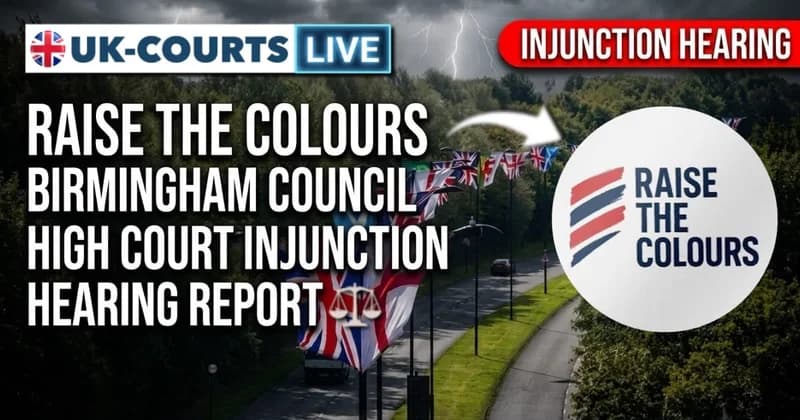
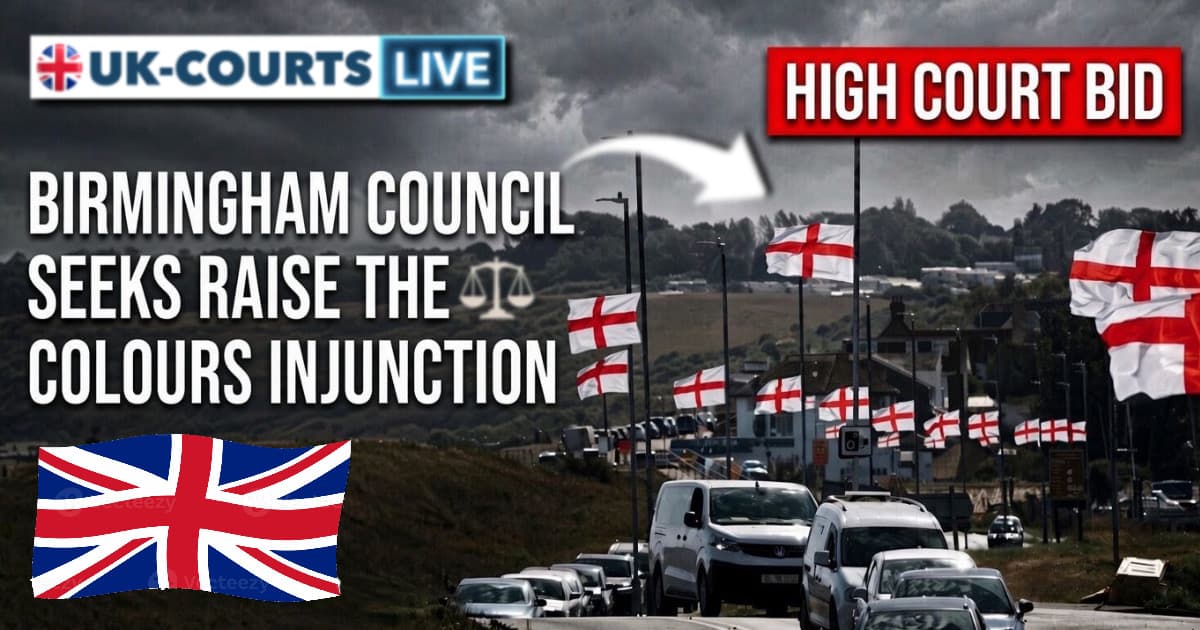
Birmingham City Council is asking the High Court for a sweeping, borough-wide injunction and power of arrest to stop campaign groups including Raise The Colours persistently installing unauthorised flags on municipal infrastructure, citing resident complaints, highway safety hazards and the harassment of contractors tasked with their removal.
Local authorities already hold general statutory powers to remove any unauthorised flag from public infrastructure, whether it displays an English flag, a Palestinian flag, or any other banner. This proposed injunction is based on the council's claim that the persistent actions of "Raise the Colours" group has created a special circumstance where greater powers are needed, although explicit reference is made to organised groups raising mainly Palestinian flags, who would equally be targeted by the injunction.
While neighbouring authorities like Solihull routinely exercise restraint where displays draw no complaints and reflect broad local consensus, parts of Birmingham present a starkly different demographic picture. In multi-ethnic wards with large immigrant-heritage populations, unilateral flag-posting by outside groups is frequently rejected by residents as aggressive rather than a gesture of shared civic pride.
Contrary to claims that the local authority is seeking permission for a multi-million-pound flag removal campaign, court filings indicate the High Court application is designed as a cost-mitigation measure. The projected £2.6 million figure reflects the anticipated cumulative damage and safety costs if contractors remain unable to perform flag removals without specialised protection, with the injunction aimed at removing deterring harassment by members of flag-raising groups so removal of problem flags can resume safely.
The application, set to be heard at the Birmingham Civil and Family Justice Centre on Tuesday, 8 September 2026, targets seven named individuals—including Ryan Bridge, Julian Keane, Elliot Stanley (aka "Elon"), Ross Child (aka "Ross the Don"), Billy Allison, Ben Cullen, and Mark Keating—alongside "Persons Unknown" linked to the "Raise the Colours" movement.
Legal commentators highlight how the inclusion of "Persons Unknown" exposes the local authority to significant legal vulnerabilities. Under Supreme Court precedents like Barking and Dagenham, High Court judges cannot issue open-ended, blanket orders that mimic primary legislation—bypassing parliamentary scrutiny to create local, pseudo-criminal offences against the public at large.
For Birmingham City Council, this suggests any order granted against unidentified activists would necessarily be provisional, bound by narrow behavioural definitions, strict expiry dates and mandatory review hearings.
Court filings allege that since mid-2025, the group has systematically affixed Union flags, St George’s crosses, and other banners across Sutton Coldfield, Longbridge, Stirchley, and Moseley, creating highway hazards, putting maintenance crews at risk, and driving up a potential removal bill of £2.6 million, including cleanup costs and structural repairs.
Council officials also state the legal action is not about the content of the flags, but issues of safety, as well as community concerns.
The council submitted evidence alleging a growing sense of intimidation among some local In certain neighbourhoods, flag displays installed by Raise The Colours are said to be associated by residents with confrontations, doxxing, online harassment and a fear that any attempt by locals to object or remove flags will result in personal retaliation, necessitating removal by the local authorities.
The council is bypassing standard administrative powers, arguing existing laws are simply incapable of handling an organised, well-equipped and determined group that has refused all engagement, co-operation or negotiation. Fines under Section 132 of the Highways Act 1980 are too low to act as a meaningful deterrent, while criminal prosecutions only work after the fact, the local authority claims.
Localised measures like Community Protection Notices or Public Spaces Protection Orders are also said to fall short against mobile activists operating as "Persons Unknown," who shift targets across the city as soon as action is taken.
Meanwhile, removal attempts on the ground have repeatedly sparked hostile confrontations, leaving the council relying on police escorts for workers removing flags.
To bring the High Court claim, the local authority relies on its powers under Section 222 of the Local Government Act 1972 and Section 1 of the Localism Act 2011 to take civil action in defence of local inhabitants. These sit alongside statutory duties to keep highways clear under Sections 130 and 132 of the Highways Act 1980, crime prevention duties under Section 17 of the Crime and Disorder Act 1998, and common law claims of civil trespass and public nuisance.
The council is also seeking a power of arrest under Section 27 of the Police and Justice Act 2006, which carries a high legal threshold requiring proof of a significant risk of violence or harm.
While the draft order explicitly protects flag displays on private property and peaceful protest, any defence challenge will almost certainly focus on Article 10 (freedom of expression) and Article 11 (freedom of assembly) of the European Convention on Human Rights, arguing that a city-wide injunction against unidentified parties sets a dangerous precedent for legitimate political expression.
To substantiate its claim of severe, ongoing harm, the local authority has provided evidence pointing to a pattern of intimidation that has brought municipal operations to a standstill. Council filings detail how maintenance crews and Kier contractors attempting to remove unauthorised fixtures have allegedly been met with physical blockades, racial and sexist slurs, and aggressive filming—tactics that ultimately forced contractors to suspend routine operations over employee safety concerns.
The council projects total removal and repair costs could reach £2.6 million, while the reliance on dedicated police escorts to protect workers adds an unsustainable £132 per flag to contracts.
Under the procedural timetable established by HHJ Emma Kelly in the High Court, the defendants—including named individuals and "Persons Unknown"—were given until 4pm on Friday, 4 September 2026, to file any responsive evidence ahead of the interim injunction hearing scheduled for 8 September.