Andrew and Tristan Tate Extradition Hearing Adjourned Amid US Prosecutor Pushback
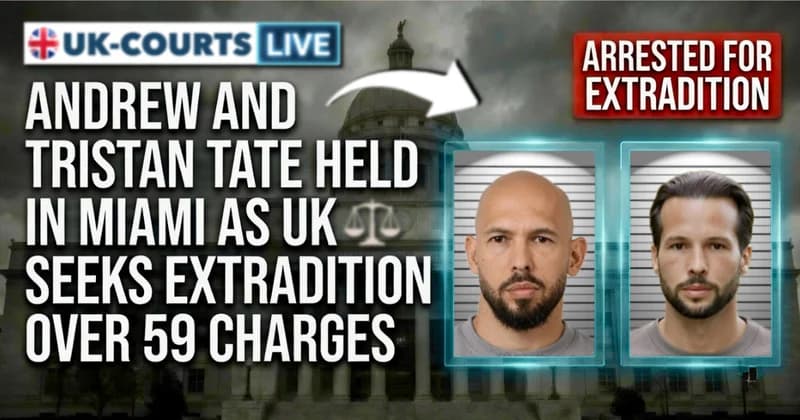
Extradition proceedings for Andrew and Tristan Tate face a two-week delay in Miami federal court after US prosecutors effectively dismantled the brothers' bail application.

There is a distinct procedural irony currently playing out inside the Federal District Court for the Southern District of Florida in Miami, where the ongoing extradition proceedings concerning Andrew and Tristan Tate have taken an unexpected turn.
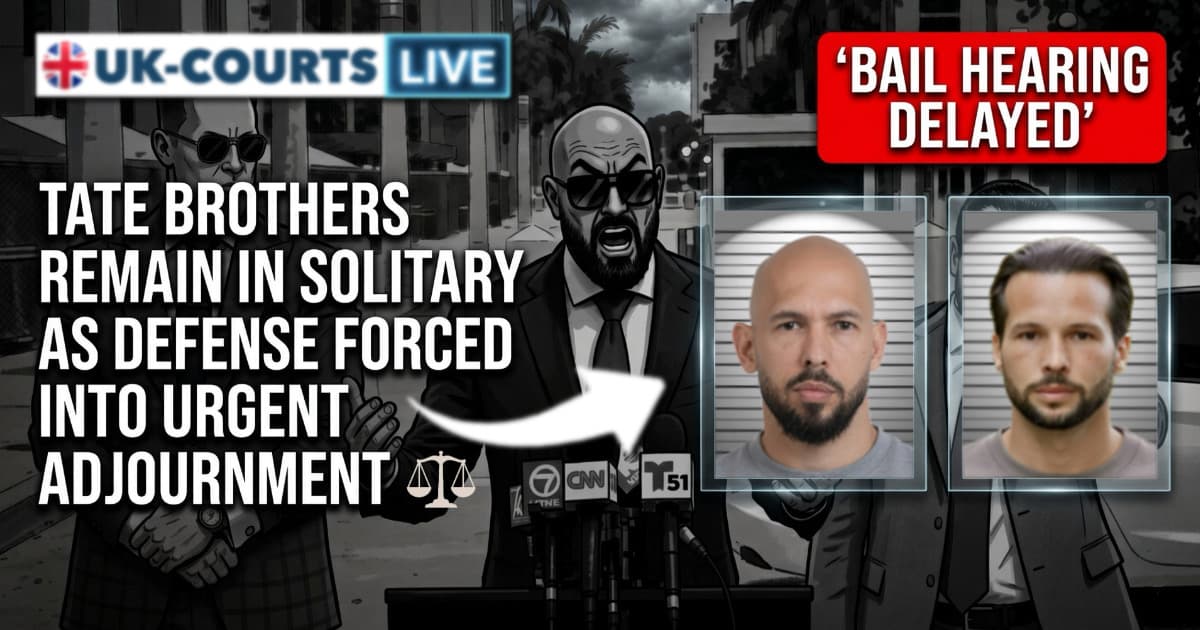
Facing a comprehensive opposition memorandum filed by federal prosecutors acting on behalf of the United Kingdom, the defense team found itself so utterly flat-footed that it was forced to make a formal application to the judge for an urgent two-week adjournment.
The scheduled pre-trial detention hearing was abruptly cancelled, with defense counsel petitioning the court for additional time until at least 21 August 2026 to prepare a written rebuttal and attempt to secure fact witnesses.
The resulting situation carries a stark procedural reality: in seeking a fortnight’s grace period to mount an argument against their clients’ continued incarceration, the defense has effectively guaranteed that both brothers remain locked away in solitary confinement at the Federal Detention Centre for an additional two weeks.
Outside the courthouse, the visual contrast to their former digital omnipresence was equally stark. A public protest originally organised to coincide with the scheduled bond hearing had not been cancelled, but even so this turned out to be a very meagre gathering and not the large numbers that were promised before hand.
Reports from the scene indicated that as few as 50 supporters actually materialised outside the facility, with attendance capping out at no more than 100 at its absolute peak.
For influencers who built their entire brand on claims of an unassailable global fanbase, the pitiful turnout begs the obvious question of whether their real-world popularity has taken a terminal nosedive.
If physical presence on the pavement offers any true metric of genuine backing, the ghostly gathering in Miami suggests the roaring online army has largely evaporated.
Back in the real world of the courtroom, to understand how the defence strategy unravelled so spectacularly, one must examine the rigorous statutory mechanics governing international extradition inside the American federal judicial system.
Unlike standard domestic criminal prosecutions in the United States, where the federal Bail Reform Act creates a statutory presumption in favour of pre-trial release, international extradition proceedings operate under a strict legal presumption against bail.
Under settled American legal precedent, an individual facing extradition to a foreign sovereign state cannot simply post bond or offer routine assurances.
To secure pre-trial release, the defense must satisfy a formidable two-prong legal test. First, they must establish by clear evidence that the detainee poses neither a flight risk nor a danger to the community.
Second, and far more challenging, they must demonstrate the existence of extraordinary or special circumstances that compellingly justify release pending the outcome of the extradition proceedings.
When the Tate brothers submitted their initial motion for pre-trial bond, their legal team relied heavily on familiar narratives, contending that their clients were globally recognizable figures who could not possibly abscond without immediate detection.
They further alleged that detention conditions inside the Miami facility were so severely lacking that special circumstances existed, claiming a complete lack of access to basic commissary items and inadequate facilities.
However, the response filed by federal prosecutors from the Southern District of Florida did not merely rehash boilerplate legal arguments. Instead, the US Department of Justice delivered a granular, evidence-heavy filing that methodically dismantled the defense assertions point by point.
On the question of flight risk, prosecutors produced a detailed accounting of the brothers' demonstrated global mobility, international financial networks, vast liquid assets, private aviation arrangements and possession of up to seven separate passports.
The prosecution forcefully argued that immense wealth and international connections actively heighten flight risk rather than mitigate it, noting that public fame offers zero guarantee against an individual attempting to evade judicial process when facing serious criminal charges in another jurisdiction.
Even more damaging to the defense argument was the prosecution’s direct rebuttal regarding detention conditions. In response to claims that the brothers were being deprived of basic necessities and commissary access, federal prosecutors attached actual purchase receipts directly to their court filing.
The official records disclosed extensive commissary transactions, proving the defendants had consistently purchased snacks, toiletries and items including Doritos while housed in the secure holding unit.
Far from being subjected to unlawful deprivation, the filings demonstrated that the brothers were placed in restricted housing purely for their own physical protection from the general inmate population.
The government’s brief famously capped off its evidentiary submission by dryly pointing out that a federal detention facility is designed for secure custody rather than luxury accommodation, explicitly noting that the holding center is not a Marriott.
This meticulous presentation of physical receipts and financial records created an immediate crisis for the defense counsel.
Faced with concrete documentary evidence refuting their primary claims of hardship, the legal team was left with no option but to concede that they could not proceed with the scheduled hearing without substantial delay.
In their formal motion seeking a postponement, defense counsel acknowledged that the government’s filing raised several new factual allegations that required a written response and the sourcing of potential witness testimony. The translation in legal terms is straightforward: the prosecution presented an evidentiary mountain, and the defense needed a timeout to figure out how to climb it.
The procedural delay also highlights the complete breakdown of various political narratives that had circulated around the case.
Prior to their arrest in Miami, significant speculation existed regarding potential political protections or executive intervention that might shield the brothers from facing British justice.
Yet the uncompromising stance taken by the Department of Justice demonstrates that institutional legal mechanics continue to function entirely independent of public posturing.
Within the realm of international judicial diplomacy, particularly where sensitive allegations are concerned, no government administration is inclined to compromise established bilateral treaties or face the severe political fallout of creating an exception for high-profile figures.
Institutional adherence to standard extradition procedure remains absolute, and federal prosecutors are treating the case with the exact same rigor applied to any international fugitive.
Furthermore, the legal reality on American soil stands in sharp contrast to the previous procedural history in Eastern Europe.
While much was made of earlier decisions by the Bucharest Court of Appeal in Romania, which had deferred physical surrender until local European trial proceedings concluded, the moment the brothers voluntarily entered American sovereign jurisdiction in Florida, they placed themselves directly within the reach of the 2003 US-UK Extradition Treaty.
US federal judges do not defer to foreign scheduling orders or administrative preferences; they enforce domestic statutory law and international treaties executed by the United States government.
When a valid British extradition request arrives before a federal magistrate in Miami, American law enforcement is legally bound to process it according to established US judicial procedure.
As the August deadline approaches, the defense team faces an exceedingly steep hill to climb.
Attempting to rebut official store receipts, multi-passport documentation and extensive financial records will require far more than rhetorical flourishes or online commentary.
Under the unyielding framework of international extradition law, emotional appeals carry zero weight against documented facts and statutory presumptions.
By forcing a two-week delay to regroup, the defense has ultimately illustrated the unforgiving nature of federal court proceedings: while lawyers draft lengthy filings and hunt for elusive rebuttal witnesses, the clock continues to tick, the legal standards remain relentlessly high, and the Tate Brothers remain firmly behind bars awaiting their day in court.