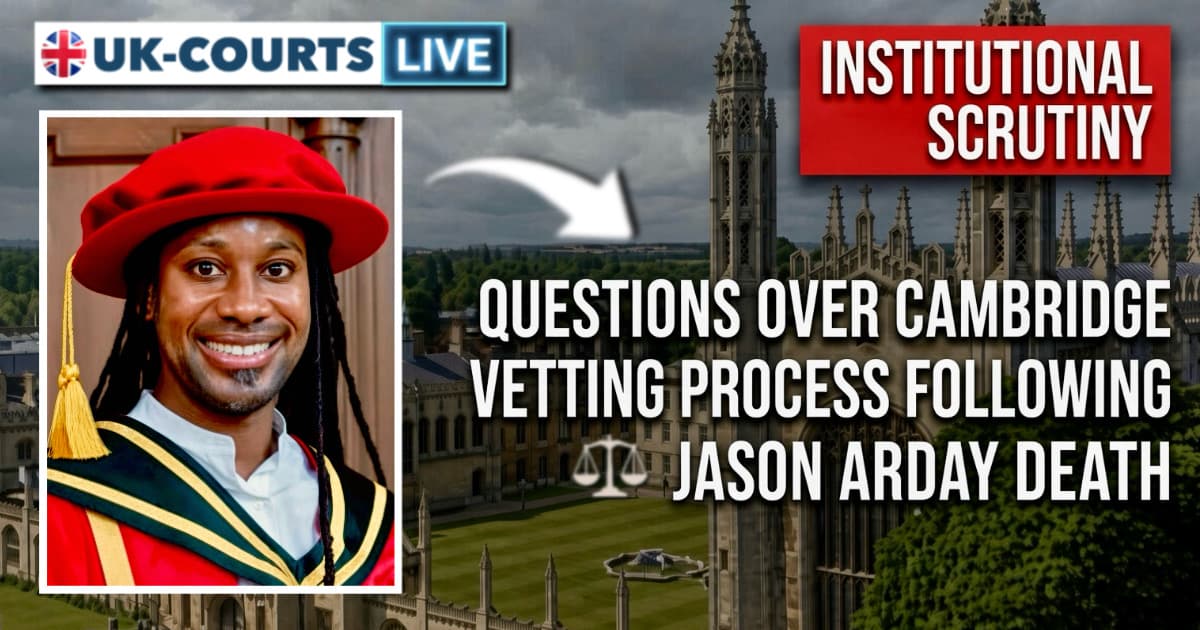
Question Asked Following Death of Former Cambridge Professor Jason Arday
Following the tragic death of Jason Arday, an examination of the Cambridge University appointment process, due diligence, and personal responsibility.
The tragic and untimely death of Jason Arday following his resignation from the University of Cambridge exposes a catastrophic institutional failure that extends far beyond a simple academic scandal.
While the immediate commentary has rightly focused on the intense media scrutiny of biographical claims and the devastating personal toll of plagiarism allegations, the uncomfortable truth remains that Cambridge itself must bear a significant degree of responsibility.
By prioritising the optics of a progressive milestone over the fundamental requirement for rigorous due diligence, the university elevated an ill-prepared individual to a position of immense prestige and effectively set the stage for a highly public and ultimately fatal collapse.
To understand the depth of this institutional failure one must look past the celebratory headlines that accompanied his appointment as Cambridge’s youngest black professor in 2023 and examine the glaring disparities in his academic foundation.
The traditional Oxbridge ecosystem is sustained by an uncompromising standard of academic rigour where generations of students and professors quietly excel in foundational disciplines without fanfare.
Arday did not emerge from this demanding crucible. His undergraduate foundation was built on a combined degree in Education Studies and Physical Education at St Mary’s University in Twickenham.
This is an institution that despite its merits operates in a fundamentally different academic stratosphere to the ancient universities.
He was placed into the lofty ranks of a Cambridge professorship in the Sociology of Education without having been truly tested against the elite academic pillars required to survive in such an unforgiving environment.
This glaring mismatch should have been the first warning sign for any competent appointments committee but the failure of due diligence extended far beyond his academic pedigree.
The university seemingly turned a blind eye to a highly publicised and grandiose personal narrative that accompanied his rise.
Claims regarding his early life and educational struggles were widely broadcast and formed a core part of his public identity yet they were apparently accepted at face value without the basic verification that any high-profile appointment demands.
In the modern era of relentless media and digital scrutiny it is a dereliction of duty to appoint an individual to a globally recognised role without ensuring their personal and professional history can withstand inevitable investigation.
A thorough vetting process would have quickly revealed that these heavily romanticised claims were fragile and the inevitable unravelling of such a narrative was a public relations disaster simply waiting to unfold.
By failing to conduct this essential vetting Cambridge did Arday a profound and tragic disservice. Appointing him to such a prominent position guaranteed a level of global attention that his background and fragile claims could never support.
If the university had properly investigated his academic work and the increasingly bizarre nature of his autobiographical claims from the outset it would have been immediately apparent that he was not equipped to handle the intense pressure of the Oxbridge spotlight.
More importantly it should have been obvious that placing an individual whose professional identity was built on such unstable ground into the highest echelons of academia would eventually lead to a devastating public humiliation.
The psychological fortitude required to endure the complete public collapse of one's life's work and personal narrative is immense.
An institution with a genuine duty of care would have recognised that an individual who felt compelled to construct such a vulnerable web of claims in the first place would never possess the psychological resilience needed to survive its public destruction.
Instead of protecting him by quietly acknowledging he was unsuited for the role Cambridge placed him on a pedestal and left him entirely exposed to the inevitable storm.
The narrative that Arday was simply hounded by an aggressive media or malicious critics entirely misses the root cause of this tragedy. The ultimate responsibility lies with the institution that handed him the title.
In their rush to secure a prominent and celebrated appointment the custodians of Cambridge University bypassed the vital checks and balances designed to protect both the institution's integrity and the individual's wellbeing.
They appointed a man to a role he was academically and psychologically unequipped to hold and in doing so they authored the first chapter of a wholly preventable tragedy.