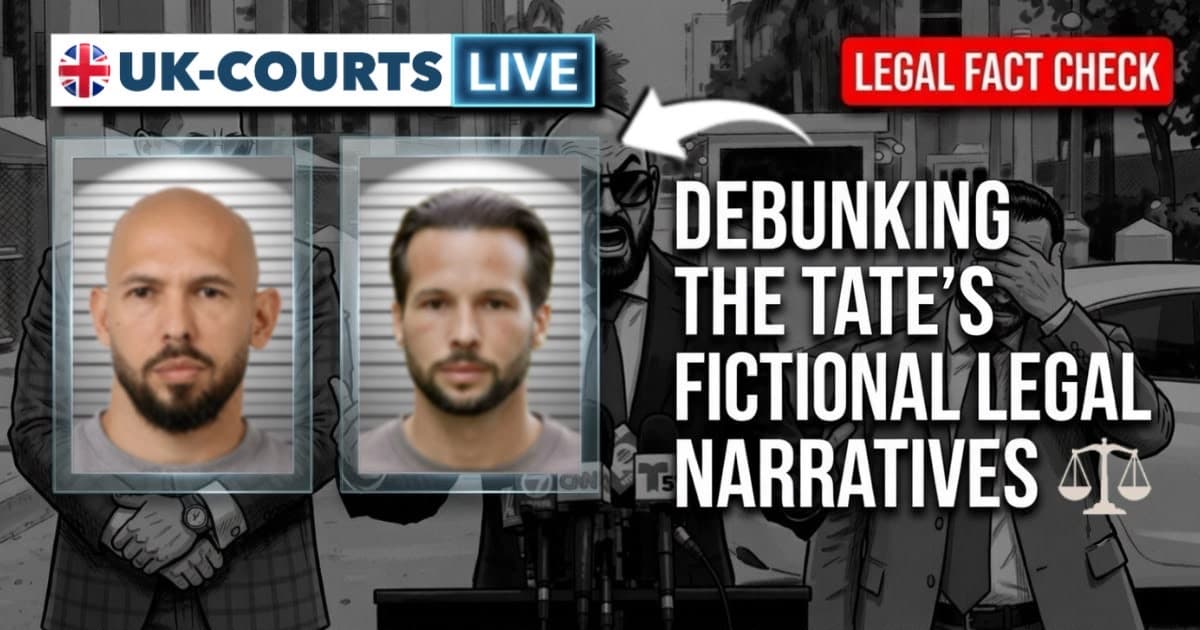
Debunking the Tate’s Fictional Legal Narratives
Claims surrounding Andrew and Tristan Tate's US extradition to the UK and non-existent plea deals are debunked in a detailed legal analysis ahead of their trial.

Following the arrest of Andrew and Tristan Tate in Miami, several narratives have been propagated online regarding their legal situation.
These include:
- Claims that the allegations can be challenged and must be proven in an Florida magistrates court before extradition, or that UK authorities have a deadline of 60 days to prove guilt
- Claims that the current detention in solitary confinement is unlawful.
- Claims that legal proceedings in Romania complicate or block outright and US-UK extradition,
- Claims that the UK can offer drastically reduced sentences in exchange for guilty pleas from the brothers
- Claims that extradition can easily be halted by a US political leadership favourable to the Tates
With these reaching a wide audience, we felt it necessary to clarify by presenting the relevant legal facts.
No Requirement to Prove Guilt in a US Court
Claims that UK authorities face a strict 60-day deadline to prove the Tate brothers’ guilt fundamentally misunderstand extradition procedure. No such requirement exists under the US-UK extradition treaty or federal law.
In extradition proceedings, the United States does not adjudicate guilt. American courts conduct a limited review focused on probable cause, dual criminality (whether the alleged conduct violates laws in both countries), and treaty compliance. A full trial on the merits—where guilt must be proven beyond reasonable doubt—occurs only in the requesting state (here, the UK) after successful extradition.
The UK has already authorised charges and submitted evidence, and Florida courts must rule whether that evidence proves the probable cause required for the case to proceed to trial in the UK
The UK is not required to present its entire case or secure convictions within an arbitrary window. Any suggestion otherwise conflates preliminary extradition steps with a criminal trial.
Solitary Confinement Detention Periods of over 15 Days Are Not Illegal in the US
The Tate brothers are in a solitary confinement regime in a Special Housing Unit in US federal custody (Miami) as the UK extradition request moves through the courts.
SHU regimes are authorised under US law (18 U.S.C. § 3184; 28 C.F.R. § 541.21 et seq.) They are frequently used for pretrial detention, extradition cases, and immigration cases.
Administrative detention and SHU placement can only be used when justified by flight risk, security, or safety reasons - not as punishment.
US authorities are obligated to justify and periodically review every detention decision, but there is no fixed limit on how long SHU can last.
The Mandela Rules regarding solitary confinement periods over 15 days are non-binding international standards, not enforceable US law.
In the last 5 years, ICE has placed detainees over 8’00 times in administrative segregation (protective custody, medical, mental health, security threats) for an average period if 60 days.
There is no US constitutional or statutory violation with solitary exceeding 15 days.
For the Tate brothers, any US detention period, including a segregation regime, would be kept to a minimum if the brothers allow extradition to proceed without objections.
This is US practice, and the UK has no operational control over US Marshals housing decisions.
Additionally, in the case of segregation for their own safety, they would have the option of requesting a move to gen pop, although the US would weigh this against the imperative of ensuring they can face an trial in the UK.
Romanian Proceedings Do Not Block UK Extradition
The Romanian agreement to extradite the Tates following the conclusion of Romanian legal proceedings does not interfere with extradition requests made by the UK to another country.
The decision of Romanian courts to comply with the UK extradition request but delay it until the conclusion of Romanian legal proceedings determined what Romanian authorities would do while the Tates were in Romania.
It does not apply elsewhere, and delays in the Romania case led some to previously urging the UK government to extradite the brothers from the UAE, another country the UK has an extradition treaty with.
Plea Deal Speculation Contradicts Legal Realities
The Tate’s representative has claimed UK prosecutors seek only the reputational harm that would come from Tate brothers rape convictions, and would leverage weak evidence, via the threat of a 100-year jail term, and an American-style plea bargaining system to achieve those goals.
The UK does not have any American-style plea bargaining system.
The UK has awards a sentence reduction of 1/3 for plea at the earliest opportunity.
There is no option for the justice system to make charges disappear or drastically reduce their seriousness: sentencing guideline are rigorously applied, stipulating significant sentences for the sort of serious crimes the Tates are accused of.
No Straight-Forward Option to Refuse on Political Grounds
McBride has raised the possibility of political objections on the theme ‘there is no justice in the UK’. The claim is that there is a simple opt-out available, with no serious negative consequences, if the US decides at a high level they object to the UK justice system or institutions, without finding specific, serious flaws in the case or procedure.
This misunderstands the nature of an extradition treats, which is essentially an agreement to co-operate on the basis that each country considers the other to have a fair legal system.
An extradition requests cannot be refused on the grounds of general political disagreements or disapproval of some UK institutions. It is an iron-clad agreement, and if the legal conditions are met, suspects are delivered to the UK.
There have been dozens of extraditions enacted since signing the 2006 agreement, including approximately 58 surrenders from the US to the UK. Judicial refusals by US courts are vanishingly rare.
Granting an extradition isn’t a comment on innocence or guilt, merely that the case has met the threshold where it deserves a hearing, where a jury of ordinary members of the public will judge the charges on their merits.
Refusing the Tates‘ extradition on political grounds would entail designating the UK as a legally unsafe country. The consequences would be significant and the partnership that the US relies on to get its own citizen wanted for trial back to the States from America would be in question.
In contrast to these false narratives, what we can actually expect is, a wait of around two years if the Tates make use of every legal option to drag out proceedings as long as possible, or, if they decide to let the process go ahead as normal trial, a wait of around two months. Either way, it is highly likely that the Tates are coming home to face a UK trial.