
Digwa Judge Under Fire After Wrongly Labelling Islamic Murder Weapon as Sikh Kirpan
Judge William Mousley KC faces intense criticism after misidentifying a historic Islamic battlefield weapon as a Sikh dagger during a Southampton Crown Court sentencing.

In the sobering atmosphere of Southampton Crown Court, His Honour Judge William Mousley KC delivered a sentencing remark that will echo dangerously far beyond the courtroom walls.
While sentencing 53-year-old Kiran Kaur to three years in prison for hiding the weapon her son Vickrum Digwa used to murder 18-year-old Henry Nowak, Judge Mousley KC made a catastrophic factual and legal error.
Speaking ex-cathedra from the bench, the judge explicitly labelled the murder weapon a "large Sikh dagger" and tied its possession directly to the strict religious requirements of the Sikh faith.
This assertion was completely false. The weapon used to end Henry Nowak's life was not a sacred article of faith. It was a historic Islamic battlefield weapon designed for the sole purpose of penetrating military armour.
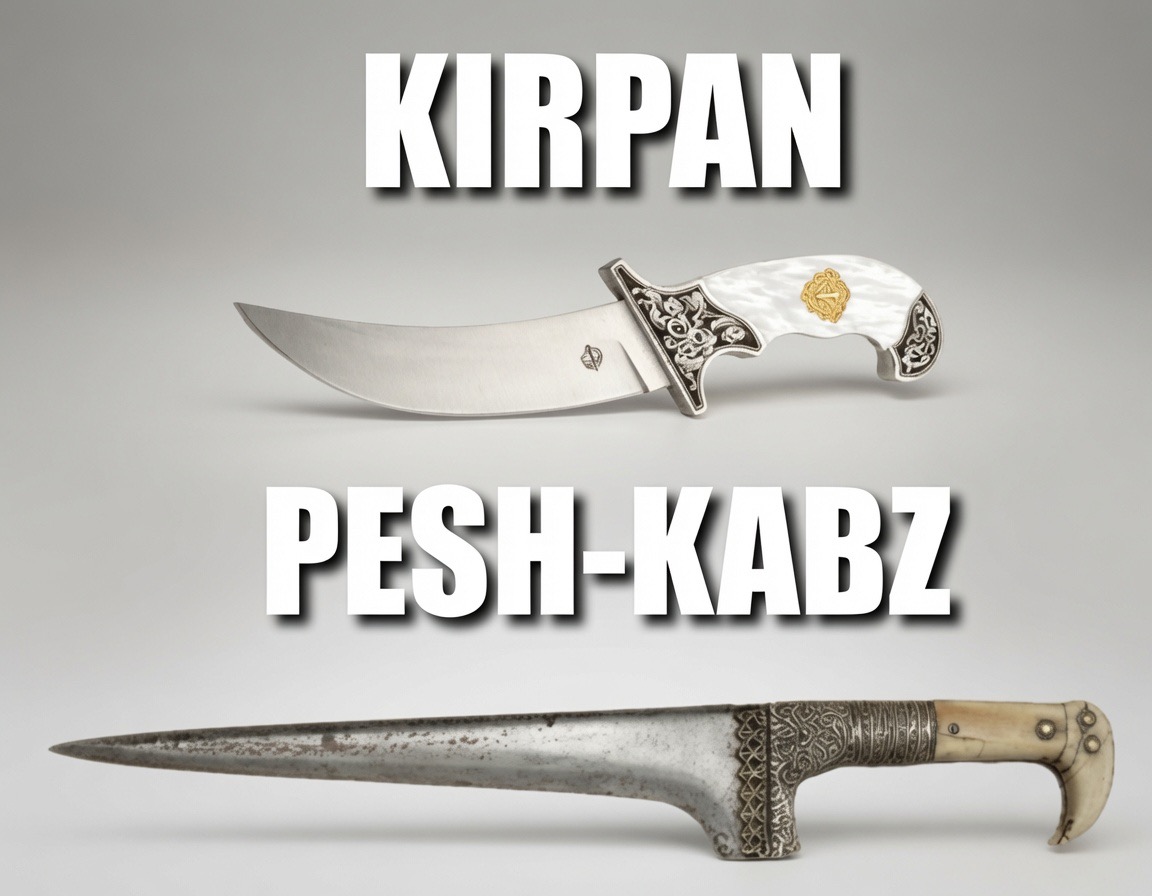
A Sikh Kirpan & Islamic Pesh-Kabz Knife
By conflating a lethal combat dagger with a peaceful religious tradition, Judge Mousley KC has published a legal misdirection that threatens to undermine weapon legislation and fuel a deeply damaging narrative of two-tier policing.
The True Identity of the Murder Weapon
To understand the sheer scale of the judge’s error, one must look at the forensic reality of the blade itself. Judge Mousley KC referred to the weapon as a "Sikh dagger" and conflated it with the Kirpan.
The physical exhibit in this case was undeniably a Pesh-Kabz or a closely related Chura. This is an Indo-Persian combat weapon that originated in Safavid Persia and spread across the Mughal Empire and the Khyber Pass region.
The very name of the weapon is Persian, translating directly to "fore-grip" and bearing zero linguistic ties to Punjabi or Sikh scriptures.
Historically, this weapon was the ubiquitous sidearm of Muslim Pashtun tribe and Mughal courtiers. Its engineering is brutally specific.
Unlike a traditional Kirpan which is a curved defensive blade, the Pesh-Kabz features a straight 21-centimetre blade with a heavily reinforced T-section spine.
This rigid spine was forged specifically to prevent the blade from snapping when thrusting through heavy chainmail armour.
This was not a religious garment. It was a highly aggressive armour-piercing tool forged for war. It carries absolutely no theological standing within the Five Ks (Panj Kakar) of the Sikh faith.
By labelling it a "Sikh dagger", Judge Mousley KC effectively grandfathered a brutal Islamic battlefield weapon into the legal protection of a holy artifact.
Fabricating Law from the Bench
The factual misidentification of the blade was only the beginning of the judicial misstep. Judge Mousley KC then proceeded to completely rewrite English criminal law to justify his narrative.
In his remarks, Judge Mousley KC stated: "The legal approach to the carrying of such a knife, as long as the blade length does not exceed 9 inches, is that an offence of Having a Bladed Article in a public place will not be prosecuted".
This statement is legally fictitious. There is no nine-inch boundary written into Section 139 of the Criminal Justice Act 1988 for religious exemptions.
The law requires an objective test that the specific item is carried purely for "religious reasons". It does not grant a blanket pass based on arbitrary measurements.
What Judge Mousley KC did was take informal ACPO (Association of Chief Police Officers) operational street-level guidance and elevate it to the status of black-letter law.
He took a fluid police metric used to exercise discretion and presented it in open court as an absolute statutory defence.
Furthermore, by using the vague phrase "such a knife", Judge Mousley KC decoupled the statutory defence from the sacred Kirpan itself.
He implied that the law allows any generic knife under nine inches to be carried legally as long as the person holding it identifies as a Sikh.
English law simply does not recognise an identity-based exemption for weapon possession.
The defence applies to the specific mandated object, not the person and certainly not to an armour-piercing Pesh-Kabz.
The Dangerous Legacy of a Judicial Misdirection
The fallout from these sentencing remarks is profound. When a Crown Court judge prioritises community appeasement over strict legal accuracy, the entire justice system suffers.
By artificially inventing a nine-inch rule and attaching it to a generic knife, Judge Mousley KC has created a highly dangerous public myth.
If a young person reads these remarks and believes they have a judicially sanctioned right to carry a combat knife under nine inches, they will find themselves facing a mandatory minimum prison sentence when the reality of the actual statute hits them in a Magistrates' Court.
More critically, these remarks act as lighter fluid for the growing public suspicion of two-tier policing.
When ordinary citizens are prosecuted relentlessly for leaving a utility knife in a work van or carrying a penknife, they will rightly look at Judge Mousley KC's remarks and ask why the court appears to operate a separate set of rules for a specific ethnic group.
Judge Mousley KC had ample time to study the law, review the forensic evidence, research the type of knife it actually was and deliver a precise legal ruling.
Instead, he chose to deliver a clumsy, historically illiterate and legally fabricated lecture.
He traded the strict boundaries of weapon legislation for a piece of social engineering that has insulted the Sikh community, misrepresented Islamic military history and misled the British public on exactly what is legal on our streets.
The Pesh-Kabz: The Anatomy and History of an Islamic Battlefield Weapon
To fully comprehend the magnitude of the judicial error made in Southampton Crown Court, one must look closely at the history, etymology and metallurgical design of the Pesh-Kabz.
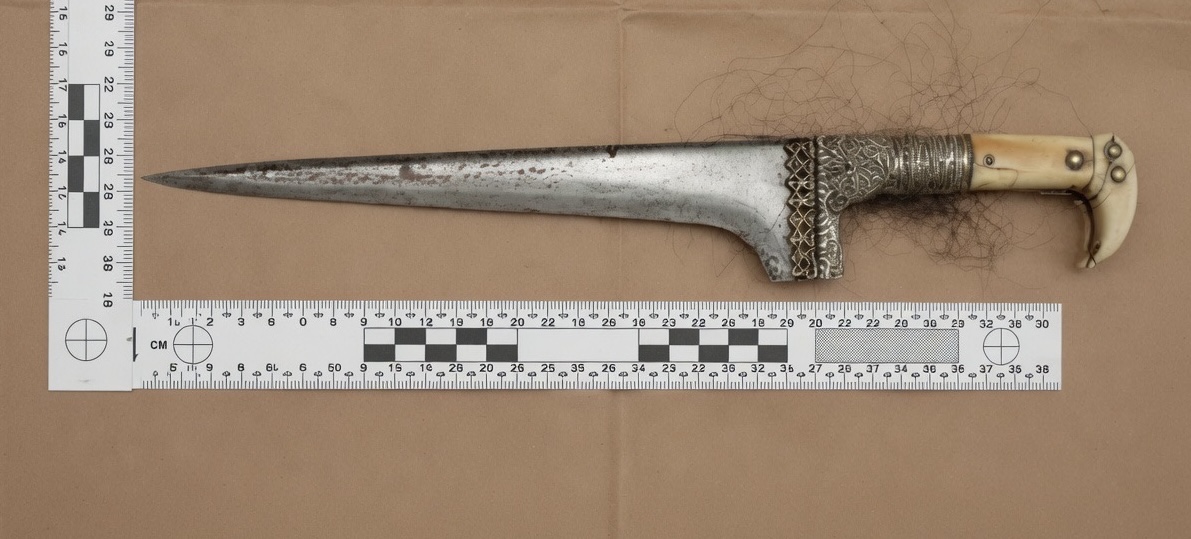
Vickrum Digwa’s Islamic Pesh-Kabs
This is not a weapon whose origins are lost to the mists of time; its pedigree is well documented by military historians, ethnographers and the world's leading museum curators.
It is an artefact of war that is entirely, undeniably and fundamentally Islamic in its cultural origin.
The Armour-Piercing Design
The Pesh-Kabz was engineered during the Safavid dynasty in Persia for a single, brutal purpose.
As heavy chainmail armour became the standard protection for cavalry and elite infantry across Central Asia the need arose for a close-quarters sidearm capable of defeating it.
The lethal genius of the Pesh-Kabz lies in its T-section spine. If you look at the blade from the top down, the spine is flat and heavily reinforced, tapering down to a needle-sharp point.
While standard flat blades would flex, buckle or snap when thrust into riveted steel rings the T-section gave the Pesh-Kabz immense structural rigidity.
This allowed the wielder to drive the point straight through chainmail or heavy leather padding with devastating force.
It is not a tool, a ceremonial ornament or a defensive safeguard; it is a dedicated thrusting weapon engineered exclusively to penetrate military armour on the battlefield and kill.
Linguistic and Cultural Origins
The cultural footprint of the Pesh-Kabz is firmly rooted in the Islamic world. The very name of the weapon provides undeniable proof of its origin.
It is derived entirely from the Persian language—"pesh" meaning front or forward and "kabz" (or qabza) meaning grip. It translates to "fore-grip" referring to how it was traditionally worn tucked into the front of a waist sash.
As the Islamic Mughal Empire expanded from Central Asia down into northern India it brought Persian martial culture, architecture and weaponry with it.
The Pesh-Kabz quickly became the ubiquitous sidearm of the Mughal courts, Muslim Pashtun tribesmen and Afghan warriors operating out of the Khyber region.
During the 19th century British military dispatches from the North-West Frontier consistently referred to it as the "Afghan knife" due to its widespread use by Muslim tribal fighters.
Today, institutions such as the Wallace Collection and the Metropolitan Museum of Art explicitly categorise the weapon under their Islamic and Indo-Persian armouries.
The Total Disconnect from the Sikh Faith
To claim that the Pesh-Kabz is a "Sikh dagger" is an unforgivable historical distortion. The Sikh faith mandates the carrying of the Kirpan as one of the Five Ks (Panj Kakar).
The Kirpan is traditionally a curved, single-edged blade meant to symbolise protection, grace and divine justice. It is an article of faith carried to defend the innocent.
The Pesh-Kabz has zero linguistic ties to the Punjabi language, zero theological standing in Sikh scripture and zero connection to Sikh martial tradition.
In a dark historical irony the Pesh-Kabz was the weapon of choice for the invading forces and Mughal empires that the early Sikh armies fought against in their struggle for survival.
By looking at an armour-piercing Islamic combat dagger and cementing it into the public record as a strict religious requirement of the Sikh faith, the court displayed a staggering level of historical illiteracy.
It completely validated the necessity to hold the judiciary to account when they replace forensic reality with careless assumption.