Andrew Tate & Tristan Tate Denied Bail by Miami Court in UK Extradition Case
Andrew and Tristan Tate denied release: their own evidence undermined their case

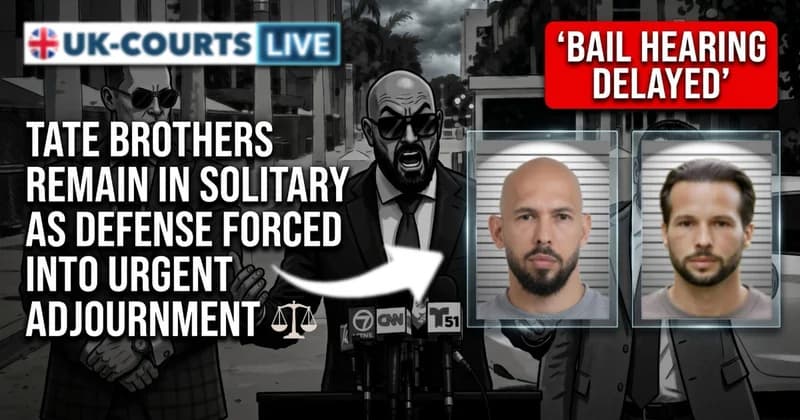
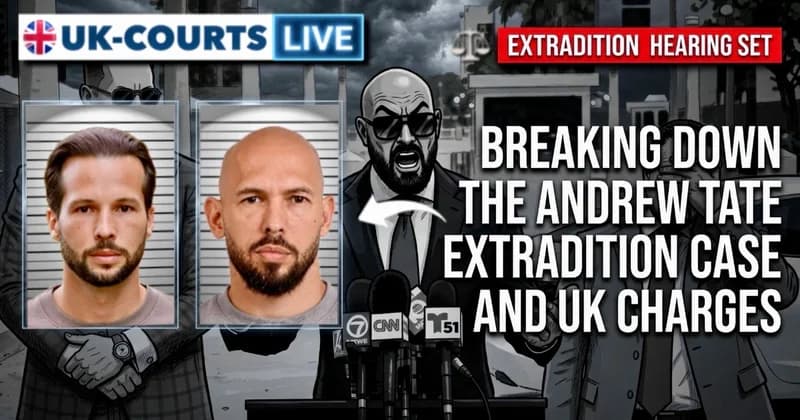
Andrew Tate and Tristan Tate have been denied release from custody by a federal magistrate judge in Miami as they contest an extradition request brought by the United Kingdom.
U.S. Magistrate Judge Lauren Louis ruled that the brothers failed to satisfy the legal burdens required to secure a bond in foreign extradition proceedings. She concluded that they presented an acute flight risk and potential danger to the community, and that none of the claimed special circumstances justified release. In reaching that conclusion, the court found that much of the difficulty for the defence came from the evidence it itself advanced.
The dual U.S. and British citizens were arrested in Miami on 18 July 2026 following provisional arrest warrants issued by British authorities. The Crown Prosecution Service is seeking their return to face serious allegations involving sexual offences and assault, including choking and rape.
The Tates’ legal team argued that the requirement to show “special circumstances” was unconstitutional and urged the court to evaluate their release solely under the Bail Reform Act. Judge Louis dismissed this challenge out of hand. She made clear that she was strictly bound by governing Eleventh Circuit precedent, which maintains a strong presumption against bond in international extradition cases. Respondents must prove they are neither a flight risk nor a danger to the community and that special circumstances warrant release. The Bail Reform Act does not apply to these proceedings.
Flight risk
Turning to the core risk assessments, the court determined that the Tates possess an “exceptional capacity to flee the jurisdiction” and described them as “quintessential flight risks.”
Their own travel logs captured 43 international flights between February 2025 and July 2026 while they were under Romanian judicial supervision. The court noted that the log appeared incomplete. They have strong foreign connections, with all of their children (Andrew has three and is expecting a fourth; Tristan has eight) residing abroad, largely in Dubai and Romania, and virtually no demonstrated ties to the Southern District of Florida beyond the arrest itself.
The defence contended that Romanian asset seizures had left them without the means to flee and that their social-media boasts of extreme wealth were mere hyperbole of the “Top G” persona. A witness called by the defence, Natasha Sesai, undercut that claim. She testified that both brothers continued to fund their children’s upbringing after the Romanian measures and that Andrew had purchased luxury accessories for her during the same period. The court found this “belied the intimation that Respondents’ lack of billionaire status renders them incapable of procuring the means by which to undertake flight.”
Further problems arose from the defence’s own evidence and testimony. Andrew emphatically denied ever controlling the Twitter account @OfWudan, which had posted statements celebrating efforts to obstruct criminal process and claiming the means to effectuate flight. A government video showed him identifying that same handle as the best way for followers to stay connected with him. The judge held that this “directly impeached” his denial and damaged his credibility.
Tristan’s explanation for a document the court described as a fake Mexican passport also shifted. In written submissions the defence called it a cardboard Halloween prop based on a James Bond novel character. At the hearing Tristan said an assistant had printed it around 2021. It was undisputed that the CURP identification number on the document had been issued by the Mexican government. An audio recording in which Andrew discusses the importance of multiple passports and presenting different national identification documents to law-enforcement agencies added to the court’s concerns.
The judge found a “dearth of competent, credible evidence” of local ties, stability or an absence of incentive to flee. Neither brother met his burden on flight risk.
Danger to the community
Addressing community safety, Judge Louis noted that the nature of the underlying allegations — forcible rape and choking — indicated potential danger. Sesai’s testimony that Andrew had not abused her or their child, and that both brothers are loving fathers, was found “not particularly probative” of whether they posed a danger arising from the charged conduct against other women.
Prosecutors placed before the court a letter from the Romanian Ministry of Justice indicating that Andrew faces seven counts and Tristan twelve counts of “influencing witness testimony on a continuing basis” while under judicial supervision. The Tates conceded that certain contact with alleged victims or witnesses had occurred, though they disputed that it constituted witness tampering. The court held that the contact was prohibited under the Romanian conditions and had breached the restrictions imposed on them, leaving any justification for the Romanian courts to decide.
Special circumstances rejected
The defence advanced multiple grounds intended to constitute special circumstances: challenges to the probable cause supporting the UK warrants, the existence of Romanian surrender orders, claimed lack of urgency or delay by the United Kingdom, the availability of bail in the UK, the brothers’ public visibility, the anticipated length of proceedings, conditions of confinement and the need to participate in pending Romanian and civil litigation.
Judge Louis rejected them individually and cumulatively. Challenges to probable cause were described as commonplace and premature before the formal UK extradition request is filed. Reliance on the Romanian surrender orders asked the US court to resolve a supposed priority dispute between Romania and the United Kingdom that neither government had asserted in these proceedings. Ordinary delay and the availability of bail in the requesting country are not special circumstances. Public visibility cut both ways given the brothers’ own public self-portrayals as law-evaders. The anticipated length of proceedings did not justify release on the record before the court.
Claims regarding conditions at the Federal Detention Centre in Miami — administrative segregation, short beds, lack of radio or television and weight loss — were described as “thoroughly impeached.” The brothers’ own testimony was contradicted by evidence that they had obtained a radio, worked as orderlies with additional time outside their cell, gained rather than lost weight and had regular attorney visits. They were cellmates, not in solitary confinement, and produced no medical evidence of deteriorating health comparable to the cases on which they relied.
Arguments about concurrent legal obligations in Romania were found “conjectural.” Submissions from foreign counsel did not establish that detention rendered participation impossible, and secure technological means exist within federal facilities for remote hearings and consultations.
Consequences of the ruling
With all proposed special circumstances firmly dismantled and the burdens concerning flight risk and community safety unmet, the extradition matter proceeds toward the formal submission deadline set for mid-September under the Treaty.
These were findings about the risks associated with release, not findings that the underlying criminal allegations are true. The Tates deny wrongdoing and remain entitled to contest the extradition request.
The reality of the court’s ruling materially changes the calculations the brothers must make. This decision puts them in a position where any future strategy — including potential challenges that could extend the process for a considerable period — must now be managed from the isolation of federal custody and entirely away from public life. Pre-extradition detention in a U.S. federal facility does not credit against any future prison sentence that might be served in Britain. The strict confinement of the Special Housing Unit cuts off the constant algorithmic visibility and digital output that fuel their commercial enterprise. One is left to ponder how long a multi-year legal contest remains viable when the online content machine is forced into silence.