Tate Civil Action Cannot Halt US-UK Criminal Extradition Process
Legal analysis reveals why private civil litigation against accusers cannot bar Crown prosecutions or US-UK extradition under treaty law.

It is a truth universally acknowledged by anyone with a Wi-Fi connection that the internet is currently overflowing with armchair legal scholars, many of whom are breathlessly assuring us that the Tate brothers have discovered a magical legal loophole.
The latest fairy tale currently enchanting their most devoted fans is the rather adorable notion that by launching a civil countersuit against an accuser—commonly referred to in the online ether as "Girl A"—the entire international extradition machine will grind to a screeching, apologetic halt.
It is a wonderfully creative narrative, perfectly suited for the echo chamber of social media, but as a piece of actual legal strategy, it is the jurisprudential equivalent of trying to stop a runaway freight train with a strongly worded Post-it note.
To appreciate the sheer absurdity of this proposition, one must briefly step out of the metaverse and into the rigid, unyielding architecture of English common law and bilateral treaty obligations.
Under the Senior Courts Act 1981, a civil action is fundamentally a private dispute between two individuals squabbling over tortious liability, financial damages, or equitable remedies.
A criminal prosecution, conversely, is the sovereign exercise of state power, meticulously governed by the Code for Crown Prosecutors and brought by the Crown Prosecution Service.
As Lord Diplock so elegantly established in our foundational administrative jurisprudence, public law and private law operate on entirely different planetary systems.
The idea that a private civil claim for defamation or emotional distress possesses the jurisdictional authority to reach across the Atlantic, tap a United States Federal District Judge on the shoulder, and void an active criminal extradition warrant is pure, unadulterated legal fantasy.
You cannot injunct a sovereign state's criminal justice system simply because you have decided to sue its primary witness in a different courtroom.
Furthermore, one only needs to look at the Tates' previous attempts to weaponise collateral litigation to see exactly how the British judiciary handles such procedural sleight of hand.
When they previously sought to derail the Crown Prosecution Service via judicial review, challenging administrative decisions and complainant anonymity in the High Court under the citation:
The King (on the application of Tate) v Director of Public Prosecutions [2026] EWHC 1600 (Admin), the Divisional Court sent them packing with absolute firmness.
The High Court made it crystal clear that tactical administrative challenges designed to second-guess or paralyse the operational decisions of prosecuting authorities are simply not entertained.
If a formal High Court judicial review of a prosecutorial decision cannot put the brakes on the machinery of criminal justice, a private civil claim against a complainant certainly does not possess a higher juridical magic to do so.
There also seems to be a profound misunderstanding among these online legal pundits about how evidence is actually tested.
You do not neutralise a witness's credibility by suing them in a civil court; you do it under the crushing pressure of cross-examination in a criminal trial, governed by the strict rules of the Criminal Justice Act 2003.
Issues of collateral motive, credibility, and inconsistent statements are matters for a jury to weigh under the watchful eye of a trial judge, not pre-trial vetoes that somehow cancel an indictment.
The Crown Prosecution Service already applied the rigorous Full Code Test, satisfying both the evidential and public interest stages, long before U.S. Marshals ever executed a warrant in Miami.
The Crown's case has already survived intense institutional scrutiny, and it is not going to evaporate because a civil writ has been filed in an entirely separate jurisdiction.
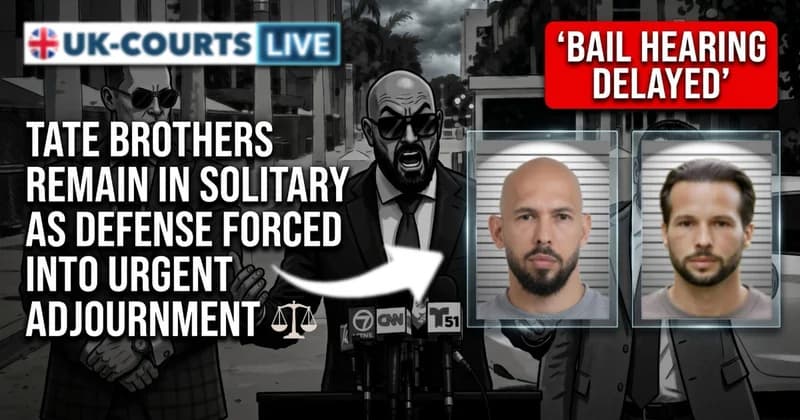
Ultimately, floating the threat of civil litigation while sitting in a maximum-security federal holding facility in Florida might generate excellent engagement metrics online, but it provides precisely zero mechanical leverage within an actual courtroom.
The extradition proceedings currently unfolding under Title 18 of the United States Code and the 2003 US-UK Extradition Treaty are concerned strictly with probable cause and dual criminality, utterly insulated from the theatrical sideshow of private civil disputes.
To recap for those still clinging to this legally illiterate notion: a civil countersuit is a private legal action that carries absolutely no statutory, equitable, or jurisdictional power to stay a sovereign criminal prosecution or override a bilateral international treaty.
When the procedural smoke and mirrors finally clear, the Tates will inevitably find themselves transferred to British custody, where the 21 Crown charges waiting for them will be answered before a jury at the Old Bailey, entirely unimpeded by whatever civil paperwork their fans believed would miraculously save them.