Why The “Persons Unknown” Campaign Can Stop Flag Ban Silencing Brummies
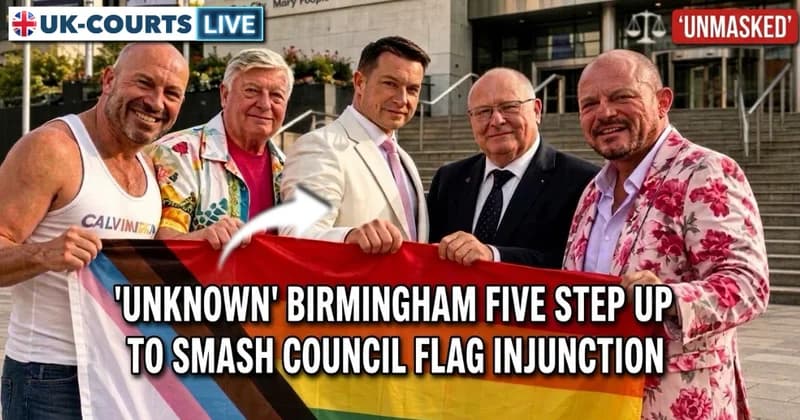
We explain how the filing by Adam Biggs and the ‘Birmingham 5’ flag campaigners could defeat Birmingham City Council’s bid for an injunction against unauthorised flags.

The response to our first article on the Birmingham 5, whose legal filing represents a fundamental defence of the rights of all the people of Brum to express themselves freely, was so great that the VP News inbox almost went into meltdown.
We can now provide this latest quote from the “Persons Unknown” who are standing up to defend Birmingham’s flag freedoms.
“By framing this injunction against ‘Persons Unknown,’ the Council effectively put all 1.2 million citizens of Birmingham on trial,”
says Adam Biggs, Spokesperson for the Birmingham Five.
“We are stepped forward because equality law is uncompromising: an injunction must be strictly impartial to survive, and if it cannot legally restrict every banner across our city, the Council's entire case collapses.”
And, with Birmingham Live recently publishing lengthy excepts from the group’s stunning legal filings in their article, we no longer have to reply to misplaced concerns that we had been duped by a publicity stunt, as doubts over the seriousness of this story have been silenced and interest grows in media circles.
Yet, many are still asking us, could the Birmingham Five really spell an end to the attempted flag ban, and if so, could we explain how, in simple terms?
To this , all I can say is, in a country whose legal system holds practical logic in high regard, guided by the ideal that the law must make sense to all, it feels rather like fulfilling both a professional and patriotic duty at once to give it a go?
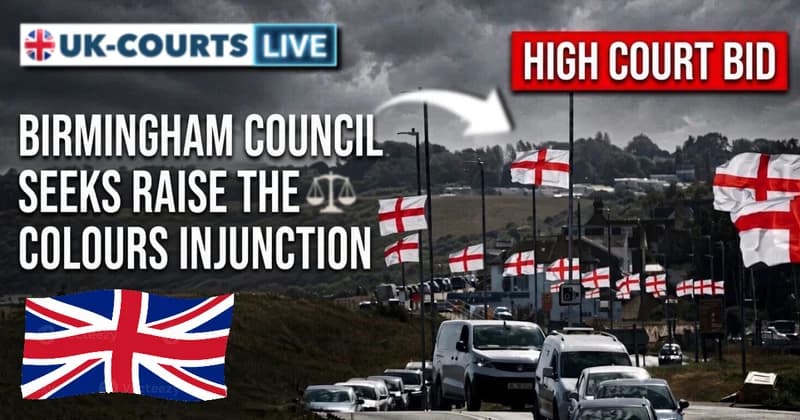
So, first, no explanation can proceed without letting the magnitude of this sink in. Birmingham City Council is petitioning the courts for powers that would restrict displays of our own flags, by any person, anywhere within Birmingham.
Whatever way you look at it, it is extraordinary.
But here’s the thing: to stand any realistic chance of passing impartiality hurdles, this would require banning every single flag. Right down to a local cycling club.
Targeting just our national flags — or targeting any other group of flags, although our national flags have exclusive, greater, protections — would expose the proposed injunction to numerous challenges, including appeals or Judicial Reviews.
in other words, it is all or nothing.
If a judge found one single flag where the injunction seems so disproportionate as to be unacceptably unfair, suddenly the ‘impartial case that includes Raise The Colours and national flags in its scope’ begins to look like a discriminatory, targeted case against national flags in general, and a political movement in particular.
While the legal architecture may be elaborate, the principle is very simple.
As with two people on each side of seesaw, when one person gets off, balance is instantly lost. The person on the other side inevitably crashes to the ground.
Likewise, with one exemption, impartiality collapses, and with it, the hope of upholding the claim against one party.
Therefore, even if, initially, an injunction against Ryan Bridge / Raise The Colours was considered justified, if it was later not considered justified to extend the exact same restriction to a group of minority rights activists, then a new, highly formidable defence would emerge for individuals associated with RTC.
As a reminder for out more sceptical readers, I must emphasis that this is not being passed by a vote. MPs and councillors have no more say in court than anyone else, and remain only as persuasive as their legal arguments.
Significantly, basic equality provisions are not restricted to designated minorities, but apply to all. This means that discrimination against self-described Patriots, or discrimination against self-described LGBTQ+ community members can each be fail discrimination legal tests, based on protections established in law.
Now, the local, and national significance of this legal challenge is huge: prove that the injunction would be unfair against members of the gay community, and it looks incredible unlikely that Birmingham City Council could gain any injunction against any flag.
While this could be important to Raise The Colours supporters, speaking to Adam Biggs, it is clear he doesn’t see himself as stepping in on RTC’s battle.
He was already, like every one of Birmingham’s 1.2m inhabitants, a defendant in the case - masked under the anonymous category of the 8th defendant, labelled ‘Person’s Unknown’.
He is a freedom loving Brexiteer whose political experience have given him a strong belief in ground-up politics and people power.
As a gay rights activists, he brings a unique perspective, as someone who has been discriminated against by UK law.
His campaign is for all people. In his own words
We are the 8th defendant, fighting an unfair Birmingham council decision to ban everyone from showing their freedom of expression via flags.
He point out the injustice: a flag representing the legal rights that generations of gay men have fought for could lead to arrest, if attached to a railing without permission. If a Polish resident wished to celebrate a day of national significance by spontaneously attaching a flag to a lamppost, they too could potentially be arrested, with the maximum available sentence being 2 years imprisonment.