David Walliams Named as Mystery Celebrity - What Next?
Comedian David Walliams unmasked following a High Court ruling rejecting his injunction bid to block media reporting of sexual misconduct allegations. So what next for Walliams?
The legal veil protecting one of the most recognisable figures in British entertainment has been definitively lifted for good following the conclusion of an unprecedented High Court confidentiality battle.
Comedian, author and former television judge David Walliams has been publicly identified as the celebrity claimant who spent weeks attempting to secure a permanent injunction to prevent Guardian News and Media and Independent Television News from publishing a cache of serious sexual misconduct allegations.
The unmasking follows a decisive judgment delivered by Mr Justice Nicklin rejecting the bid for a prior restraint order, combined with the subsequent expiration of the legal deadline for Walliams to challenge that ruling in the Court of Appeal.
With the reporting restrictions legally dissolved and the joint investigative findings published across national news platforms, the matter transitions from a closed courtroom confidentiality dispute into a profoundly complex landscape involving criminal scrutiny, civil liabilities and professional wreckage.
To understand the current legal position, it is necessary to examine the mechanics of the High Court proceedings that preceded the public disclosure.
Walliams initiated legal action to restrain the media organisations from reporting allegations that he used his celebrity status and professional standing to target young women and teenagers, including instances dating back ten to twenty years.
Central to his legal application was an extraordinary plea grounded in human rights law and medical vulnerability. His legal team argued that the publication of the investigative reports would trigger acute psychological distress, creating a high probability of suicide given that he had previously endured mental health crises and hospitalisation.
Under Articles 2 and 3 of the European Convention on Human Rights, which enshrine the right to life and protect individuals from inhuman or degrading treatment, the court was urged to exercise its inherent jurisdiction to protect a citizen from self-inflicted harm caused by media exposure.
Mr Justice Nicklin engaged in a meticulous balancing exercise, weighing Walliams' privacy rights under Article 8 against the freedom of expression guaranteed to the press and the public under Article 10.
The resulting judgment established crucial boundaries regarding how the judiciary must assess suicide risk in media injunction applications.
The court acknowledged the gravity of the medical evidence presented on behalf of Walliams but determined that an injunction of this nature would constitute an exceptionally serious interference with press freedom concerning matters of substantial public interest.
Crucially, the judge addressed the institutional responsibility for safeguarding health. He observed that the state had already taken substantial and effective measures to protect Walliams by detaining him under the Mental Health Act and providing structured inpatient psychiatric treatment within a secure environment.
The court ruled that inpatient clinical care significantly mitigated suicide risk, and that the judiciary could not establish a permanent gagging order on the national press simply because publication might distress an individual receiving psychiatric treatment.
Although Mr Justice Nicklin dismissed the injunction application, he granted Walliams permission in principle to take the case to the Court of Appeal.
This procedural step kept the interim anonymity orders in place temporarily, allowing legal representatives time to formulate proper grounds for challenge.
The court established a strict deadline requiring Walliams to file a formal notice of appeal or an application for an extension of time by half past four on Monday afternoon.
When that deadline elapsed without any submission from Walliams or his legal team, the legal architecture supporting his anonymity collapsed automatically.
Court staff confirmed that no challenge had been lodged, meaning the reporting restrictions expired immediately. This failure to appeal granted ITV News and The Guardian the green light to publish their three-year investigative findings and explicitly name Walliams as the subject of the proceedings.
The published allegations span multiple decades and professional arenas. Several women have come forward to accuse Walliams of grooming them when they were teenagers or young adults, detailing instances where he allegedly leveraged his fame to initiate contact and cultivate inappropriate relationships.
Further claims focus on his workplace conduct during his tenure as a judge on ITV entertainment programmes, with former colleagues alleging inappropriate text messages and uncomfortable encounters. Walliams has categorically denied all allegations of unlawful conduct and sexual predation.
In public statements issued through his legal representatives, he acknowledged that looking back he behaved thoughtlessly towards individuals with whom he had casual relationships and conceded that he did not always take people's feelings properly into account.
However, he maintained that he never abused his position of power, that he broke no laws and that he is not a sexual predator.
The immediate professional and institutional fallout has been swift and comprehensive.
The British Broadcasting Corporation announced it was reviewing all material written by or featuring Walliams and began removing popular titles such as Little Britain, Doctor Who, Big School, Would I Lie To You and Michael McIntyre's The Wheel from its streaming and catch-up platforms.
The Labour Party suspended his party membership pending internal inquiries. In the literary sector, his former publisher HarperCollins, which had previously terminated its commercial relationship following internal reviews into workplace conduct, reiterated its commitment to staff safety, while Waterstones confirmed it was returning remaining unsold stock of his children books to the publisher.
Furthermore, his literary representation was severed immediately when Independent Talent Group issued a public statement confirming they were deeply disturbed by the allegations and no longer represented him in any capacity.
Fremantle UK, the production company behind Britain's Got Talent, issued statements noting that no formal complaints had been raised during his time on the programme while encouraging any affected individuals to come forward.
What lies next in the legal process remains the critical question as the story unfolds. The primary legal horizon involves potential criminal investigations.
The Metropolitan Police confirmed publicly that officers contacted both The Guardian and ITV News following the publication of the investigative reports to ensure that any potential victims were informed of the proper channels for reporting criminal allegations.
The force stated that while no related reports of sexual assault or other offences had been received at the time of publication, any information brought forward would be carefully assessed by specialist officers.
If formal complaints are submitted to police forces regarding historical offences, the standard investigative machinery will activate.
Detectives will gather evidence, interview complainants and witnesses, examine digital communications and documents, and ultimately submit a file of evidence to the Crown Prosecution Service to determine whether criminal charges are warranted.
On the civil front, the landscape is fraught with complex strategic considerations. Walliams has issued unequivocal denials asserting that he has not broken the law and is not a sexual predator.
In theoretical terms, public figures accused of wrongdoing in investigative journalism retain the option of issuing defamation proceedings in the High Court to vindicate their reputation.
However, pursuing libel litigation requires a claimant to prove serious harm to reputation and opens the door for defendants to plead justification by establishing that the published allegations are substantially true.
Given that the preliminary legal skirmish involved a rigorous High Court challenge where media organisations successfully defended their right to publish matters of substantial public interest, any subsequent defamation claim would face formidable evidentiary hurdles and intense public scrutiny.
Beyond formal courtroom litigation, the broader legal accountability will likely play out through institutional inquiries, employment reviews and regulatory oversight.
Production companies and publishing houses facing historical allegations involving staff members and interns are increasingly subjected to mandatory governance standards concerning workplace safety and safeguarding.
The disclosures surrounding workplace conduct at publishing firms and television studios mean that corporate compliance departments will review past human resources protocols to ensure that complaints from junior staff were handled properly.
The conclusion of the anonymity litigation marks a decisive pivot point in modern British media law and celebrity accountability.
By testing the boundaries of privacy injunctions, suicide risk arguments and press freedom under the European Convention on Human Rights, the High Court has reinforced the principle that the administration of justice and public interest reporting cannot be indefinitely subordinated to protect a litigant from the psychological consequences of the exposure.
As the Metropolitan Police open channels for potential complainants and the wider entertainment industry purges associated content, David Walliams faces an uncertain future where his legal battles have only just begun.
Watch the report
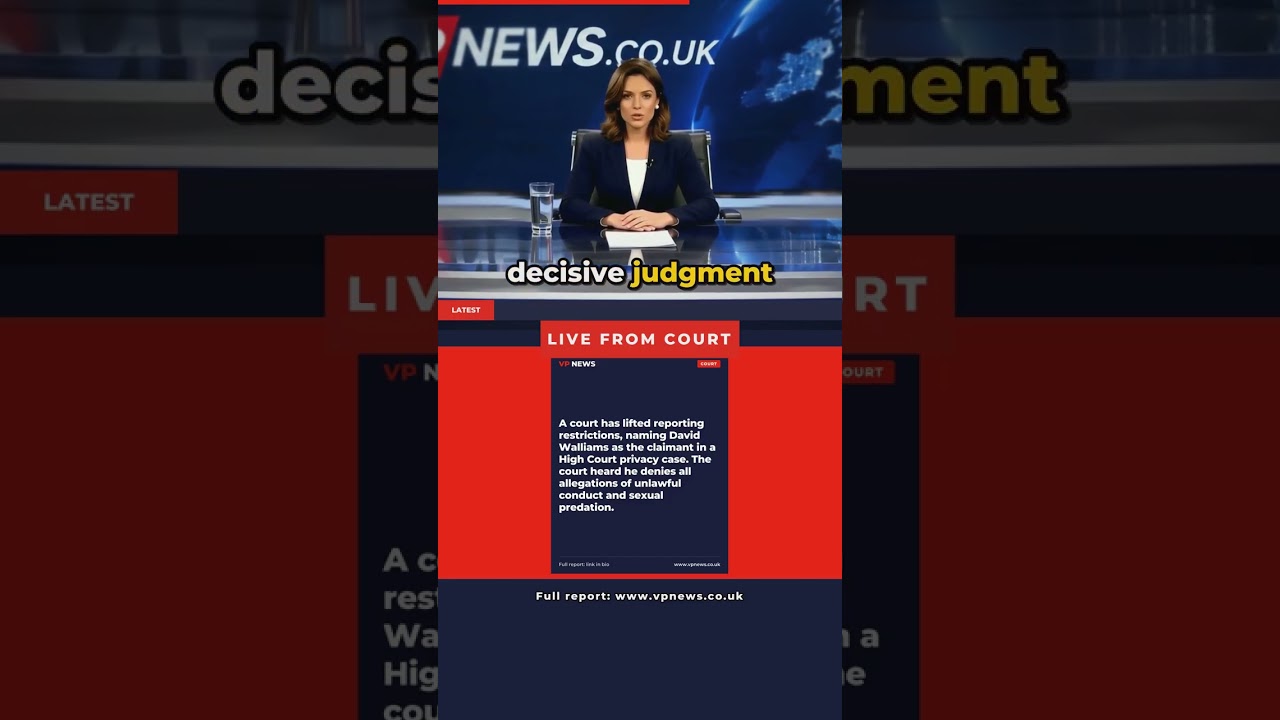
Presented by an AI presenter, reading a script based on our report.
The reporter
 James HornungCourt Correspondent and Legal Commentator