High Court Slashes Birmingham Council Flag Injunction as Kingstanding Patriots Split From Ryan Bridge
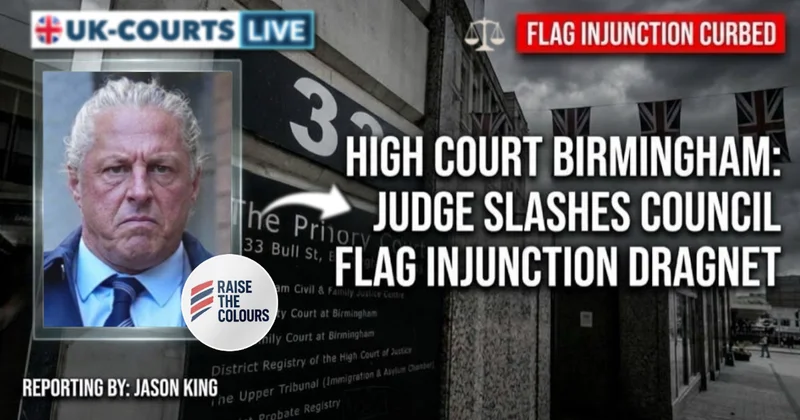
Her Honour Judge Emma Kelly trims Birmingham City Council's interim flag injunction at the High Court as Kingstanding Patriots sever ties with Ryan Bridge and Raise the Colours.
In this story
A sweeping judicial intervention at the High Court in Birmingham has stripped back the most draconian elements of Birmingham City Council’s proposed city-wide flag injunction while leaving the door wide open for the blanket restriction on ordinary residents to be dismantled altogether at full trial.
Live Reporting by: Jason King
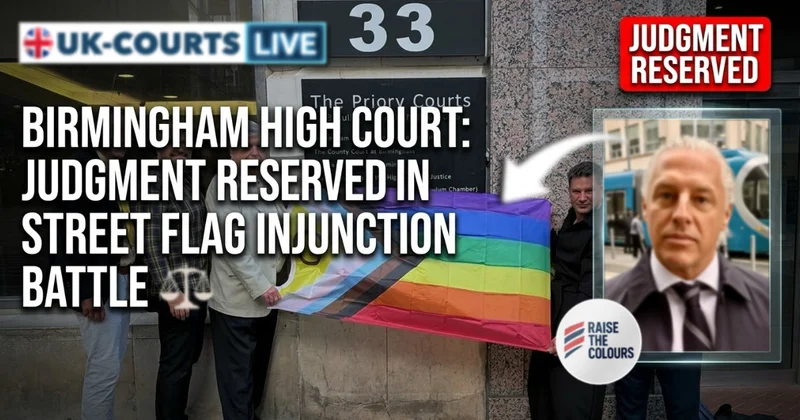
On the surface, the interim ruling handed down by Her Honour Judge Emma Kelly on 18 November 2026 in Birmingham City Council v Ryan Bridge & Ors [2026] EWHC 2907 (KB) appears to hand the local authority the temporary restraint it sought over highway infrastructure.
Yet a forensic examination of the 47-page judgment reveals a profound judicial pushback against municipal overreach, achieved largely through the intervention of the "Birmingham Five" representing the interests of ordinary citizens caught in the council’s "Persons Unknown" net.
Simultaneously, the political landscape surrounding the dispute has fractured dramatically.
The prominent grassroots group Kingstanding Patriots has formally severed all ties with lead defendant Ryan Bridge, and his Raise the Colours organisation, announcing a unilateral, community-spirited operation to remove flags from council-owned property across the city to spare the cash-strapped authority further expense.
Judicial Surgery on the Council’s Dragnet
When Birmingham City Council originally marched into the Priory Courts, its legal team sought an expansive, loosely drafted contra mundum order capable of sweeping up almost any resident engaging in peaceful public expression.
Following robust written and oral representations from the five non-party intervenors, namely Mark Hudson, Adam Biggs, Thomas Greenslade, Timothy Hodge and Tony Kaye, alongside arguments from Bridge’s direct access counsel Dr Liam Wells, Judge Kelly took a red pen to the council’s draft order.
The judge refused to rubber-stamp the local authority’s broad terminology.
In a decisive victory for legal certainty and civil liberties, the court struck out the council’s proposed clause banning general highway obstruction, ruling it went beyond existing criminal statutes and was entirely unnecessary.
Furthermore, Judge Kelly rejected the council’s attempts to invent sweeping, subjective definitions for everyday legal concepts such as "obstructing" and "harassment, alarm or distress", which would have criminalised actions as minor as standing near a contractor or engaging in unwanted conversation.
By refusing those definitions, the court ensured that any future allegation of breach must be proven to the strict criminal standard of proof rather than relying on an administrator’s elastic interpretation.
Crucially, the court placed on formal record that the interim order does not ban the flying of the Union Flag, the Cross of St George, Pride flags or any other banners in Birmingham.
Judge Kelly explicitly affirmed the arguments raised by the intervenors that citizens remain entirely free to fly flags from their homes, gardens and private businesses, to wear patriotic or identity clothing on the street and to carry flags on handheld poles during peaceful public assemblies.
The geographic reach of the order was also tightly ring-fenced strictly to the Birmingham administrative boundary, preventing any spillover into neighbouring jurisdictions.
The Strategic Architecture of an Interim Holding Pattern
To understand why the "Persons Unknown" category remains inside the interim order for now, one must examine the strict procedural mechanics of quia timet and newcomer injunctions laid down by the Supreme Court in Wolverhampton City Council v London Gypsies and Travellers [2023].
At this preliminary stage, the court has heard no oral evidence and has made no final findings of fact.
The interim order is purely a temporary holding measure designed to preserve the status quo until a full Part 7 trial can take place within the next twelve months.
From a technical legal standpoint, local authorities pursuing targeted enforcement against a primary defendant frequently rely on an overarching "Persons Unknown" class at the interlocutory stage to prevent an immediate jurisdictional loophole.
Were the court to sever the "Persons Unknown" category prematurely before the substantive case against the primary named defendant is tested, a central defendant could potentially invoke the Wolverhampton newcomer principles to argue that the targeted restraint is discriminatory, defective or unenforceable in isolation.
Consequently, retaining the omnibus category during the interim window serves a specific structural purpose while the main proceedings against Ryan Bridge and Raise the Colours move toward trial.
It therfore could be noted that the core evidential thrust of the council’s case, comprising 22 specific allegations in its Scott Schedule, is overwhelmingly aimed at Bridge’s personal conduct, his livestreams and his organisation’s operational methods.
Should the council succeed in establishing its substantive case and securing final, permanent relief against Bridge at full trial, the underlying rationale for maintaining a sprawling, city-wide injunction against unidentified members of the public evaporates entirely.
Once the primary objective of binding the central protagonist is achieved at trial, there is every prospect that the court will decline to make the "Persons Unknown" element permanent, allowing the blanket restriction on ordinary Birmingham residents to fall away completely.
Kingstanding Patriots Sever Ties with Raise the Colours
While lawyers prepare for the consequential matters hearing and the road to trial, the grassroots movement on the ground in north Birmingham has undergone a decisive realignment.
A spokesman for the Kingstanding Patriots group has issued an exclusive statement to VP News, formally distancing the organisation from Ryan Bridge and Raise the Colours.
The group stated that any perceived association with Bridge and his organisation has proved deeply negative, bringing their positive community work into disrepute and proving highly detrimental to their cause.
In their assessment, the conduct and public messaging associated with Raise the Colours are directly responsible, from a legal standpoint, for dragging ordinary local patriots into the High Court.
The spokesman confirmed that Kingstanding Patriots are no longer associated in any capacity with Ryan Bridge or Raise the Colours and will continue operating entirely independently with zero future connection to him or his group.
A Community-Led Operation to Save Council Funds
In a striking display of civic responsibility and cooperation with Birmingham City Council, Kingstanding Patriots also announced an immediate, practical initiative to de-escalate tensions and protect the public purse.
Recognising that Birmingham City Council faces severe financial pressures, the group stated that it does not wish to see a cash-strapped local authority forced to spend scarce taxpayers' money on contractors to remove flags from municipal infrastructure.
Instead, members of Kingstanding Patriots will personally endeavour over the coming weeks to carefully remove flags from all Birmingham City Council-owned property across the area, with particular focus on the prominent display at Kingstanding Circle roundabout.
The spokesman emphasised that this voluntary clear-up applies strictly to council-owned street furniture and highway assets, and will not touch flags displayed on private property, residential houses or independent businesses.
By taking responsibility for removing the flags themselves, the group aims to ensure their activities leave no negative financial footprint on the council, allowing municipal funds to be directed toward vital community services across Birmingham.
The group has chosen to make this operation and its constructive rationale public in advance so that local authorities and West Midlands Police are fully aware of their peaceful intentions, ensuring volunteers carrying out the removal work in good faith are not misunderstood or subjected to unnecessary enforcement action.
Looking Ahead to Trial
For the five intervenors who stepped forward to strip away the anonymity of the "Persons Unknown" class and hold the council to account in Courtroom 205, the judgment confirms that active citizen scrutiny forces judicial restraint.
The council did not walk away with the unchecked blank cheque it demanded. Instead, it was handed a heavily edited, strictly temporary order hedged with express protections for free speech and a 48-hour liberty to apply clause allowing any affected resident to challenge its terms.
With Kingstanding Patriots taking proactive steps on the ground to clear council lampposts and sever links with Raise the Colours, the heat is rapidly dissipating from Birmingham’s streets.
As the litigation narrows toward the substantive trial against Ryan Bridge, the temporary net cast over the wider public looks increasingly like a transient procedural device whose days are strictly numbered.
Reporting & Analysis by Jason King
Lead Reporter -VP News
The reporter
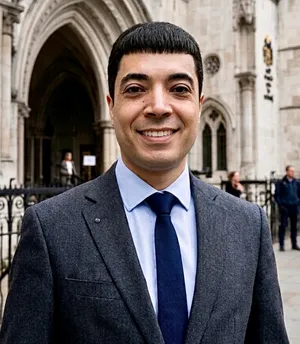 Jason KingCourt Correspondent and Birmingham Desk Lead