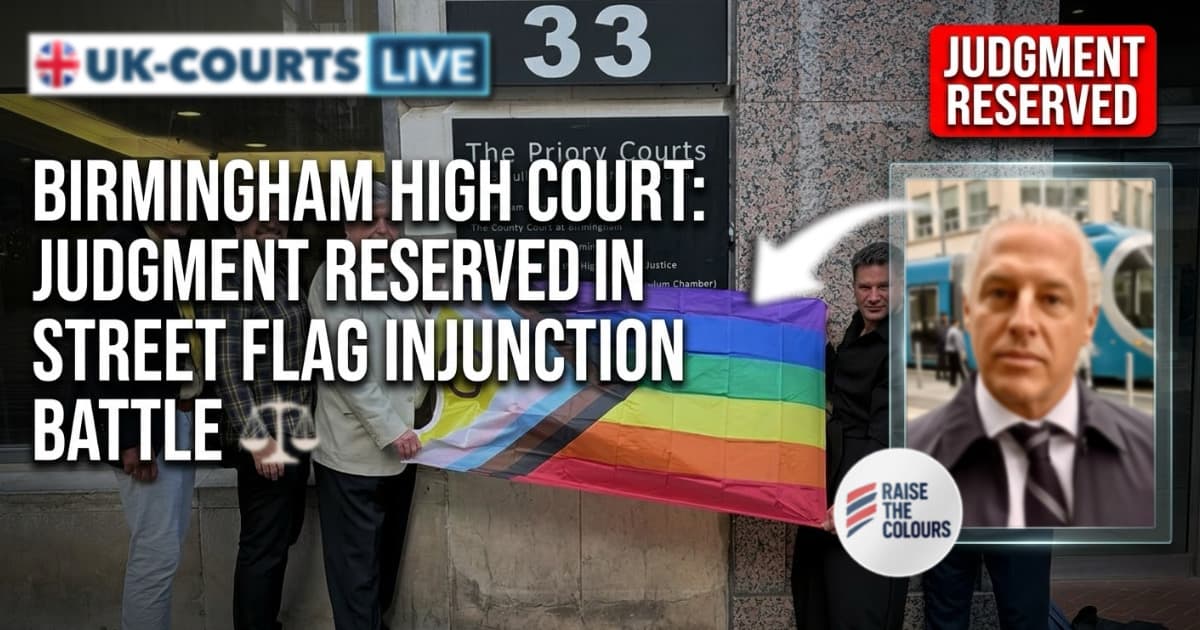
High Court Reserves Judgment in Birmingham City Council Unauthorised Flags Injunction Battle
Judge Emma Kelly reserves judgment following a High Court hearing over Birmingham City Council's application for a sweeping injunction against unauthorised flag attachments…

High Court Judge Emma Kelly has reserved her judgment following a contested interim hearing regarding a sweeping injunction sought by Birmingham City Council to prevent unauthorised flags and attachments from being placed on public street furniture across the city.
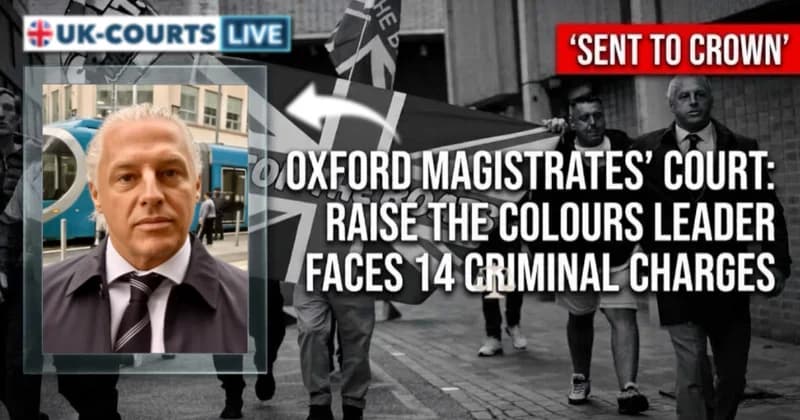
The local authority is seeking civil orders and powers of arrest against Raise the Colours activist Ryan Bridge and "persons unknown", alleging that widespread flagging operations on highways and lampposts have generated public safety risks, intimidation of council contractors, and significant removal costs.
Following extensive submissions at the High Court sitting on Bull Street, Judge Kelly confirmed that her written decision on the interim application will be handed down to the parties at a later date.
The council’s legal representative, Jonathan Manning, told the court that the injunction was not aimed at suppressing free speech, political views, or patriotism, but at preventing the illegal attachment of items to council-owned infrastructure.
The court heard that unauthorised attachments were being erected without statutory consent, creating logistical burdens and physical hazards.
Manning highlighted an incident earlier this year where a resident suffered a broken leg following a collision involving a cherry picker operated during a Raise the Colours event.
The council submitted that a attached power of arrest was essential to allow police to immediately remove individuals breaching the order, arguing that standard criminal procedures provided insufficient protection against immediate public confrontation.
In response, legal representatives for Ryan Bridge argued that the proposed injunction was disproportionate and unnecessary.
Barrister Liam Wells, alongside assisting counsel, stated that Bridge had not incited illegality, violence, or online abuse, and was willing to offer formal legal undertakings not to attach flags without consent.
Defense counsel emphasised that Bridge’s campaign represented a protected expression of political belief under Articles 10 and 11 of the Human Rights Act, characterising the movement as a peaceful celebration of national heritage and identity.
The court heard supporting statements from members of the public, including a British Asian Muslim man and a local activist, who described the flying of national flags as an empowering symbol of shared community rather than racism.
Bridge’s legal team further argued that seeking formal council consent would have been futile due to established political opposition from local representatives.
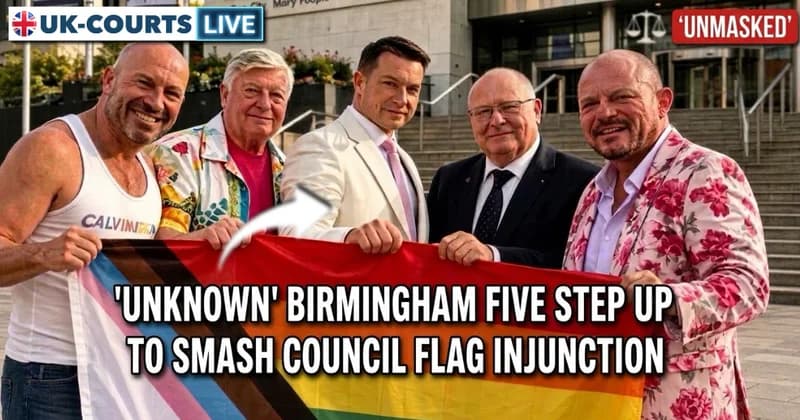
The hearing also heard submissions from five independent intervenors opposing the injunction under the "persons unknown" defendants category.
Adam Biggs, addressing the court on behalf of local residents and LGBTQ+ activists, warned that the wording of the injunction was overly broad and risked criminalising ordinary citizens. Biggs submitted that the order could inadvertently penalise individuals displaying Pride flags, political banners, or even community posters for lost pets.
He argued that the broad restrictions mirrored legacy discriminatory measures, creating a chilling effect on legitimate public assembly and protest across the city.
In response to concerns regarding the scope of the order, Manning denied that the injunction would penalise flag displays on private property, t-shirts, or window frames, assuring the court that the order applied strictly to public street furniture and highways.
The council maintained that the inclusion of "persons unknown" was legally necessary to prevent new groups from resuming unauthorised attachments if named individuals ceased activity. Having heard full oral argument from all parties, Judge Kelly adjourned the court, confirming that her formal ruling will be published in due course.
Follow UK Courts Live
Every hearing as it happens, on the network you use.