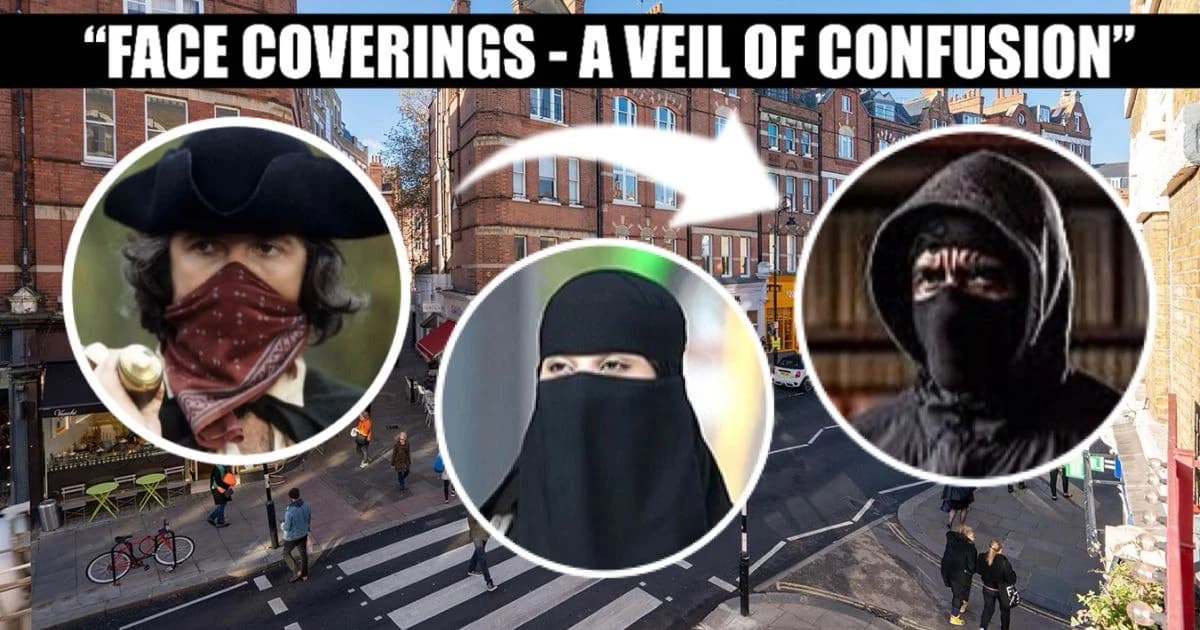
Face Coverings - A Veil Confusion
The debate over banning the burqa is a distraction, mired in accusations of discrimination and bias. Targeting Islamic face veils alone fails legal…

Unmasking Britain: A Legally Robust Case for a Universal Face Covering Ban
The debate over banning the burqa is a distraction, mired in accusations of discrimination and bias. Targeting Islamic face veils alone fails legal scrutiny. Enter a universal ban on all face coverings—burqas, balaclavas, ski masks, surgical masks—rooted in the unassailable principle of public safety. Such a policy, mirrored by Muslim-majority nations like Chad and Morocco where burqas and other Islamic face coverings are outlawed for public safety, would restore law and order to Britain’s streets while deftly neutralising cultural disputes. Here’s the case, argued with street sense and legal precision.
Modern Highwaymen, Unmasked
Britain’s streets in 2025 evoke a grim echo of 18th-century lawlessness. Phone thieves, the modern highwaymen, have traded Black Bess for Sur-ron e-bikes, scarves for ski masks, and rapiers for machetes. These faceless predators—often teenagers—swoop through London and Birmingham, snatching phones, menacing commuters, and vanishing into alleys before police can respond. Their superpower? Anonymity. In an era where crime detection hinges on CCTV and number plate recognition, masks shield identities, and Sur-rons, illegal on public roads, bear no plates, rendering them ghosts to law enforcement. Unmask these culprits, and their bravado collapses.
The Debate’s False Dichotomy
When Reform MP Sarah Pochin proposed banning face coverings, the reaction was predictable. Many on the left cried “Islamophobia,” framing any restriction on religious garb as intolerance. Others fixated on burqas, ignoring the bigger issues. Both miss the mark. This isn’t about faith or sentiment—it’s about criminality. Face coverings, whether niqabs or ski masks, obscure identity, abetting crime. Muslim-majority states like Chad, Cameroon, and Morocco banned veils to thwart jihadists and fraudsters, not to enforce secularism. Britain can adopt a universal ban to achieve the same.
A Legal Legacy of Pragmatism
History provides precedent. In 1723, the Waltham Black Act went after the criminal gangs using soot to cover their faces while poaching or committing other crimes, recognising anonymity as a felon’s tool. Its logic holds. Modern democracies have followed suit:
- New York, 1870s: Anti-mask laws were passed in response the Ku Klux Klan’s veiled intimidation.
- Italy and Germany, 1970s-80s: Face covering bans curtailed Red Brigades’ terror.
- Chad, Morocco, et al.: Veil bans targeted bombers and fraud, not religion.
These were precise, legally sound responses to real threats. Britain’s current crisis—where CCTV is thwarted by masks and unregistered Sur-rons—demands the same.
A Straightforward Solution
The policy is elegantly simple: ban all face coverings in public spaces, save for those with a verifiable medical certificate. No religious exemptions, no sartorial loopholes. This neutral approach—equally applied to burqas, balaclavas, or ski masks—avoids discriminatory intent, aligning with the Equality Act 2010 and European human rights law. It targets not Muslims but criminals, whose anonymity thrives on any mask, as grainy CCTV footage attests.
Addressing the Critics
The objections are familiar: “What of personal freedom?” “What of cultural respect?” The rebuttal is clear. Public safety routinely overrides individual liberties—knife bans, speed limits, and pavement scooter rules prove this. Acid attacks, though less common than machete threats, which dominate public fear, underscore the stakes. There are several Muslim countries which don’t allow face coverings in public places, and others that restrict them, making it hard to argue that religious expression requires facial obscurity. A medical justification must be the benchmark, not cultural or religious preference. Public spaces demand mutual visibility; anonymity undermines accountability. Those seeking seclusion can stay private—shared streets require shared faces.
The Cost of Inaction
Those wary of causing offence mistake timidity for tolerance. Burqa-ban enthusiasts, meanwhile, chase headlines, not solutions, ignoring the masks fuelling most crimes. A universal ban transcends both, offering legal clarity and fairness.
Restoring Order, Legally
This is neither radical nor prejudiced—it’s a return to first principles. Anonymity fuels crime; the law must unmask it. The Black Act worked, as did anti-Klan and anti-terror laws. A blanket face covering ban, paired with medical exemptions, will curb Britain’s modern highwaymen. Dispense with the posturing and act—before another masked thief strikes.