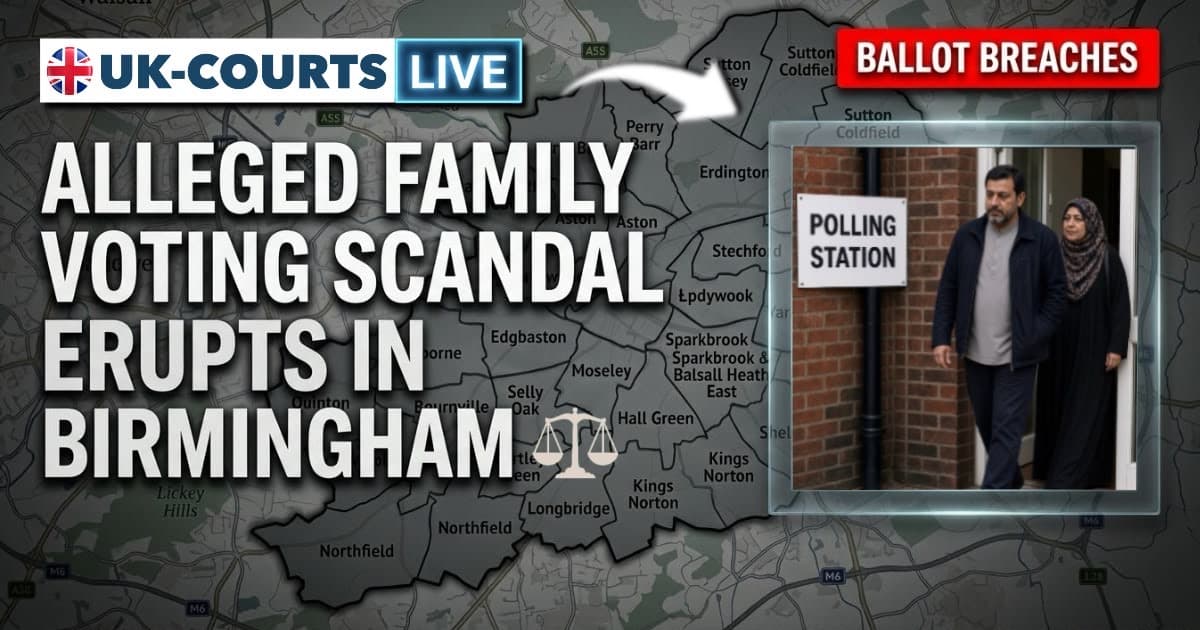
Alleged Family Voting Scandal Erupts in Birmingham
Birmingham City Council has disclosed reports of potential breaches of the secret ballot at 50 polling stations during the May 2026 local elections, prompting calls for the Electoral Commission to investigate. The incidents involved voters allegedly entering polling booths together, attempting to...

Birmingham City Council has disclosed reports of potential breaches of the secret ballot at 50 polling stations during the May 2026 local elections, prompting calls for the Electoral Commission to investigate.
The incidents involved voters allegedly entering polling booths together, attempting to influence relatives, communicating about how to vote and, in some cases becoming confrontational when polling station staff intervened.
The details emerged through a Freedom of Information request after the council had initially released only a summary of the incidents.
At a polling station in Birmingham’s Jewellery Quarter, voters were described as becoming “aggressive” after an officer told them they could not talk to each other while in the booths.
In Balsall Heath a man was reported to have been “trying continuously” to influence voters. When challenged by the presiding officer, he accused officials of fraud.
The officer recorded being “so stressed and under pressure” as a result of the incident. A separate family at the same polling station was described as “rude”.
Another report recorded an allegation that a man had attempted to influence voting through “Islamic gestures, blinking eyes and hand signals”. A woman was also reported to have become aggressive after being told not to talk or show her vote.
At Garretts Green, a father was seen holding “all the poll cards” belonging to his relatives and “advising” each of them how to vote.
The presiding officer instructed the family to use separate booths. Despite the intervention, the officer recorded: “It was clear that votes were being influenced.”
There were similar reports elsewhere.
In Handsworth, voters allegedly continued conferring after being told to stop, with the polling station report stating that they “changed language when advised to vote independently”.
In Hall Green South, a woman was reported to have repeatedly tried to speak to her husband and show him who to vote for. She then allegedly pointed towards where he should mark his ballot, prompting the presiding officer to intervene physically by placing an arm between them.
At Quinton, a woman entered a polling booth with her daughter and told staff that she wanted to make sure her daughter “voted correctly”.
The reports concern what is commonly described as “family voting” — conduct in which people share a polling booth or otherwise attempt to influence another person’s ballot.
The records raise a separate question that cannot be answered from the paperwork alone: how much family voting was never recorded in the first place?
The council’s figures are a record of incidents reported by polling station staff, not a headcount of every occasion on which voters may have spoken, shared a booth or attempted to influence another person’s ballot.
That distinction matters. Several polling station reports describe the behaviour as something staff encountered repeatedly or regarded as routine. Others refer to difficulties monitoring voting areas during busy periods, prompting questions of whether the written returns captured every incident staff witnessed.
The issue is not confined to Birmingham.
Democracy Volunteers said its observers recorded 291 potential incidents of family voting across the UK during the May elections.
There were also allegations surrounding the Gorton and Denton by-election. Electoral observers reported what they described as extremely high levels of potential family voting, including occasions involving voters sharing booths or looking over one another’s shoulders.
Greater Manchester Police subsequently said it had found no evidence of voting coercion. The investigation was said to have been affected by a lack of suspect descriptions and limited CCTV.
The Birmingham council reports do not, by themselves, establish that criminal offences were committed or that any election result was affected. They record observations and incidents reported by polling station staff.
Birmingham City Council said its Returning Officer had passed all available observations of potential family voting to police and that the council understood police had decided to take no further action.
West Midlands Police said it would assess new information that had come to light and work with Birmingham City Council and the Electoral Commission as part of the review process.
The Electoral Commission said it provides guidance and support intended to protect the integrity of elections and works with police where allegations of electoral abuse and intimidation are raised.
It said it was gathering evidence concerning the May 2026 elections and would publish its findings in the coming weeks.
The disclosure has also prompted a political response.
Reform UK leader Nigel Farage said in a statement published on Facebook that the incidents amounted to “endemic corrupt voting” and described the material as “incontrovertible evidence”.
His statement referred to the reported use of “Islamic gestures”, the father holding his relatives’ poll cards and the mother who entered a booth with her daughter.
Farage also raised the issue of postal voting, saying that if such conduct occurred at public polling stations, questions should be asked about pressure exerted on postal voters away from polling stations.
The stakes underlying these findings extend far beyond standard administrative friction. In any functioning democracy, political campaigns invest immense effort in the open marketplace of ideas—knocking on doors, debating policies, and engaging in direct persuasion to earn a citizen's support. That open, voluntary dialogue forms the foundation of democratic choice.
The principle of the secret ballot serves a distinctly different, vital purpose. Under standards set out by the Electoral Commission, polling station staff are tasked with ensuring every citizen can mark their ballot independently, in secret and entirely free from influence or coercion.
If a formal investigation were to confirm that numerous voters simply followed external instructions inside the booth rather than exercising their own independent choice, it would raise fundamental questions about the integrity of those votes. While current administrative records document procedural breaches, they do not establish that systemic voting fraud occurred—nor would it be sound to assume that these logged incidents capture every potential occurrence.
In tightly contested races where outcomes are decided by narrow margins the ultimate concern is whether the evidence could establish that an election result was not correct. That fundamental uncertainty is precisely why these records demand a thorough, independent review.