Seven Votes, Four Counts, and a Flood of Misinformation: What Really Happened in Birmingham’s Glebe Farm and Tile Cross Ward
The questions raised about electoral integrity are serious ones — even if the answers, on this occasion, are rather less dramatic than the posts suggest.

Social media posts alleging vote-rigging in Birmingham’s Glebe Farm and Tile Cross ward have attracted hundreds of thousands of engagements over recent days. They deserve a considered response, because the questions they raise about electoral integrity are serious ones — even if the answers, on this occasion, are rather less dramatic than the posts suggest.
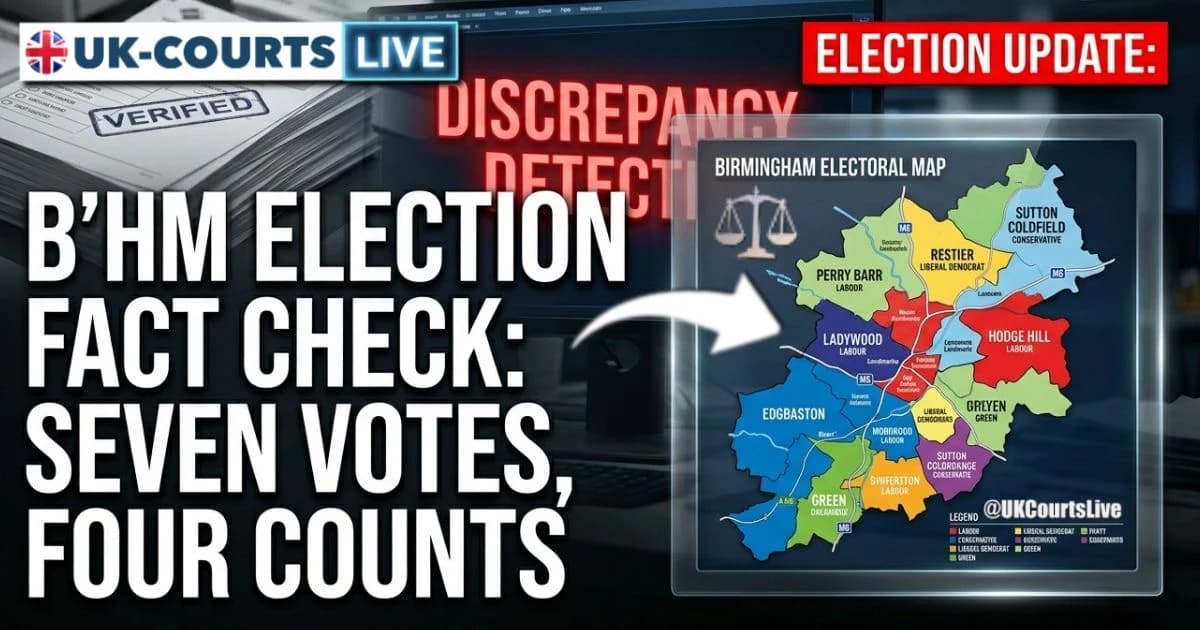
The ward returned two councillors. Jess Ankrett of Reform UK came first with 1,394 votes. Shehryar Kayani of the Workers Party of Britain took the second seat with 1,163 votes, finishing ahead of Reform’s second candidate, Satnam Tank, by a margin of single figures. John Cotton, the Labour leader of Birmingham City Council, lost his seat with 896 votes. The strongest Labour candidate, Marje Bridle, finished fifth on 1,035. Neither Labour candidate was within reach of either seat.
Two recounts on Saturday returned identical results. A full second count on Monday — a more thorough process than a recount, involving the physical re-examination of every ballot paper — found seven papers that had not been recorded in any previous count. The result was unchanged throughout: one seat to Reform, one to the Workers Party.
The viral claims built around those seven ballots share a common flaw: they misread, in some cases dramatically, what the numbers actually show.
The most straightforward error appears in a post asserting that the Workers Party won by a single vote, with the clear implication that fraud had delivered them a seat they would not otherwise have held. This is wrong on both counts. The margin was six votes, established in the first count and maintained in every subsequent one. More fundamentally, the Workers Party did not gain their seat through the recount process — they held it throughout. The recounts, if anything, represented a risk to their position rather than an opportunity. It is worth noting that Reform UK, whose candidate Tank stood to benefit most directly from any change in the result, has raised no formal objection.
A second claim — that the seven additional ballots were cast for Labour with the intention of returning Cotton to his seat — requires only a moment’s arithmetic to dismiss. Cotton finished 267 votes short of the second seat. No configuration of seven ballots, however cast, could have altered that position. The claim does not survive contact with the result sheet.
A third post, which attracted the greatest engagement of all, was more carefully constructed than either of those. It recited the counting timeline with sufficient accuracy to lend itself an air of authority, then built upon that foundation a series of rhetorical questions implying that something corrupt had taken place. It stopped short, deliberately, of making any direct allegation. What it also stopped short of mentioning was that Cotton was never in contention, that the result had been consistent across every count, and that the parties who would have had legitimate grounds for complaint have made none through the appropriate channels.
That said, the seven-ballot discrepancy is not a matter to be waved away. Under the Representation of the People Act 1983, the Returning Officer carries a clear legal obligation to document and account for any variance between the verified ballot paper total — established and witnessed before counting begins — and the figures produced by the count itself. That documentation has not yet been made public. Agents from all parties were present throughout the process, as is their legal entitlement, and their accounts of events will be material to any proper assessment of what occurred. A variance of this kind, however small in percentage terms, sits precisely at the threshold where formal explanation is not merely desirable but required.
The discrepancy is a legitimate question, and it deserves a legitimate answer — from the Returning Officer, through the proper process, and on the record. What it does not warrant is the conclusion, stated or implied, that the result of this election was fabricated. The votes were counted, recounted, and counted again. The result was the same every time.