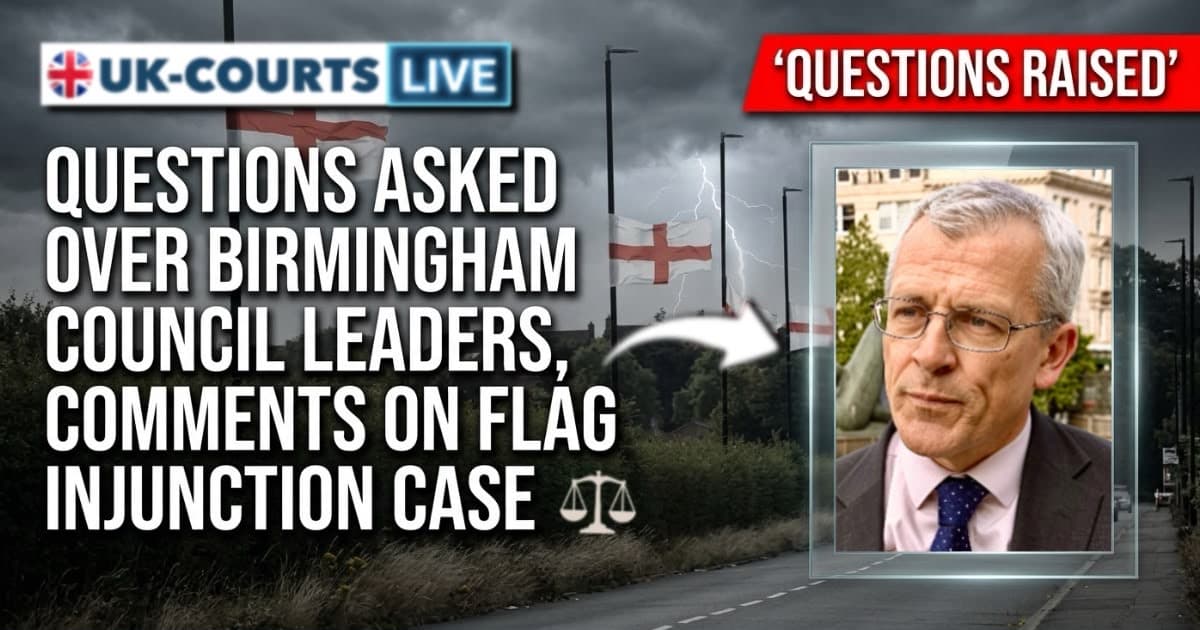
Questions Raised Over Birmingham Council Leadership’s Chamber Statements On Active High Court Flag Injunction
Senior council figures accused of misleading chamber as high-stakes flag injunction suffers high court setback & sparks public priority backlash

Questions are being raised over the accuracy of statements made by senior Birmingham City Council figures regarding active High Court proceedings, amid growing concerns that elected members may have been given a misleading account of a legal setback.
During a recent full council meeting, Cabinet Member Councillor Nicky Brennan and Council Leader Roger Harmer addressed the authority’s ongoing legal attempt to secure an interim injunction against street flaggers. Cllr Brennan characterised the High Court’s decision to adjourn as the judge simply having "raised concerns about the way the council’s case had been presented and described aspects of it as troubling."
In response, Cllr Harmer told the chamber that the delay was largely a routine procedural courtesy:
"A large part of what the judge said was, quite understandably perhaps, seeking to protect people who were bringing their defence without legal support in the court, And this judge is understandably well known for seeking to give people in that situation a second chance. And to go through and therefore pausing the hearings and then restarting them at a later date is something that’s not at all unusual. And the council will provide the extra information and the content that is needed."
However, a direct comparison between the official court record and the leader's statements to the chamber reveals a stark disconnect, raising serious questions about whether leadership accurately presented the status of active litigation to fellow councillors.
A "Second Chance" or a Right to a First Chance?
Far from granting a benevolent courtesy to unrepresented defendants, Judge Kelly halted the High Court proceedings because the council’s legal submission was fundamentally flawed, legally questionable & procedurally unfair.
Where Leader Roger Harmer framed the adjournment as the court granting unrepresented litigants a soft "second chance," the judicial reality was precisely the reverse: Judge Kelly paused proceedings to force Birmingham City Council to give the named defendants a proper first chance to defend themselves at all.
The official court record highlights three critical failures that executive leadership chose to gloss over:
- Denial of Natural Justice: Judge Kelly explicitly branded the council’s 281-page evidence submission "troubling," ruling that because it failed to specify what individual named defendants were actually alleged to have done, those accused were legally unable to prepare a defence against unarticulated claims.
- The Undermined "Emergency" Premise: The judge directly challenged the council’s justification for seeking an urgent interim injunction, quizzing legal counsel on why an emergency order was required when the flagging activity had continued unchanged for months without escalation.
- The Ignored Constitutional Threshold: Most crucially, Judge Kelly explicitly ordered the council to produce clearer evidence so that the court could properly evaluate the defendants’ rights under Section 10 of the Human Rights Act (Article 10 ECHR—Freedom of Expression).
Under local government codes of conduct, executive members owe a duty of strict accuracy when reporting to the chamber on active court cases involving substantial public expenditure. Reframing a judicial order to correct fundamental procedural unfairness as an act of routine charity risks actively misleading elected members on the true viability & standing of an active lawsuit.
The Reform Challenge: Financial Priorities vs "Shop Canopy" Governance
This divergence between courtroom reality and political framing was seized upon during the meeting by Reform Group Leader Councillor Jex Parkin, who mounted a sustained attack on the administration's core priorities:
"Birmingham is broken, blighted by potholes, still under severe financial pressure and with tens of thousands of residents waiting for social housing... Yet the one thing that they can do is target the flag of our country... What on earth makes you think that’s an acceptable priority for this administration?"
In his supplementary question, Cllr Parkin pressed the Leader further on the financial burden and political justification for the court action:
"It’s a question of priorities for this council... their main priority, it seems, is proposing taking down flags that are going to cost several millions of pounds to do so. It’s heavy-handed... and it’s actually the last priority that this council should be concerned about."
In response, Cllr Harmer attempted to brush off Parkin’s critique by reducing the High Court injunction to a matter of routine administrative compliance:
"Birmingham, I think, has suffered as a city from people not playing respect to the law... Whether that’s people ignoring planning rules and building extensions or canopies over the pavement without permission... one of those areas is just a disregard that okay the rules say... you should not fix unauthorised attachment onto street furniture... And you can’t have one rule that says, well, the law applies in some areas and not in others."
However, by dismissing Parkin’s priority challenge as a simple matter of "street clutter enforcement" akin to illegal shop canopies, Cllr Harmer glossed over the vast legal difference between removing an unauthorised shop sign and asking the High Court to issue an injunction that restricts public expression.
By treating the High Court application as routine highway maintenance, the Leader failed to address either Parkin's priority challenge or the judge's explicit human rights mandate.
The Human Rights Dimension: Public Space as Civic Expression
Central to the legal battle—and entirely absent from the Leader's chamber defence—is how Article 10 free expression claims intersect with the use of public infrastructure.
Community groups and defendants have framed the mounting of flags on prominent street furniture not as mere private display, but as a distinct form of collective, civic expression. Under this framing, placing flags along shared thoroughfares and highway structures serves a specific communicative function: asserting shared cultural identity and local pride within the public square.
Crucially, campaigners argue that this form of expression cannot simply be replicated by displaying flags on private property:
- Visibility and Shared Space: Private displays are limited to personal boundary lines, whereas street lampposts occupy the shared public realm, projecting a collective presence to the wider community.
- The "Alternative Medium" Legal Test: Under Article 10 jurisprudence, courts must consider whether restricting expression in a specific venue leaves effective alternative channels open. Demonstrators maintain that banishing flags to private gardens eliminates the precise public and symbolic character of the display.
- Proportionality Threshold: Because public space carries long-standing traditions of civic expression, the High Court must weigh the council's interest in maintaining highway aesthetics against the threshold of interfering with visible community expression.
The Risk of Total Collapse
Because Judge Kelly found that the council failed to link specific acts to specific individuals, the High Court cannot yet perform this mandatory balancing test between highway powers and fundamental rights.
If the council’s legal team returns to court on September 30 with an evidence bundle that still fails to satisfy these strict human rights and evidentiary thresholds, the injunction application risks collapse.
If that occurs, warnings over wasted municipal resources will be fully vindicated: the administration will face difficult questions not only over the substantial cost of a failed legal action, but over why the council chamber was seemingly assured that the case was on firm footing when the High Court had already found its evidence "troubling."