Cambridge Crown Court Hears Evidence in Anthony Williams Mass Stabbing Trial
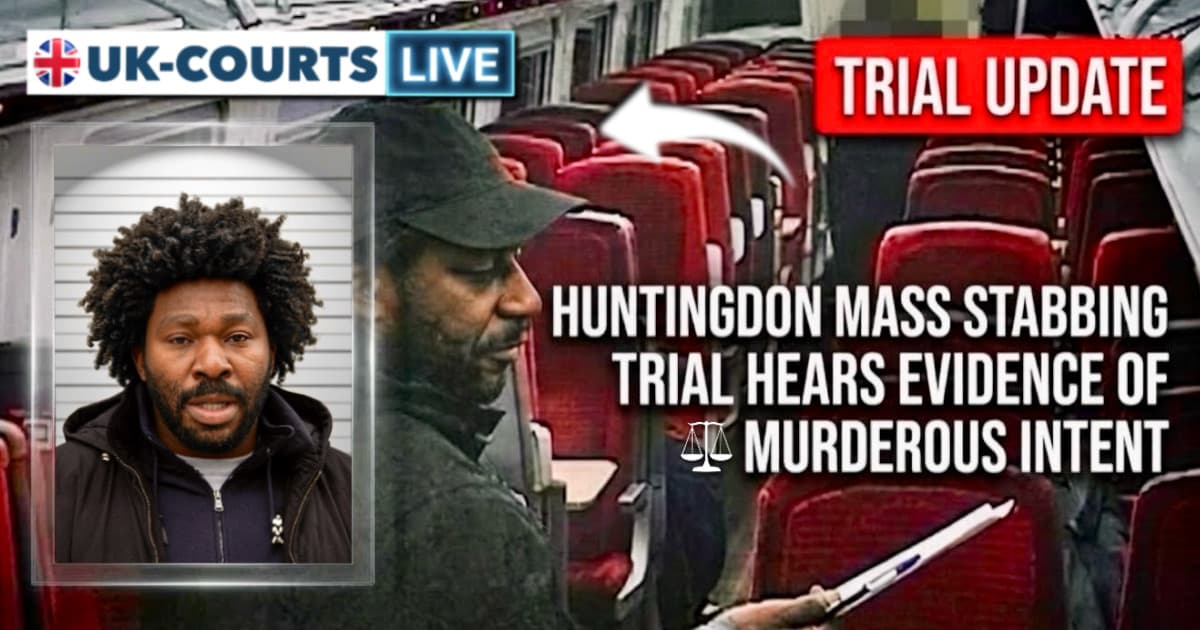
Jury deliberates intent in the trial of Anthony Williams, accused of 14 counts of attempted murder across Peterborough, London DLR, and an LNER express train.

At Cambridge Crown Court, the jury has been considering extensive evidence in the trial of Anthony Williams, who stands accused of fourteen counts of attempted murder following a violent multi-site spree across three different regions.
Williams, thirty-three, of no fixed abode and formerly of Langford Road, Peterborough, faces ten counts of attempted murder relating to a mass stabbing on a London-bound LNER passenger train.
He is further charged with three counts of attempted murder stemming from unprovoked street attacks in Peterborough and a fourteenth count involving a knife attack on a teenager aboard a Docklands Light Railway train in east London.
Presided over by Mr Justice Calver, the trial focuses exclusively on the central issue of intent. Williams has formally entered guilty pleas to alternative charges of wounding with intent to cause grievous bodily harm, possession of a bladed article, affray and common assault.
His defence counsel does not contest that he committed the acts of violence.
However, prosecutor Christopher Paxton KC told the jury that Williams acted with a clear, deliberate intention to end human life, driving a knife into defenceless strangers with full force.
Due to ongoing medical management, Williams is participating in proceedings via a remote videolink from Rampton High Security Hospital in Nottinghamshire.
The Peterborough Footbridge and Street Attacks
The chronology of violent events presented by the prosecution begins in Peterborough, where Williams launched three separate, unprovoked knife attacks over a single afternoon and evening.
The first victim was a fourteen-year-old schoolboy who had met up with a friend to go trick-or-treating. While waiting on a pedestrian footbridge over the River Nene, near Henry Penn Walk, the boy was approached by Williams, who drew a kitchen knife from his waistband.
In a recorded police interview played to the jury, the boy described Williams as having wide-open, unblinking eyes and looking like he was under the influence of drugs or mentally unstable. Williams lunged at the boy with a full-extension thrust to the chest.
by adrenaline, the teenager initially felt only a blunt impact, comparing the sensation to being poked, before realizing the severity of the wound. The boy and his friend fled into nearby undergrowth and hid in bushes to call emergency services.
Shortly thereafter on the same footbridge, Williams targeted Dawid Taborski, who was walking with a friend towards a music event. Taborski testified that a man with an unusually deep voice approached him, repeatedly asking, "Are you involved, are you involved?".
Williams then pulled a knife from a rucksack and lunged towards him. Taborski backed away, shouted at the attacker to step back, and managed to flee unharmed.
A third attack occurred in the Railworld car park in Peterborough. William Ogelby was walking towards a cashpoint when Williams approached and greeted him with the phrase "wagwan".
When Ogelby responded normally, Williams pulled a kitchen knife from his backpack and lunged four times, targeting Ogelby's chest and stomach.
Ogelby jumped backwards to evade the blade before sprinting away, later telling police he genuinely believed he was about to be killed.
Following these street attacks, prosecution evidence showed Williams outside a barbershop in Fletton, Peterborough, swigging from an open alcohol bottle while brandishing a knife, before entering the shop and committing an affray.
The Theft of Weapons and the London DLR Attack
Jurors were shown evidence detailing Williams' movements as he traveled south towards London.
Prosecutors outlined how Williams stopped at an Asda store near Stevenage railway station with the deliberate purpose of stealing a new set of knives, after which he was spotted walking along live railway tracks before being warned off by officers.
In the early hours of the morning, Williams boarded a Docklands Light Railway train in east London. Shortly after the train departed West Silvertown station, Williams fixated on seventeen-year-old Isaiah Idris.
Holding a knife to the teenager's chest, Williams repeatedly shouted, "Are you beefing the devil?" and "Are you the demon?". Williams then slashed Idris across the face, causing severe facial lacerations, before the teenager used his hands to block further incoming strikes.
A fellow passenger, Macarena Lopez, who was returning home from a Halloween gathering, gave a recorded account describing the incident as an apparent psychotic episode or confusion-induced chaos.
She recalled that Williams appeared convinced the teenager was a demonic entity. Lopez noted that when the train pulled into Pontoon Dock station, Williams' demeanour abruptly shifted, describing it as though a switch had been flipped in his brain, causing the erratic violence to stop instantly.
Later that morning, Williams boarded a Northbound train service out of King's Cross.
Off-duty police detention officer Jordan Morley testified via a written statement that as Williams walked down the carriage near Hitchin, he randomly spat in Morley's face while staring at him silently.
Williams then sat down several rows ahead before Morley disembarked at Biggleswade and reported the incident to British Transport Police. Williams disembarked at Peterborough at approximately 8:37 am.
Mass Violence Aboard the LNER Express
The central element of the indictment concerns the mass attack aboard an LNER express train traveling from York to London King's Cross.
Williams boarded the service at Peterborough, carrying a hidden bladed weapon.
Shortly after the train departed the station, Williams moved into carriage J and initiated an unprovoked stabbing spree.
The first passenger targeted was Jonathan Gjoshe, who was sitting in carriage J checking his mobile phone. Gjoshe made brief eye contact with Williams, initially assuming he was an acquaintance.
Williams drew a knife and stabbed Gjoshe in a slow, deliberate motion. Gjoshe described how, as shock and adrenaline set in, he jumped over a table, saw his arm drenched in blood, and ran through the train shouting to fellow passengers, "I've been stabbed, run!".
Gjoshe recalled that several passengers initially remained in their seats, assuming the warning was a practical joke, before the severity of the situation became clear.
Gjoshe was hospitalised for four days, repeatedly asking medical staff if he was going to survive.
As Williams moved through the carriages, horror unfolded rapidly. Passenger Sachin Balakrishnan heard screaming and saw people climbing over seats to escape.
Williams pursued fleeing passengers down the aisles. Balakrishnan was cornered and stabbed in the forearm and chest.
The blade penetrated his chest cavity, puncturing a lung and missing his heart by mere centimeters.
Seventy-three-year-old David Presland was knocked to the floor during the stampede. While on his hands and knees, defenceless on the carriage floor, Williams stood over him in black clothing and stabbed him repeatedly in the back.
CCTV shown to the jury captured Presland raising a hand from the floor to ward off the blade. Another passenger, Kevin Deely, rushed to Presland's assistance.
Deely shouted at Williams, "You don't have to do this!", before throwing a piece of luggage at the attacker to create a barrier. Deely was stabbed in the head and torso.
As Deely bled profusely, nearby passengers passed items of clothing down the carriage to form makeshift bandages.
Passenger Resistance and Crew Heroism
Faced with a lethal attack inside a moving train, passengers and staff improvised weapons and barriers to protect themselves and others.
Scott Bletcher, who was returning home from Christmas shopping in Newark, was stabbed in the head, arm and chest after seeing Williams holding a knife at eye level.
Bletcher managed to retreat and place a 999 call from a locked toilet, telling the operator, "I've been stabbed in the head, there's a man who's gone berserk on a train".
Passenger Michael Paffett described how people overturned a heavy catering trolley across the aisle to form a barricade.
During the confrontation, another passenger threw a full-size toaster from the buffet car directly at Williams to keep him at bay.
Football supporter Stephen Crean, wearing Nottingham Forest clothing, had just purchased a meal deal in the buffet car when Williams confronted him, drawing a blade and asking, "Do you want to die?".
Crean and others attempted to force the buffet car door shut. When the door clicked shut, Crean launched himself directly at Williams to disarm him.
Crean described the physical struggle as an erratic grapple, stating they were "all over the place" as he attempted to control the knife.
Crean suffered severe cuts to his hands as Williams twisted the blade. Crean eventually retreated into a toilet, dialed 999, and remained inside until police boarded the train.
Another passenger, Scott Green, was traveling with his cockapoo dog, Poppy, when he felt a sharp jab into his side.
Realising he was being stabbed, Green grabbed the knife blade with his bare hands in a bid to disarm Williams.
During the struggle, Green's dog went into an active attack mode, barking aggressively and startling Williams. The distraction forced Williams to retreat.
Prosecution notes revealed that Williams had previously experienced a dog bite incident, which may have contributed to his sudden retreat.
A female passenger pulled Green into an adjacent toilet for safety.
Green described Williams as having a completely blank, detached expression, stating he looked "dead in the eyes".
Raza Aslam described how train staff member Samir Zitouni acted with extraordinary courage, moving continuously back and forth through the carriages to gather defensive items and assist passengers.
Aslam helped a mother and child lock themselves safely inside a toilet cubicle before being confronted by Williams. Aslam noted that Williams maintained a unnerving, calm demeanor, displaying visible pleasure and contempt as he attacked.
Zitouni armed himself with a metal frying pan from the kitchen and confronted Williams directly to shield passengers.
During the confrontation, Zitouni threw objects, including a woman's Zimmer frame, at the armed attacker.
Williams attacked Zitouni, stabbing him multiple times. Zitouni suffered double punctured lungs and catastrophic internal bleeding, requiring emergency intervention, four blood transfusions, chest drains and mechanical ventilation.
CCTV footage shown in court captured Zitouni, wearing a blood-soaked uniform shirt, collapsing in the gap between the train and the platform after the train driver executed an emergency unscheduled stop at Huntingdon station.
The entire violent incident aboard the LNER train lasted approximately five minutes, during which ten men were stabbed or injured.
Legal Issues and Ongoing Proceedings
In his opening address, Christopher Paxton KC stressed to the jury that the minor nature of some physical wounds does not detract from the prosecution's case that Williams intended to kill.
The prosecution submits that wielding a lethal weapon against defenceless individuals, targeting vital body areas such as the chest, head and back, demonstrates an unequivocal intent to commit murder.
The defence relies on Williams' mental state at the time of the offences, arguing that while he carried out the physical attacks, his condition degraded his capacity to form the specific legal intent required for attempted murder.
The trial before Mr Justice Calver continues at Cambridge Crown Court.
Follow UK Courts Live
Every hearing as it happens, on the network you use.