Why RAF Fairford Terror Bail Decision Exploded Online Misinformation
Legal analysis of the RAF Fairford counter-terrorism investigation and why police bail decisions align strictly with the Bail Act 1976.

If there is one thing that reliably raises my blood pressure faster than a poorly prepared prosecution bundle, it is the spectacle of social media commentators suddenly discovering the UK justice system and deciding they understand it better than those of us who have spent decades in the trenches of the criminal courts. Over the past week the internet has collectively decided that the bailing of five young men arrested near RAF Fairford is the ultimate smoking gun for a two-tier justice system. The narrative is as viral as it is legally illiterate, asking how these five suspected terrorists can be allowed to wander the streets on police bail while high-profile figures like Danny Thomas are remanded in custody. The outrage is deafening but it is also entirely misplaced and born out of a fundamental misunderstanding of both the Bail Act 1976 and the stark realities of counter-terrorism operations.
Let us step back from the digital hysteria and look at the cold, unvarnished mechanics of this case through the lens of actual legal practice. When the initial news broke of five men arrested in the dead of night near a forward operating location used by US bombers it sounded like a plot lifted directly from a geopolitical thriller. The immediate assumption, heavily fanned by certain corners of the press, was that a highly coordinated terror cell had been intercepted mid-strike. But then the details began to leak and to any experienced court correspondent the narrative immediately began to unravel.
First we have the white vans. Forensic searches yielded petrol cans and siphoning equipment but absolutely no explosives.
Then came the rather embarrassing revelation that one of the suspects had actually dialled 999 himself an hour before a local farmer raised the alarm. Calling the emergency services to announce your presence outside a heavily fortified military installation is simply not standard operating procedure for a state-sponsored terror squad.
Then came the operational pivot that broke the internet when the five were released on police bail while a 25-year-old UK-Iranian dual national was simultaneously swept up in Westminster by Counter Terrorism Command under Section 5 of the Terrorism Act.
To the untrained eye bailing the five looks like state leniency. To anyone who understands how the Crown Prosecution Service and Counter Terrorism Policing operate it is a glaring neon sign pointing to a proxy operation.
You do not grant police bail to individuals you genuinely believe possess the mens rea—the guilty mind—to carry out a terror attack on a military base. If there is even a fractional risk that a suspect is an active threat to national security they are held in extended detention or remanded to the highest security estate available. The police simply do not take chances with live terrorists.
The fact that they were bailed tells us almost everything we need to know about how the police view their actual culpability. Intelligence agencies have warned for years about hostile state actors using low-level, local criminals as unwitting cut-outs.
Looking purely at the publicly available evidence of fuel containers and a complete lack of explosives points far more directly toward a group who believed they were embarking on a bit of nocturnal diesel theft.
This is a lucrative criminal enterprise given current fuel prices and supply shortages. If they were duped into creating a smokescreen for a sophisticated handler and genuinely believed they were just there to siphon fuel then slapping them with terror charges is legally unsustainable. Without proof of terrorist intent the Crown cannot lay charges under the Terrorism Act.
Any eventual legal exposure would instead sit firmly in the realm of summary property or trespass offences such as going equipped to steal. That is precisely why Counter Terrorism Policing’s Senior National Coordinator pointedly described the decision to bail the group as an investigative decision grounded in experience and strategy.
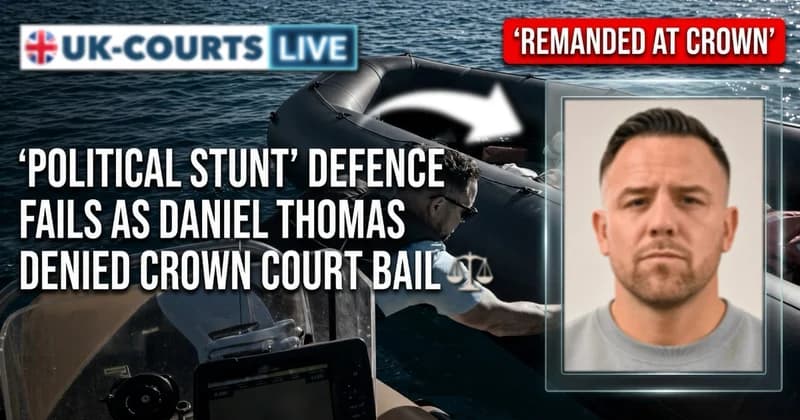
This brings us neatly back to the internet's favourite false equivalence and the comparison to defendants held on remand such as Danny Thomas.
Comparing a complex counter-terrorism proxy investigation to standard criminal remands betrays a complete ignorance of statutory law. Under the Bail Act 1976 courts do not evaluate bail based on public outrage or political optics.
Remand in custody is governed by specific statutory grounds which include a demonstrated risk that the defendant will abscond, commit further serious offences or interfere with witnesses.
This is often weighed against an established record of non-compliance or active reoffending while on bail. Where detectives establish that a group of suspects lacked knowledge of a wider terror conspiracy and present no ongoing security threat, keeping them locked in high-security remand would be legally indefensible and immediately vulnerable to judicial challenge.
Justice is not dispensed via social media polls and those of us who value the rule of law should be incredibly thankful for that fact.