Two Men Convicted of Sir Keir Starmer Arson Conspiracy Plot
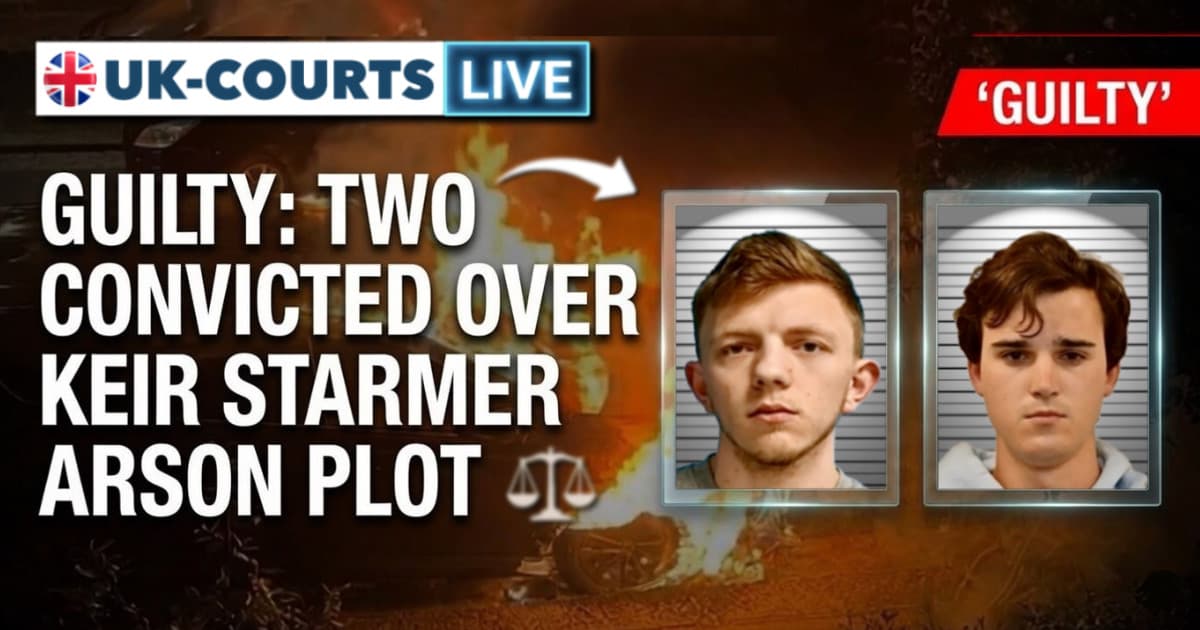
Two men have been found guilty at the Old Bailey of conspiring to launch a series of targeted arson attacks on a vehicle and residential properties directly connected to Prime Minister Sir Keir Starmer.

Two men have been found guilty at the Old Bailey of conspiring to launch a series of targeted arson attacks on a vehicle and residential properties directly connected to Prime Minister Sir Keir Starmer.
Following a comprehensive trial, an Old Bailey jury convicted 22-year-old Ukrainian national Roman Lavrynovych and 27-year-old Ukrainian-born Romanian national Stanislav Carpiuc for their roles in the coordinated firebombing plot that took place in May 2025.
A third co-defendant, 35-year-old Petro Pochynok, was formally cleared by the jury and found not guilty of the conspiracy charge.
All three men, who resided in London, had consistently denied conspiring together and "with others" to damage property by fire between the dates of April 1 and May 13, 2025.
The Verdicts and Specific Charges
The jury returned mixed verdicts regarding the specific indictments faced by the primary operative:
Conspiracy to Commit Arson: Both Roman Lavrynovych and Stanislav Carpiuc were convicted of the overarching conspiracy to damage property by fire.
Arson with Intent to Endanger Life: Lavrynovych was formally acquitted by the jury on two counts of damaging property by fire with intent to endanger life relating to the incidents on May 11 and 12, 2025.
Reckless Arson: In alternative counts, the jury convicted Lavrynovych of damaging property by fire being reckless as to whether life would be endangered.
Full Acquittal: Petro Pochynok was completely vindicated of all criminal liability after the jury rejected the Crown's conspiracy case against him.
Timeline of the Arson Attacks (May 2025)
The prosecution outlined a fast-moving, escalating campaign of arson concentrated across north London over the course of five days in May 2025, targeting assets currently or previously linked to Sir Keir Starmer.
Thursday, May 8, 2025: A Toyota car previously owned by Sir Keir Starmer was set on fire on a street he formerly lived on in Kentish Town.
Sunday, May 11, 2025: A fire was discovered at a block of flats in nearby Islington, where the Prime Minister had resided several years prior.
Monday, May 12, 2025: A fire was intentionally lit at the entrance of Sir Keir’s Kentish Town home. The property was being rented by his sister-in-law, who was inside with her family.
Online Recruitment and the Role of "El Money"
The evidentiary framework presented by the Crown focused heavily on the digital footprints connecting Lavrynovych to an elusive, online coordinator.
The court heard that Lavrynovych was systematically recruited via the encrypted messaging platform Telegram by a Russian-speaking user operating under the alias "EL", whom the defendant had saved in his contacts as "El Money".
Before escalating to arson, "El Money" had previously tasked Lavrynovych with minor operations, including putting up far-right posters around London.
Lavrynovych was promised payments totaling thousands of pounds to carry out the subsequent arson attacks, though the court heard he never actually received the promised funds.
Post-Attack Telegram Correspondences
Immediately following the final arson attack on the Kentish Town residence on May 12, "El Money" sent a series of urgent messages to Lavrynovych instructing him to destroy evidence and flee:
"There is news, you'll get crypto."
"You need to throw away the clothes."
"Look, you attacked the home of a very high-ranking person in Britain. I'll send you money, you need to leave the city."
Despite the explicit instructions to leave London, metropolitan police officers intercepted and arrested Lavrynovych just hours after the final text exchange.
Ideology and Motivations Dismissed
Throughout the trial, the prosecution emphasized to the jury that the geopolitical or political identities of those coordinating the attacks from behind the scenes were legally irrelevant to the determination of guilt.
Prosecuting counsel told jurors that it was explicitly "no part of your considerations" to decipher the true identity of "El Money" or establish what specific reasons or state motivations he may have harbored for directing the coordinates of the defendants.
Furthermore, evidence showed that the defendants themselves did not demonstrate any coherent political, personal, or ideological motivation.
The prosecution maintained that under law, it remained entirely immaterial whether the defendants explicitly knew the targeted properties belonged to or were connected to the Prime Minister, or whether that association formed any part of their personal drive to commit the offenses.
Legal Arguments in the Absence of the Jury
A significant legal battle occurred away from the presence of the jury, where defense lawyers for Lavrynovych attempted to shift the focus onto the hidden handler's identity.
The defense team launched a formal application demanding that the prosecution disclose wider intelligence held on "El Money"—specifically seeking information regarding whether the handler was directly associated with foreign intelligence services, functioned as a state informant, or was operating from a specific international base.
The Duress Defence and "Tradecraft" Claims
The disclosure application was central to Lavrynovych's core defense strategy, in which he claimed he was acting entirely under duress due to feeling intensely intimidated by his online handler.
Defense barristers argued that the specific manipulation techniques, operational security instructions, and commands utilized by "El Money" were distinctly "redolent of tradecraft"—the highly specialized operational techniques typically deployed by trained espionage and intelligence services.
The Judge's Ruling
The presiding judge flatly refused the defense application, ruling that any wider background material regarding the handler's identity or state apparatus connections was "wholly irrelevant" to the factual issues the jury had to decide.
The judge noted that because Lavrynovych objectively knew absolutely nothing about the handler’s actual institutional connections or intelligence background at the time the offenses were committed, the requested state intelligence could only serve to construct a "retrospective assessment" that a threat existed, rather than proving the defendant was operating under an immediate, operating duress during the events of May 2025.
Following the receipt of the guilty verdicts, both Lavrynovych and Carpiuc have been remanded in custody ahead of their formal sentencing hearing.