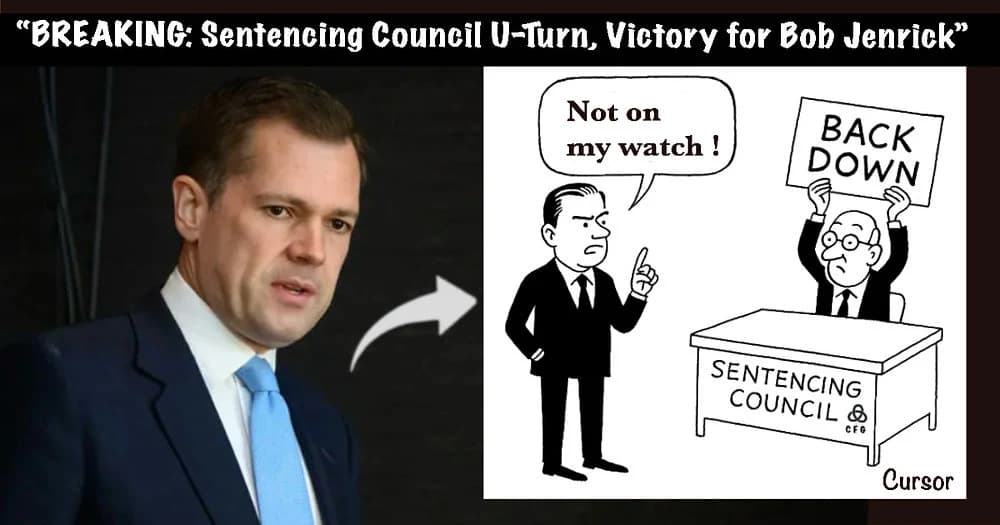
BREAKING: Sentencing Council U-turn is a victory for Robert Jenrick
BREAKING: Sentencing Council U-turn is a victory for Robert Jenrick The Sentencing Council’s climbdown haltstwo-tier justicetwo-tier justicein its tracks—thanks to Robert Jenrick’s relentless fight againstdiscriminatory sentencing rulesdiscriminatory sentencing rules! By Ben FreemanBy Ben Freeman...
BREAKING: Sentencing Council U-turn is a victory for Robert Jenrick
The Sentencing Council’s climbdown haltstwo-tier justicetwo-tier justicein its tracks—thanks to Robert Jenrick’s relentless fight againstdiscriminatory sentencing rulesdiscriminatory sentencing rules!
By Ben FreemanBy Ben Freeman
The Sentencing Council has executed adramatic U-turndramatic U-turn,shelving its controversialshelving its controversial‘two-tier justice’‘two-tier justice’guidance following intense political pressure. The climbdown, which came just hours before the guidelines were set to take effect, marks asignificant victorysignificant victoryfor Shadow Justice SecretaryRobert JenrickRobert Jenrickand an intervention by Justice Secretary Shabana Mahmood.
Their joint efforts—though originating from opposite sides of the political divide—forced the Council into aneleventh-hour retreateleventh-hour retreat, averting what critics had branded an unprecedented step toward discriminatory sentencing in England and Wales.
Under the now-suspended guidance, magistrates and judges would have been required to considerpre-sentence reportspre-sentence reportsbefore handing down custodial sentences to individuals from ethnic, religious, or cultural minority backgrounds, as well as women, young adults, and abuse survivors.
While proponents of the scheme claimed it was necessary to correct sentencing disparities, opponents, including a growing faction within government and the legal profession, lambasted it as an attempt toinstitutionalise leniencyinstitutionalise leniencyfor certain demographics while creating asentencing hierarchysentencing hierarchythat left others—most notably white Christian males—at a systemic disadvantage.
The row between ministers and theSentencing CouncilSentencing CouncilSentencing Councilescalated rapidly. The independent judicial body, which sets sentencing guidelines for courts, initially refused to amend or delay the new framework, despite mounting criticism. But that stance quickly becameuntenableuntenableafter Mahmood intervened, describing the proposed measures as“unacceptable”“unacceptable”and warning that they amounted to“differential treatment before the law.”“differential treatment before the law.”
No sooner had the Council dismissed her concerns thanNo. 10 signalled its own oppositionNo. 10 signalled its own opposition, making clear that the government was prepared to introduce emergency legislation to block the move. This, coupled withJenrick’s relentless attacksJenrick’s relentless attackson what he dubbed“two-tier justice,”“two-tier justice,”turned the tide.
Robert Jenrick, once a mere irritant to the Council, became thearchitect of its public undoingarchitect of its public undoing. His rhetoric was as sharp as it was relentless, accusing the body of seeking to transform the judiciary into an ideological enforcement wing, turning judges
In an uncharacteristically aggressive opposition campaign, he took the fight beyond Westminster’s walls, even orchestrating the now-infamous‘Two-Tier Keir’ projection‘Two-Tier Keir’ projectiononto the Ministry of Justice—an unsubtle but effective jab at Labour’s prior acquiescence to the proposals.
The government initially sought toundermine himundermine himby pointing out that similar draft guidelines had been floated under Conservative rule. However,Jenrick’s tenacityJenrick’s tenacityand ability tooutmanoeuvre his opponentsoutmanoeuvre his opponentsensured he emerged as the political victor when the Councilfinally capitulatedfinally capitulated.
That reversal, however, was not born of sudden enlightenment. With Parliament primed to legislate against them andwidespread criticism making their position untenablewidespread criticism making their position untenable, the Council’s options had narrowed tosurrender or an outright legislative defeatsurrender or an outright legislative defeat. The choice was obvious.
Its abrupt volte-face, described bySuella BravermanSuella Bravermanas“an embarrassing U-turn just days after facing down the Justice Secretary,”“an embarrassing U-turn just days after facing down the Justice Secretary,”is now being framed by many as proof of the Council’s increasing detachment from both political reality and public confidence in the judiciary.
Braverman was scathing in her condemnation of the Council, calling the abandoned guidelines
she further added
The former Home Secretary went further, branding the Sentencing Council arogue entity that should be scrapped altogetherrogue entity that should be scrapped altogether.
The fallout from this affair is unlikely to end with the shelving of the guidance. The Sentencing Council has suffered what can only be described as ahumiliating rebukehumiliating rebuke, with its credibility among ministers in tatters and its future autonomy in serious doubt. The government has already hinted at abroader reviewbroader reviewof the Council’s role, withNo. 10 confirmingNo. 10 confirmingthat the Prime Minister is considering“the role of the Sentencing Council more broadly.”“the role of the Sentencing Council more broadly.”Translation: this was not a mere policy disagreement—it was a full-blown challenge to theCouncil’s authorityCouncil’s authority, and one which it decisively lost.
What emerges from this episode is a striking contrast in political fortunes. For Robert Jenrick, it is anundisputed triumphundisputed triumph. Not only did he lead the charge against the guidance, but he also outmanoeuvred his Labour counterparts, forcing them into anawkward retreatawkward retreat. He has shown that he is more than willing to engage in guerrilla opposition tactics, a skill that may serve him well in future leadership calculations.
For theSentencing CouncilSentencing Council, the outlook is far bleaker. It has been publicly defied, politically overruled, and legally cornered. An institution that prides itself onjudicial independencejudicial independencehas now been reminded—very forcefully—that in a democracy,no public body operates beyond accountabilityno public body operates beyond accountability. It set out to make the judiciary more ‘equitable’; instead, it ended up making a highly compelling case for its own reform, instead.
And as for common sense? For once, it appears to have had itsday in courtday in court—andWONWON!
Bénédict Tarot FreemanBénédict Tarot Freeman
Editor-at-LargeEditor-at-LargeEditor-at-Large
VPN CITY-DESKVPN CITY-DESK