
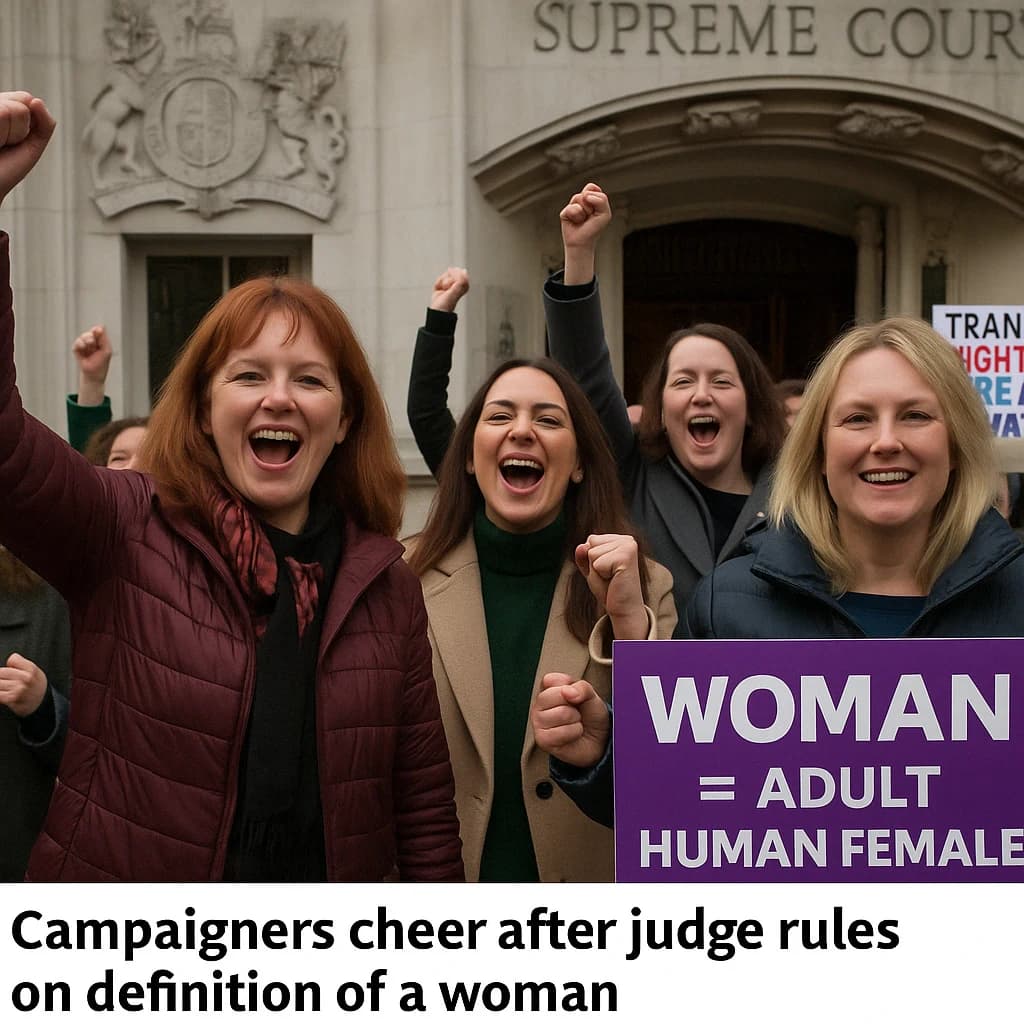
UK Supreme Court Delivers Legal Thunderbolt as Judges Rule: Sex Is Biological, Not Changeable.
The UK Supreme Court has dropped a judicial bombshell ruling unanimously that under the Equality Act 2010, the terms “woman” and “sex” refer to biological sex only, not gender identity or legal reassignment. The 88-page ruling concludes that trans women even those with a Gender Recognition...
The UK Supreme Court has dropped a judicial bombshell ruling unanimously that under the Equality Act 2010, the terms “woman” and “sex” refer to biological sex only, not gender identity or legal reassignment.
The 88-page ruling concludes that trans women even those with a Gender Recognition Certificate (GRC) cannot be legally classified as women under the Equality Act. The case, brought by For Women Scotland, has stunned political and activist circles, with celebrations erupting on one side and despair on the other.
"This confirms what we've argued all along that sex matters," said For Women Scotland in a statement. "It should not be redefined by stealth."
RESOUNDING AND UNANIMOUS. The Court Makes Definition Crystal Clear
Legal scholar Dr Michael Foran, whose legal writing was cited in court, told BBC Radio 4's PM programme:
“The decision itself is attempting to answer a question about what the words sex, man and woman mean in the Equality Act. And the Supreme Court has resoundingly and unanimously said that those words are tied to biology, not GRCs.”
He added:
“This judgement has made it clear that it is lawful to exclude biological males from female-only services, where those female-only services are lawful under the Equality Act. Most public services like toilets will be.”
“Today, Trans Rights Died” — India Willoughby.
TV presenter and trans campaigner India Willoughby issued a searing response in her Metro column:
“I believe today was the day that transgender rights in the UK died. I was numb in shock after listening to a judge effectively strip me of my rights as a woman under the Equality Act.”
Adding:
“Telling me, and others like me, that we are not women is a historical injustice. I had to fight for it, and nobody will ever take that away from me.”
EHRC WELCOMES RULING — Says It Resolves “Significant” Legal Confusion
The Equality and Human Rights Commission (EHRC), the UK’s top equalities watchdog, also welcomed the judgment. Chair Baroness Kishwer Falkner released a statement:
“This judgment resolves the difficulties we highlighted... including the challenges faced by those seeking to maintain single-sex spaces and the rights of same-sex attracted persons to form associations.”
She added:
“We will be working at pace to incorporate the implications of this judgment into our updated code of practice, expected to be laid before Parliament before the summer recess.”
Shock Stats, Real-World Impacts
Just 8,464 people across the UK hold a GRC, yet this tiny group was at the heart of a ruling that will shape law, policy, and public space access for over 34 million women and girls.
The judgment will directly impact:
- Toilets and changing rooms
- Women’s refuges
- Female-only hospital wards
- Gender-specific quotas and political shortlists
“It’s the Right Way Forward” — Olympian Weighs In
Susan Egelstaff, former Olympian and columnist, told BBC Radio Scotland:
“In a sporting context, I think it is right that trans women aren't able to compete against biological women in the female category.”
She added:
“Individuals should be allowed to live how they want, dress how they want, do what they want — but there are some areas I think should be protected for biological females. Sport is one of those areas.”
“Where Do We Go Now?” Trans Advocates Fear Exclusion
Vic Valentine, manager at Scottish Trans, said the ruling could leave trans people excluded from both men’s and women’s spaces:
“Trans people need to be able to recover on hospital wards, use toilets, go swimming and access services just like anyone else.”
“This judgement seems to suggest that there will be times where trans people can be excluded from both men’s and women’s spaces and services. It is hard to understand where we would then be expected to go.”
Politicians React
Kemi Badenoch, Secretary of State for Women and Equalities, said on social media:
“Saying 'trans women are women' was never true in fact, and isn't true in law either.”
Meanwhile, Shona Robison, Scotland’s Finance Secretary, responded:
“We acted in good faith. There has been inconsistency between the 2010 Equality Act and the 2004 Gender Recognition Act... this ruling now brings clarity.”
MP Rosie Duffield, long-time critic of gender self-ID, called the ruling a “relief”:
“This is great for women particularly for lesbians who want to meet in a single-sex safe space together and exclude men.”
What Does It Actually Mean?
Despite the firestorm, the Supreme Court was clear: trans people still have protections under the Equality Act through the separate protected characteristic of gender reassignment.
Lord Hodge stressed that trans people are a “vulnerable and often harassed minority,” and said they remain protected from harassment, direct discrimination, and unfair treatment. However, having a GRC does not grant access to sex-based rights or spaces designated for biological women unless otherwise stated in law.
What Happens Next?
The EHRC is already rewriting its official guidance to reflect the ruling. Public bodies, schools, councils, and companies across the UK will need to review their policies and determine who can and cannot access sex-specific provisions.
Legal experts say the ruling could prompt further litigation especially in education, healthcare, and sport if institutions do not adapt to the court's interpretation.
FINAL WORD
This isn’t just a legal victory, it’s a cultural turning point.
The UK’s top judges have spoken: woman means woman, and that means biological female. Trans rights continue, but they do not override the sex-based protections Parliament enacted to defend women and girls.
Whatever your stance, the message is clear: the law has now drawn a bold red line. https://supremecourt.uk/uploads/uksc_2024_0042_judgment_aea6c48cee.pdf