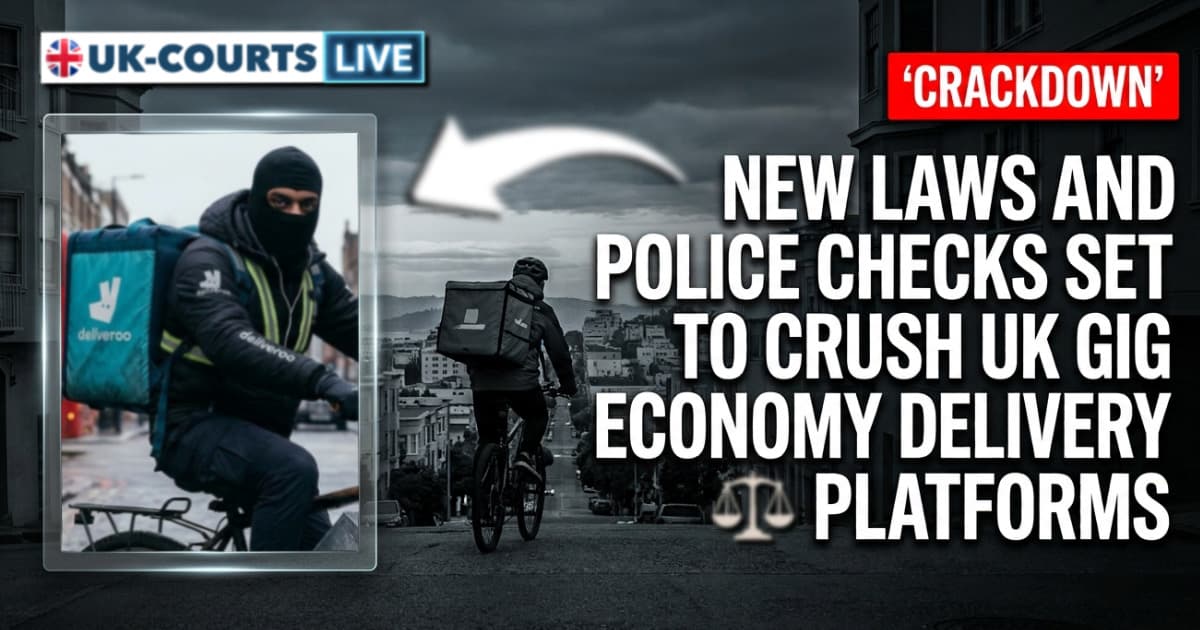
Home Office October Crackdown may Trigger Massive UK Gig Economy Meltdown
The Home Office’s Right to Work crackdown on October 1, targeting delivery platforms, will trigger an immediate 35% reduction in the UK courier workforce.

For the past five years UK citizens have been living in an artificial convenience bubble. The "instant economy" wasn't just a triumph of tech optimisation; it was heavily subsidised by a distorted labour market, unchecked tax evasion and unregulated vehicle speeds. Now that era is coming to a violent, legally enforced halt.
When the Home Office's updated Code of Practice goes into effect on 1 October 2026 the Right to Work regime will expand far beyond traditional payroll employees.
It will legally ensnare worker contracts, individual subcontractors, substitution clauses and online matching platforms.
For tech giants like Uber Eats and Deliveroo the penalties for failing to adapt are existential: up to £60,000 per illegal worker or five years in prison.
Industry forecasts now predict a devastating reality. As police forces clamp down on illegal electric delivery bikes nationwide and the Home Office tightens its strict liability regime, delivery platforms could face a virtually immediate 35% reduction in their rider workforce across the UK.
The Legal Trap: A £60,000 Hammer
Right to work checks have traditionally been associated with direct employment. A new employee joins the business, HR carries out the prescribed check before work starts, records are retained and a follow-up check is diarised. That model is no longer enough for businesses in construction, warehousing, beauty, hospitality and courier services.
The government's direction is clear: businesses should not be able to avoid illegal working obligations simply because labour is described as self-employed, casual or platform-based. By closing the "substitution" loophole the government is forcing these tech companies to act exactly like traditional employers.
In practical terms platforms must now know exactly who is doing the work, who checked their right to work and whether the contractual documents support full compliance. A board-level compliance issue has replaced a simple HR administration task.
The E-Bike Crackdown: Gravity and the Algorithm
This immigration crackdown is running in tandem with a nationwide policing strategy targeting the physical tools of the trade. Across British cities joint task forces are exploiting natural topography to trap illegal riders.
By setting up checkpoints on steep hills on major urban arteries police can easily identify modified e-bikes that hum uphill without the rider pedalling.
These 1000W+ throttle-bikes are legally classified as unregistered, uninsured motor vehicles. The rider faces immediate vehicle seizure and a £300 fine.
This policing strategy acts as a backdoor funding mechanism for the government, creating a highly profitable enforcement loop that can be scaled nationally to fund further regional task forces.
But the fallout from these illegal e-bikes goes deeper than traffic violations; they have fundamentally corrupted the delivery apps' algorithms.
Machine learning models have spent years tracking unrestricted e-bikes flying up hills at 30 mph, setting that illegal velocity as the standard baseline performance for a route.
When a legitimate UK citizen logs on using a legal 250W e-bike strictly capped at 15.5 mph they are walking into a trap. The algorithm automatically flags them as slow, depressing their rating and starving them of orders.
The Economic Friction: Why British Workers Cannot Fill the Gap
The tech giants cannot simply activate waitlists of legal British workers to plug the impending 35% gap because the economics no longer work.
The gig economy's current piece-rate pay model of £2.50 to £4.00 per drop was effectively subsidised by a workforce with artificially deflated living costs and zero tax footprints.
An illegal worker living in a government-paid hotel or a crowded HMO pays no rent, no bills and no tax. When they take home £250 a week it is pure disposable income.
By contrast a compliant UK citizen factoring in rent, utilities and tax must earn at least £600 a week to make the work viable over claiming standard benefits.
A legal British worker simply cannot survive on a piece-rate designed for a tax-free, housing-subsidised underground workforce.
The Consumer Impact: The Death of the "15-Minute Panic Drop"
For busy households nationwide ordering a missing ingredient from Tesco Whoosh or a late-night Sainsbury's shop has become a thoughtless reflex. That reflex is about to get a lot more painful.
Metric | The Distorted Baseline (Past 5 Years) | The Post-October Reality |
|---|---|---|
Average Delivery Time | 15–20 mins (Fuelled by 30 mph illegal rigs) | 35–50 mins (The physical reality of legal e-bikes) |
Delivery Cost | £1.99 – £3.99 | £6.00 – £9.00+ (Reflecting a viable UK wage) |
App Availability | Near 100% instant matching | Frequent peak-time "No Riders Available" blackouts |
The "Grocery Mission" | Casual top-up (milk, bread, biscuits) | High-value, pre-planned convenience |
The Friction Shock:
When an emergency pint of milk costs an extra £7 in fees and takes 45 minutes to arrive the economic calculus changes. The consumer will do what they did a decade ago: put on a jacket and walk to the local corner shop.
Because the algorithm will no longer have an oversupply of hyper-fast riders willing to take sub-viable fees apps will have to throttle demand. During a rainy Friday night rush consumers will open their apps only to find their favourite restaurants and local supermarkets completely greyed out.
The Corporate Fallout: Supermarket Backlash and Corporate Fleets
The delivery giants are caught in a brutal pincer movement between statutory compliance and massive volume contraction. Their entire business valuation is built on transaction volume.
British households are already highly price-sensitive due to years of food inflation, with over 60% viewing supermarket meal bundles as better value than takeaways.
If delivery fees double to pay for compliant UK labour impulse orders will crater. The platforms will see a massive drop-off in their core user base, leaving only a premium tier of affluent users.
Supermarkets like Tesco, Sainsbury's and the Co-op have heavily integrated these apps into their "Quick Commerce" strategies to monetise their local store networks.
If fulfilment rates plummet and furious customers demand refunds for late, melted or missing items the supermarket giants will turn the screws on the delivery companies.
They will either demand lower commission rates to protect their brands or pull their last-mile logistics back in-house using dedicated electric fleets.
To completely insulate themselves from the catastrophic £60,000 legal threat of account-sharing platforms will eventually have to abandon the "bring your own vehicle" freelance model in major UK cities.
The future will likely see a transition to centralised hubs where pre-vetted, legally employed riders check out corporate-owned, digitally locked and legally compliant e-bikes after a biometric scan.
The Ultimate Irony
The "wild west" era of the freelance gig economy is about to be replaced by a structured, highly regulated and exponentially more expensive corporate logistics network.
The ultimate irony of the October crackdown is that by trying to clean up the gig economy the government is going to expose an uncomfortable truth: the current pricing model of on-demand delivery was never actually sustainable in a law-abiding society.