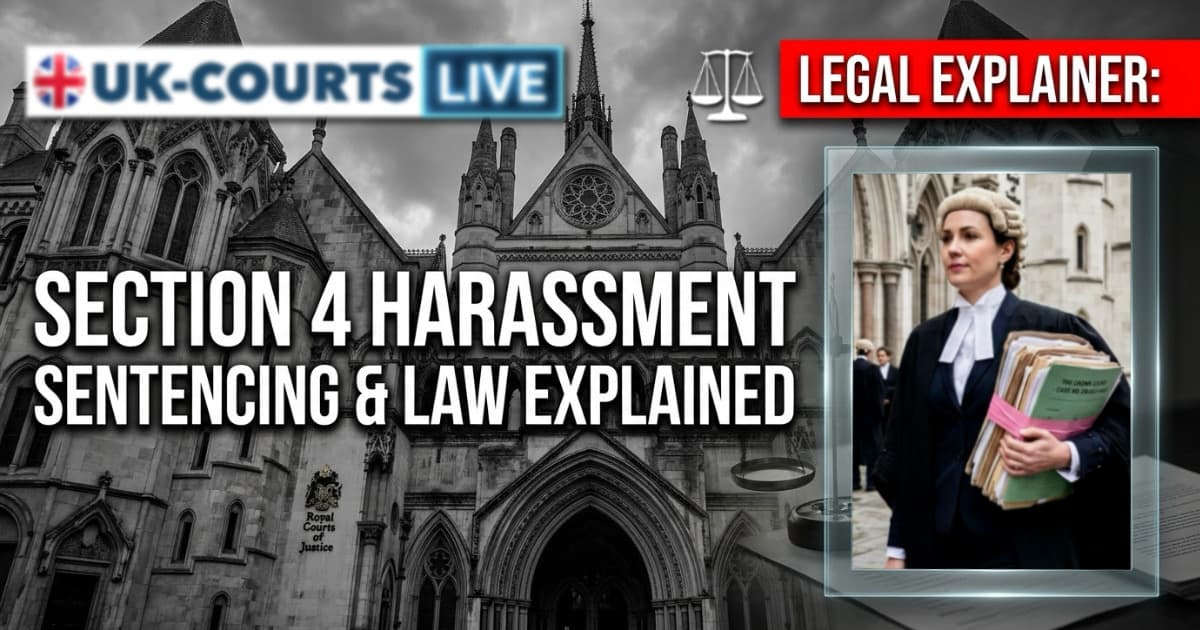
Section 4 Harassment Explained: Law, Sentencing Guidelines, and Restraining Orders
A legal analysis of Section 4 harassment causing fear of violence, detailing maximum sentences, aggravating features, and judicial powers under UK law…

With so much recent interest in the crime of harassment causing fear of violence, we thought that we would take this opportunity to give you a brief run-down of what it is, how it works and what likely sentences could be for someone convicted of it.
Section 4 of the Protection from Harassment Act 1997 creates a serious criminal offence where a person pursues a course of conduct that causes another to fear on at least two occasions that violence will be used against them.
To secure a conviction, the prosecution must prove that the defendant engaged in a pattern of behaviour knowing or ought reasonably to have known that their actions would produce genuine apprehension of physical harm.
Unlike summary offences which carry lower penalties, a charge under Section 4 reflects the severe psychological toll and intimidation inherent in targeted campaigns, carrying a statutory maximum penalty of ten years imprisonment upon conviction in the Crown Court.
When courts evaluate sentencing for this offence, they consult definitive guidelines that weigh culpability against harm.
Factors increasing culpability include high levels of planning, the employment of third parties such as private investigators to track individuals and the weaponisation of a large digital audience to direct hostility toward a complainant.
These aggravating features push baseline sentencing brackets upward into the mid-tier of judicial parameters.
Conversely, mitigation frequently centers on the duration and timeline of the conduct. Where a campaign extends across months or years, the relentless nature of the attrition is treated as a major aggravating feature.
However, if the active conduct is compressed into an acute window lasting only a few days, defence advocates can frame the actions as a reactive and highly escalated outburst rather than a calculated long-term stalking enterprise.
While a compressed timeline does not excuse criminal liability, it provides a principled basis for the court to moderate the assessment of persistence.
Weighing these competing factors determines whether an immediate custodial sentence is required or whether rehabilitation and personal mitigation justify a suspended sentence.
Under updated sentencing provisions, custodial terms of up to three years may be suspended in qualifying circumstances.
For an offence where the sentencing bracket sits around eighteen months to two years, the court possesses discretionary power to suspend the term. If the defence successfully highlights the short duration of the offending alongside a lack of previous relevant convictions, a suspended sentence paired with strict rehabilitation requirements remains a distinct possibility.
Beyond imprisonment, sentencing judges possess robust statutory powers under Section 5A of the Protection from Harassment Act to issue comprehensive restraining orders.
When digital platforms and social media channels are exploited to target individuals, courts can craft sweeping prohibitions.
These orders can explicitly ban an offender from publishing material concerning specific complainants or impose absolute prohibitions preventing them from posting content across digital platforms altogether.
Breaching a restraining order is a separate criminal offence carrying up to five years imprisonment, ensuring that any subsequent digital defiance results in immediate penal consequences.
Follow UK Courts Live
Every hearing as it happens, on the network you use.