
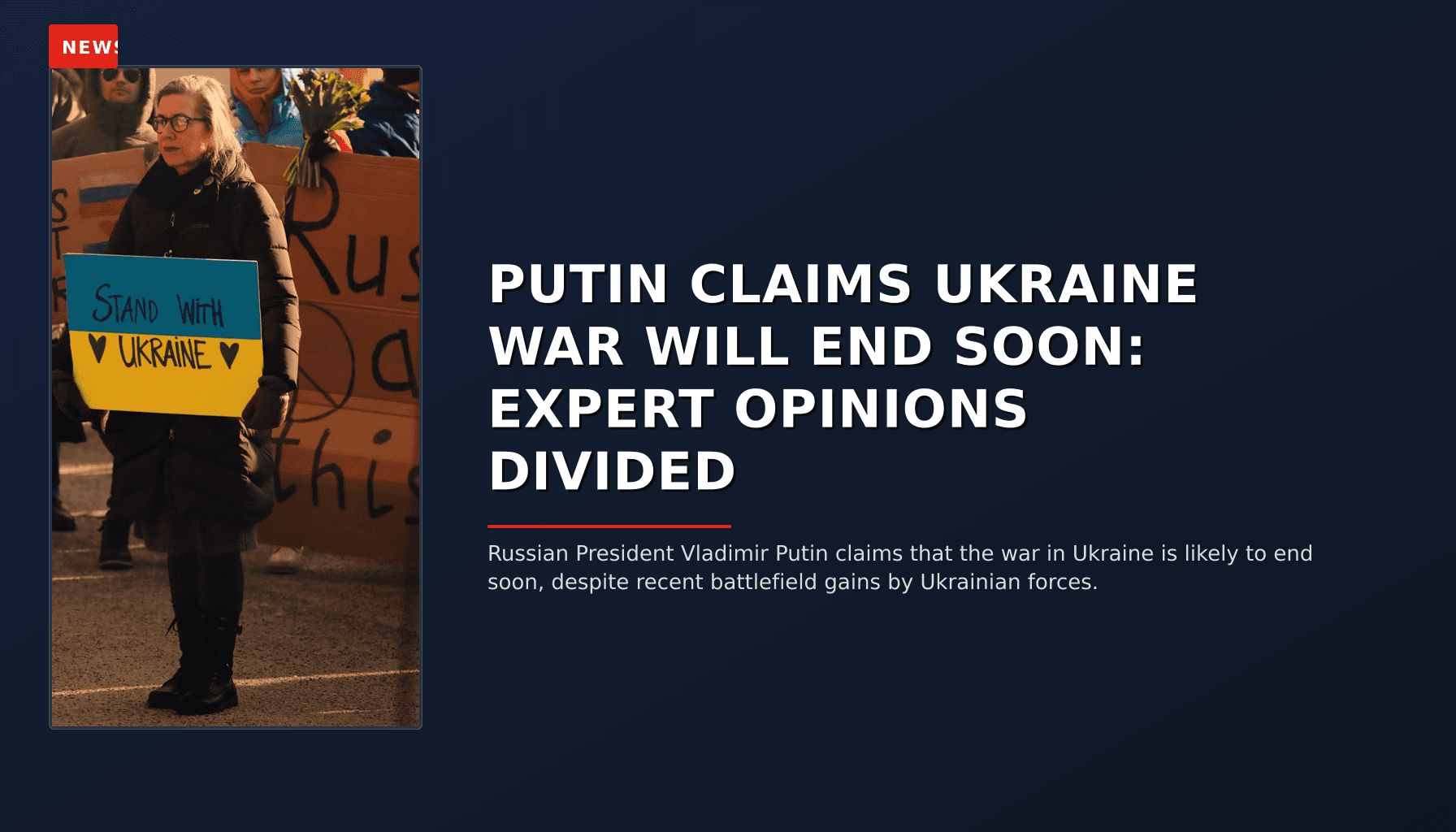
PUTIN CLAIMS UKRAINE WAR WILL END SOON: EXPERT OPINIONS DIVIDED
Putin claims the Ukraine war will end soon despite recent Ukrainian gains. Experts are divided on whether this reflects genuine expectations or strategic positioning.

Russian President Vladimir Putin asserts the conflict will likely conclude shortly, despite recent Ukrainian advances.
In a significant development, Russian President Vladimir Putin has suggested that the ongoing war in Ukraine could come to an end sooner than previously anticipated. Speaking during a recent press conference, Putin indicated that although recent battlefield gains by Ukrainian forces have been notable, he remains optimistic about the prospects for peace. This statement contrasts with earlier remarks where he emphasized the indefinite nature of the conflict.
According to sources including Reuters and BBC News, Putin's comments have sparked widespread analysis among international observers and experts. While some interpret his words as a strategic shift in Russia's approach, others see it as an attempt to manage expectations both domestically and internationally. The timing of this announcement coincides with recent reports of increased Russian military activity along key frontlines.
The President's claim that the war will probably end soon is a notable assertion, given the persistent resistance from Ukrainian forces and the involvement of Western allies in supplying arms and intelligence. Observers are cautious about Putin's remarks, noting that similar predictions have been made in the past without immediate resolution. Some experts suggest that this could be a tactical move to pressure negotiations or gauge international reactions.
It is worth considering the broader context of Putin's statements. His government has consistently maintained a tough stance towards Ukraine, advocating for territorial gains and refusing to back down despite significant losses. However, recent battlefield developments, including Ukrainian counteroffensives supported by advanced weaponry, have put increased pressure on Russian forces.
Read more: ISRAELI AIRSTRIKES IN LEBANON CAUSE 39 DEATHS: INTERNATIONAL REACTION INTENSIFIES
The validity of Putin's prediction is further complicated by the fact that both sides continue to report conflicting information regarding their positions and intentions. Some analysts argue that such public statements are often part of a broader diplomatic strategy rather than an indication of imminent resolution. Others believe that internal pressures within Russia, including economic sanctions and domestic unrest, may be influencing his approach.
As the conflict enters its third year, the international community remains on high alert. World leaders have expressed concern over the potential for further escalation, while calls for a peaceful resolution continue to grow louder. The United Nations and other global bodies are urging both sides to engage in dialogue to prevent a catastrophic escalation of the situation.
Looking ahead, it is crucial to monitor both Putin's public statements and the actual movements on the battlefield. Any indication of genuine progress towards peace must be met with caution, given the complex and fluid nature of the conflict. The involvement of multiple geopolitical actors ensures that the outcome remains deeply uncertain.

More Stories
ISRAELI AIRSTRIKES IN LEBANON CAUSE 39 DEATHS: INTERNATIONAL REACTION INTENSIFIES
9 May 2026 at 22:272 min read
Read More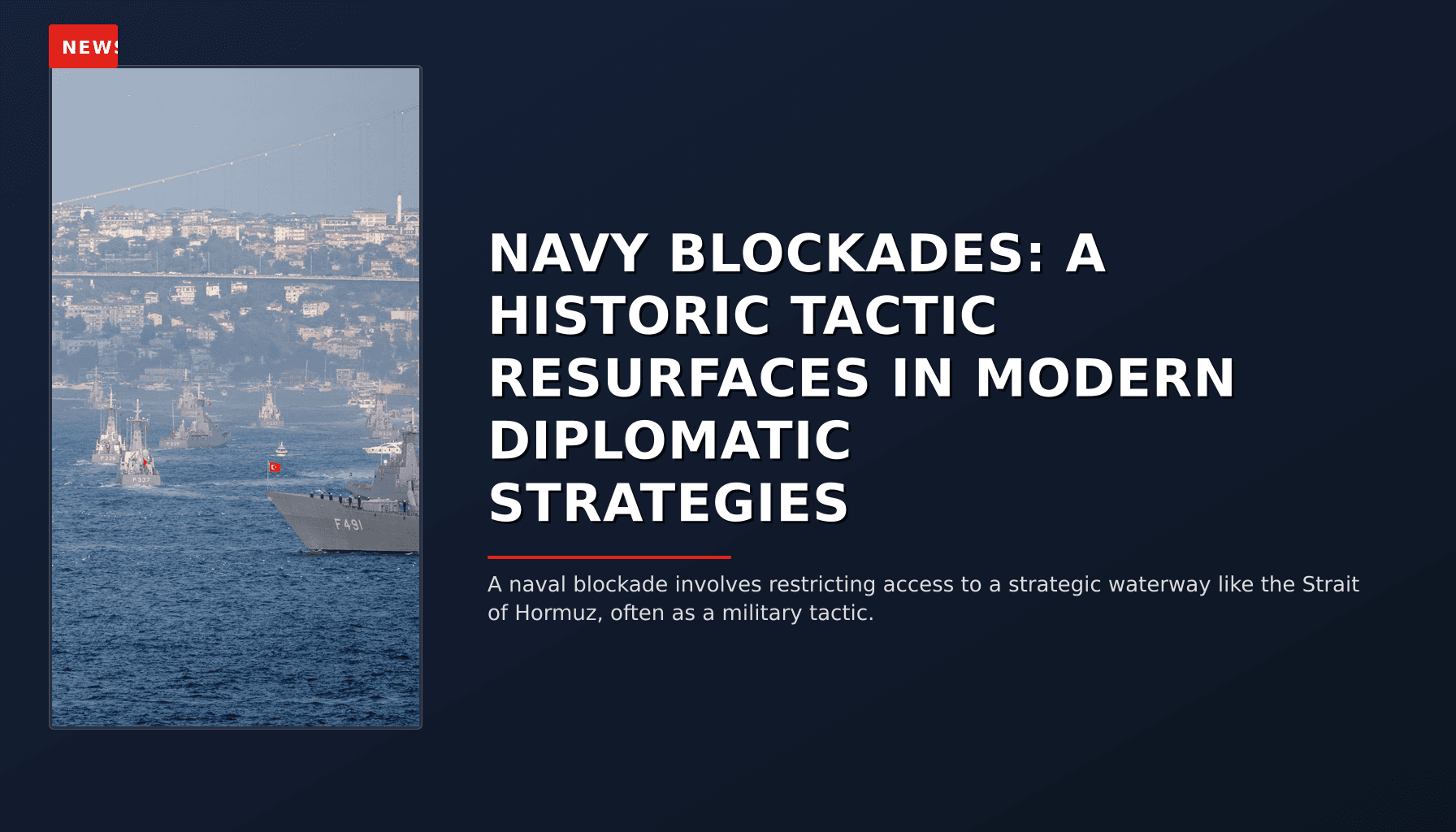
Navy Blockades: A Historic Tactic Resurfaces In Modern Diplomatic Strategies
12 April 2026 at 22:522 min read
Read More
ENGLISH TEACHERS CONSIDER STRIKE OVER PAY: GOVERNMENT AND UNION AT IMPAS...
9 May 2026 at 20:264 min read
Read MoreComments (0)
No comments yet. Be the first to share your thoughts!
Leave a Comment
Your email address will not be published. Comments are moderated before appearing.