
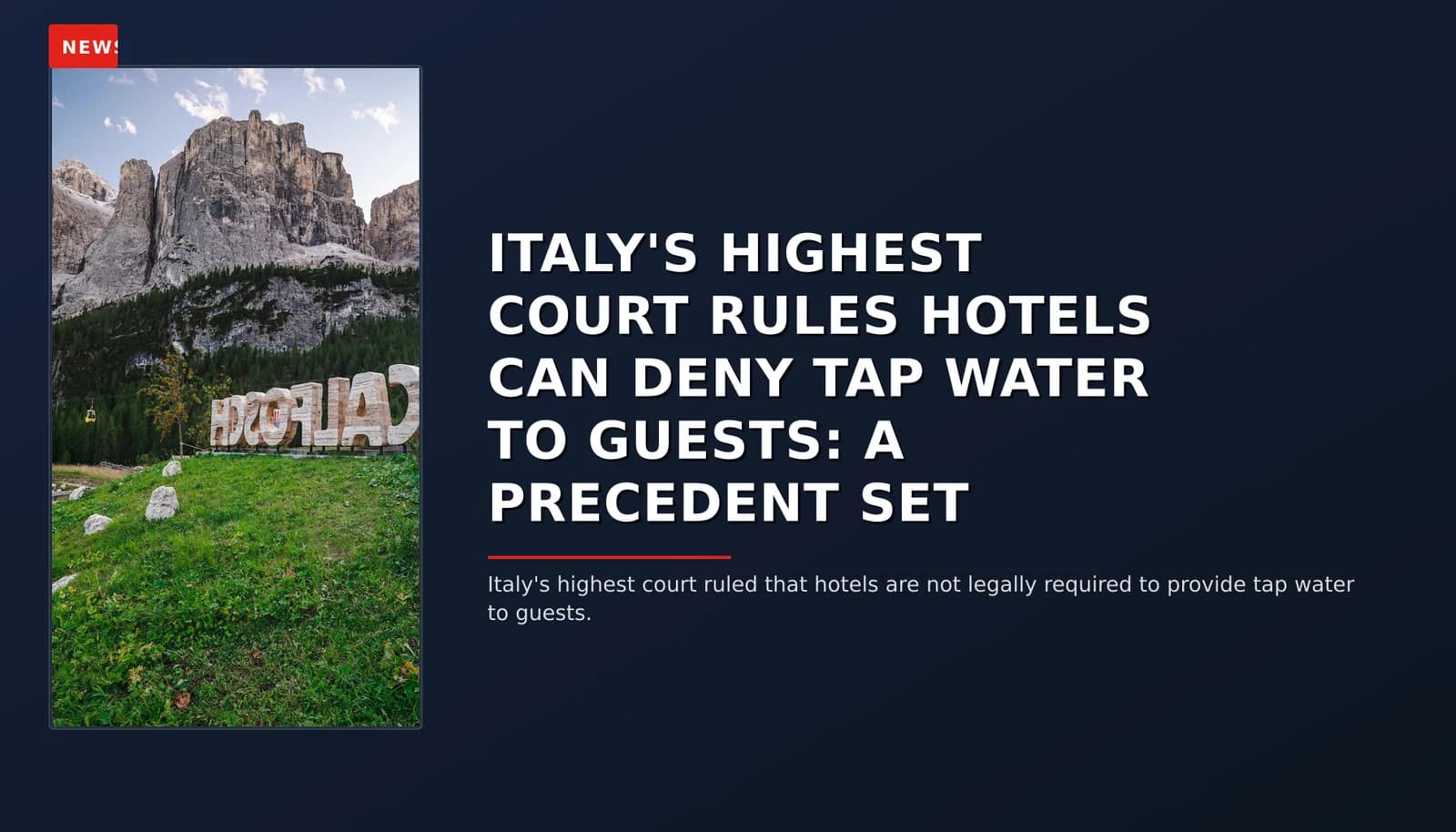
Italy's Highest Court Rules Hotels Can Deny Tap Water To Guests: A Precedent Set
Italy's Supreme Court has ruled hotels are not legally required to provide tap water, sparking debate on guest rights and environmental impact.

Italy's Supreme Court has upheld a ruling that hotels are not legally required to provide tap water, sparking debate on guest rights and hydration access.
In a landmark decision, Italy's highest court has ruled that hotels are no longer obligated to supply tap water to their guests. This verdict stems from a case involving the Hotel Sassongher in Corvara, where management denied access to tap water, claiming it was not a legal requirement. The court's decision has sent shockwaves through the hospitality industry and raised questions about guest rights and health standards.
The case began when Silvio Belardi, a guest at the Hotel Sassongher, filed a complaint after being refused access to the hotel's tap water. Initially dismissed by local courts, his appeal reached Italy's Supreme Court, which ultimately sided with the hotel. The ruling has set a legal precedent, clarifying that providing tap water is not mandated under Italian law.
According to legal experts, this decision could have broader implications for the hospitality sector. Hotels across Italy may now choose whether or not to offer tap water, potentially affecting both guest experiences and public health initiatives aimed at reducing plastic waste. Environmental groups have expressed concern, as hotels might opt to rely more heavily on bottled water, increasing plastic consumption.
The Hotel Sassongher argued that providing tap water could lead to additional costs and administrative burdens. However, critics argue that access to potable water is a fundamental right, especially in accommodation facilities. This tension between business interests and public welfare lies at the heart of the controversy.
Read more: HOTTEST MAY DAY ON RECORD: UK SWelters Through Unprecedented Heatwave
It remains unclear how this ruling will be implemented nationwide. Hotel owners associations are expected to issue guidelines soon, outlining best practices for member establishments. Meanwhile, guest advocacy groups are calling for clearer regulations to ensure fair treatment and access to basic amenities during stays.
This case highlights a growing debate in Italy over the balance between business autonomy and public rights. Similar disputes have arisen in recent years regarding mandatory services like Wi-Fi and breakfast provisions, challenging traditional expectations of hotel accommodations.
Public reaction has been mixed. Some guests express frustration, feeling that their health and comfort are being overlooked for cost-cutting measures. Others argue that hotels should be allowed to operate with greater flexibility, especially during economic downturns.
Looking ahead, legal experts predict that this ruling may face challenges in lower courts or could inspire similar cases elsewhere in Europe. The hospitality industry is likely to adapt by revising policies and communicating changes clearly to guests to avoid potential disputes.
Read more: HISTORIC HEAT RECORD: LONDON SWelters in May Heatwave
As the dust settles on this decision, the focus will shift to how hotels choose to respond. Will they continue to provide tap water voluntarily, or will many see this as an opportunity to reduce expenses? The outcome could set a new standard for guest expectations in the Italian hospitality sector and beyond.

More Stories
HOTTEST MAY DAY ON RECORD: UK SWelters Through Unprecedented Heatwave
25 May 2026 at 21:262 min read
Read More
HISTORIC HEAT RECORD: LONDON SWelters in May Heatwave
25 May 2026 at 13:353 min read
Read More
Deep-Fried Food Ban In Schools: Government'S New Health Initiative
13 April 2026 at 08:142 min read
Read MoreComments (0)
No comments yet. Be the first to share your thoughts!
Leave a Comment
Your email address will not be published. Comments are moderated before appearing.