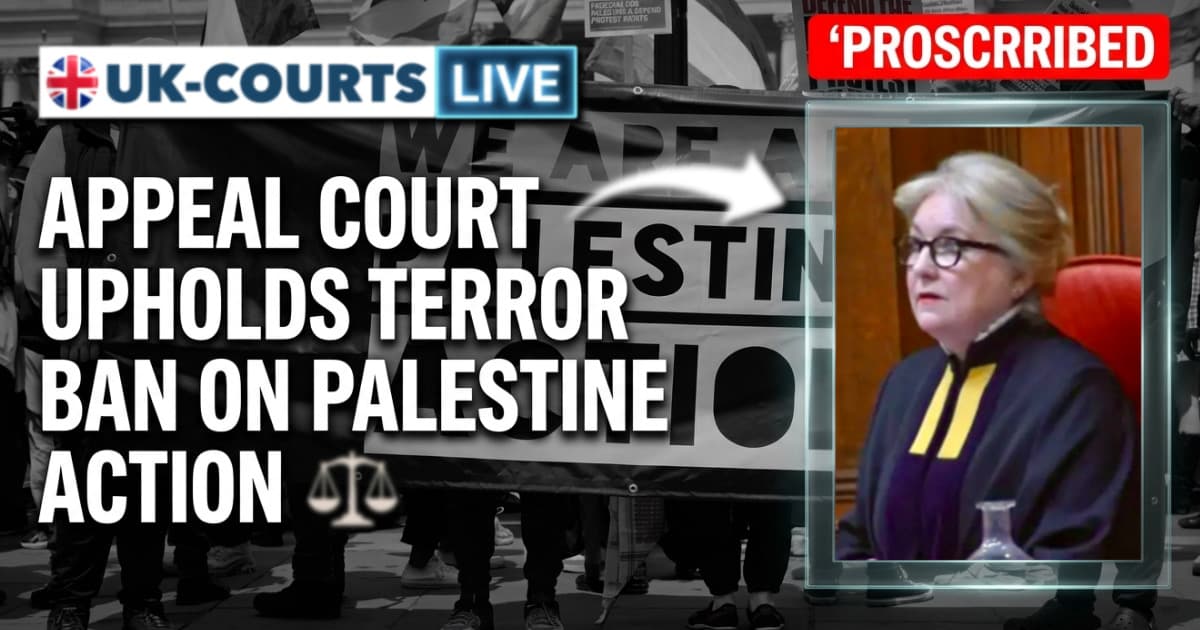
Court of Appeal Legally Upholds Government Terror Ban on Palestine Action
In what stands as one of the most significant appellate rulings on national security and executive power in recent years, the Court of Appeal has legally validated the government's proscription of Palestine Action as a terrorist organisation. Sitting before a panel of five of the country’s most...

In what stands as one of the most significant appellate rulings on national security and executive power in recent years, the Court of Appeal has legally validated the government's proscription of Palestine Action as a terrorist organisation.
Sitting before a panel of five of the country’s most senior judges, the Court overturned an earlier High Court decision which had concluded the ban was incorrectly implemented and breached fundamental rights to protest.
The appellate panel unanimously concluded that the ban was both "justified and proportionate."
The Appellate Ruling and Legal Rationale
The legal crux of the case centered on the balance between fundamental democratic rights—specifically freedom of expression and peaceful assembly—and the executive's statutory authority to identify and curtail threats to national security.
Lady Chief Justice Baroness Carr, leading the panel, delineated a strict legal boundary between transparent civil disobedience and covert operations.
While acknowledging that the proscription of the group is "highly controversial" and supported by "many otherwise lawful citizens," Baroness Carr stated it would be a "fundamental mistake to overlook the fact that Palestine Action overtly promotes unlawful violence amounting to terrorism."
The Court of Appeal’s judgment dismantled the comparison between the group's activities and historical direct-action movements, such as the suffragettes.
The Lady Chief Justice categorised Palestine Action not as a transparent civil disobedience group, but rather as a "covert organisation which operates with secret cells to avoid the detection and prosecution of those using violence to destroy property and cause injury."
Crucially to the legal threshold for proscription, the court noted the group had neither disowned nor condemned three specific incidents occurring prior to the ban, which ministers had formally assessed as amounting to terrorism.
Executive Discretion in National Security
A central pillar of the appellate decision was the reaffirmation of executive primacy in matters of national defense.
The original legal challenge, brought by Palestine Action co-founder Huda Ammori, successfully argued at the High Court level that then-Home Secretary Yvette Cooper had failed to follow her own internal departmental rules, and that the proscription unlawfully interfered with protest rights.
The High Court had initially determined that the Home Secretary's policy on bans was legally designed to limit her own discretion.
However, the Court of Appeal firmly rejected this limitation in the context of counter-terrorism.
The appellate judges agreed with the government's submitted argument that the Home Secretary was legally entitled to weigh the operational benefits of curtailing the group using terrorism legislation.
The judgment explicitly stated that the government is "generally better placed than the courts in deciding matters of national security."
While retaining the judiciary's role as the ultimate legal arbiter, the Court of Appeal ruled that judges must legally recognize that government ministers are afforded a "wide margin" of discretion within the complex field of national security.
The court cited the group's clandestine targeting of lawful businesses—specifically defence firms involved in UK national defence and international assistance to Ukraine—as the most important factor in the lawful decision-making process, a threat level the Home Secretary was best placed to assess.
Statutory Implications and Enforcement
Because the ban remained in place during the appellate process (to allow for further legal arguments and government appeals following February's High Court ruling), the statutory consequences of the proscription remain highly active.
Under current counter-terrorism legislation, it is a criminal offence to belong to or support Palestine Action. Such offences carry a maximum statutory penalty of up to 14 years in prison.
The practical application of this legislation has been extensive; since the ban came into force in July of last year, police forces have arrested thousands of individuals at demonstrations.
The immediate impact of Monday's ruling was visible outside the Royal Courts of Justice. The Metropolitan Police confirmed the arrest of 58 individuals gathered with placards on suspicion of supporting a proscribed organisation.
Official Reactions and Future Appeals
Following the publication of the judgment, current Home Secretary Shabana Mahmood welcomed the legal vindication of the policy. In her statement, she emphasized that the ruling "does not affect lawful protest in support of the Palestinian cause," but rather addresses a group she stated has "carried out acts of terrorism, celebrated those who have taken part in those acts and promoted the use of violence.
" She reiterated the court's stance that Palestine Action is "not an ordinary protest or civil disobedience group" and that its actions are inconsistent with democratic values and the rule of law.
The legal proceedings, however, are unlikely to conclude at the appellate level. Huda Ammori expressed that the group was "surprised by today's judgment" given their earlier success at the High Court.
Characterising the appellate decision as "one of the most extreme attacks on free speech and the right to protest in modern British history," Ammori confirmed her intention to escalate the legal challenge and appeal the ruling directly to the UK Supreme Court.