
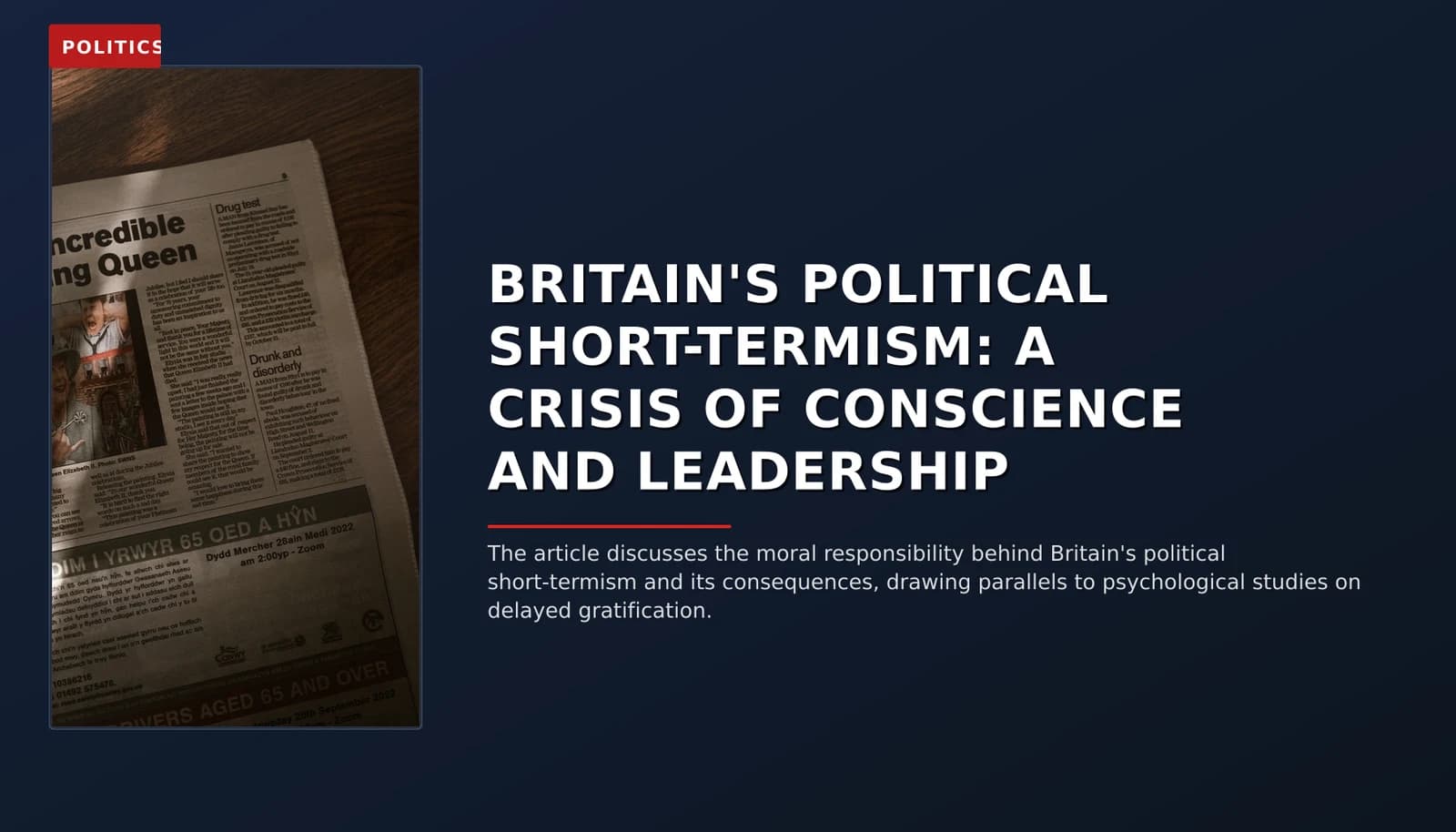
Britain's Political Short-Termism: A Crisis Of Conscience And Leadership
Examining Britain's political short-termism through the lens of psychological studies, the article questions the morality and sustainability of current governance practices.

The article explores the moral and psychological underpinnings of Britain's political short-termism and its impact on long-term decision-making.
Recent speculation about a potential leadership change in Downing Street has sparked concerns over Britain's political stability. With the possibility of a seventh prime minister in just a decade, questions arise about the sustainability of our governance model. As Walter Mischel’s marshmallow test reminds us, delayed gratification is crucial for long-term success.
The study conducted by Stanford psychologist Walter Mischel in the 1960s revealed that children who could resist eating a marshmallow for immediate reward were more likely to achieve academic and life successes. This psychological principle of delayed gratification offers valuable insights into current political dynamics, where short-term gains often overshadow long-term benefits.
The article highlights how politicians are incentivized to focus on urgent issues that generate headlines rather than tackle complex, long-term challenges. For instance, the HS2 project has faced numerous delays and cost overruns, yet it continues to dominate political discourse. Similarly, the infected blood scandal and Net Zero targets are examples of pressing issues demanding immediate attention.
The media landscape exacerbates this trend, with 24-hour news cycles prioritizing sensationalism over thoughtful analysis. Social media algorithms amplify instant gratification by rewarding outrage and clickbait. This constant pressure forces politicians to respond to crises as they emerge, often at the expense of strategic planning.
Despite these structural pressures, there is a growing recognition of the need for more sustainable governance practices. Commentators and think tanks are increasingly calling for reforms that encourage long-term thinking in politics. The challenge lies in balancing immediate public demands with future-oriented policies.
However, critics argue that voters themselves prioritize short-term relief over long-term solutions. This perspective raises questions about whether political short-termism is a reflection of public priorities or a symptom of systemic issues within the political system.
The frequent changes in leadership have left the public feeling repeatedly disappointed, as each new prime minister promises change but often delivers continuity or further division. This cycle fosters cynicism and disengagement among citizens, undermining the foundation of democratic trust.
Moving forward, addressing political short-termism will require multifaceted approaches: reforms to electoral systems, changes in media narratives, and a cultural shift towards valuing delayed outcomes. The lessons from psychological studies like Mischel’s marshmallow test suggest that patience and foresight are essential for building a resilient future.
Read more: Andy Burnham's Rise: A Sign Of The Fight To Come In Uk Politics

More Stories
Jill Biden's Concerns Over Husband's Health During 2024 Debate: A Focus On Wellbeing And Transparency
28 May 2026 at 03:053 min read
Read More
Andy Burnham's Rise: A Sign Of The Fight To Come In Uk Politics
27 May 2026 at 08:512 min read
Read More
Nigel Farage Cartoon Sparks Controversy: The Guardian Publishes Political Caricature After Henry Nowak Murder
4 June 2026 at 10:553 min read
Read MoreComments (0)
No comments yet. Be the first to share your thoughts!
Leave a Comment
Your email address will not be published. Comments are moderated before appearing.