
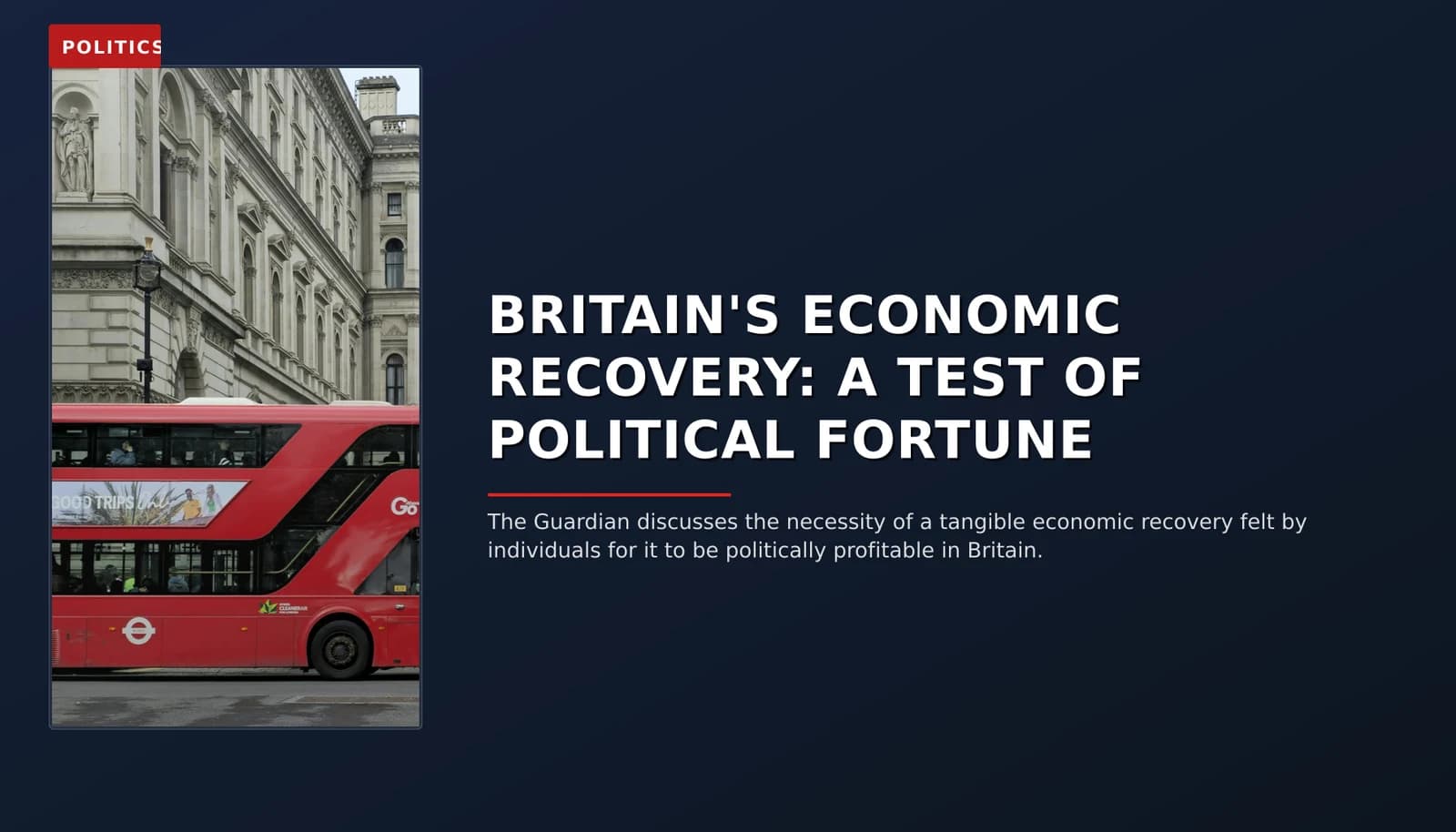
Britain's Economic Recovery: A Test Of Political Fortune
The UK's economic rebound hinges on whether citizens feel the benefits, crucial for political success.

The UK's economic rebound hinges on whether citizens feel the benefits, crucial for political success.
As Britain navigates its post-pandemic economic landscape, a recent discussion in The Guardian underscores the critical importance of a tangible recovery felt by individuals for it to yield political dividends. With inflation rates stabilising and GDP showing tentative growth, the focus now shifts to whether these improvements translate into everyday life for ordinary citizens. The stakes are high: if the recovery remains abstract or confined to economic indicators, its political benefits may be elusive.
The key claim advanced by The Guardian is that while Britain's economy is on the mend, this recovery must resonate with people in their daily lives to truly benefit the government's standing. This perspective highlights a delicate balance between macroeconomic trends and micro-level experiences, where public sentiment can make or break political narratives. According to sources within the financial sector, there are early signs that consumer confidence is inching upwards, but caution remains as employment data shows mixed signals.
Economists argue that the pace of recovery is crucial. If growth accelerates and unemployment continues to decline, it could bolster Prime Minister Rishi Sunak's agenda ahead of potential elections. However, persistent issues such as rising energy costs and stagnant wages risk overshadowing these positive indicators. The government has introduced measures aimed at stabilising the economy, but their effectiveness will be measured by public perception rather than mere statistical data.
Public opinion is a barometer that political strategists closely monitor. Surveys indicate that while a majority of citizens acknowledge some improvement in economic conditions, a significant portion remains sceptical about the long-term sustainability of these gains. This ambivalence could translate into voter apathy or support for alternative political voices, complicating the government's narrative of success.
Read more: Clash Over Deportation Policy: Reform Uk Faces Criticism And Credentials Questioned
The media landscape also plays a pivotal role in shaping this narrative. The Guardian's coverage is emblematic of broader discussions about whether recovery is truly felt across different demographics. Critics contend that while urban areas may be experiencing a revival, rural regions and lower-income brackets face distinct challenges, potentially leaving them behind economically.
Looking ahead, the success of Britain's economic strategy will depend on more than just policy implementation; it requires a concerted effort to communicate these improvements effectively to all segments of society. If the recovery remains uneven or its benefits elusive to many, the political capital derived from it may be limited at best.

More Stories
Clash Over Deportation Policy: Reform Uk Faces Criticism And Credentials Questioned
26 May 2026 at 20:083 min read
Read More
SCOTTISH PARLIAMENT BACKS INDEPENDENCE REFERENDUM: A NEW Chapter In The Debate Over Scotland's Future
26 May 2026 at 18:343 min read
Read More
Government's Social Media Ban For Under-16s: Support From Streeting
26 May 2026 at 16:402 min read
Read MoreComments (0)
No comments yet. Be the first to share your thoughts!
Leave a Comment
Your email address will not be published. Comments are moderated before appearing.