
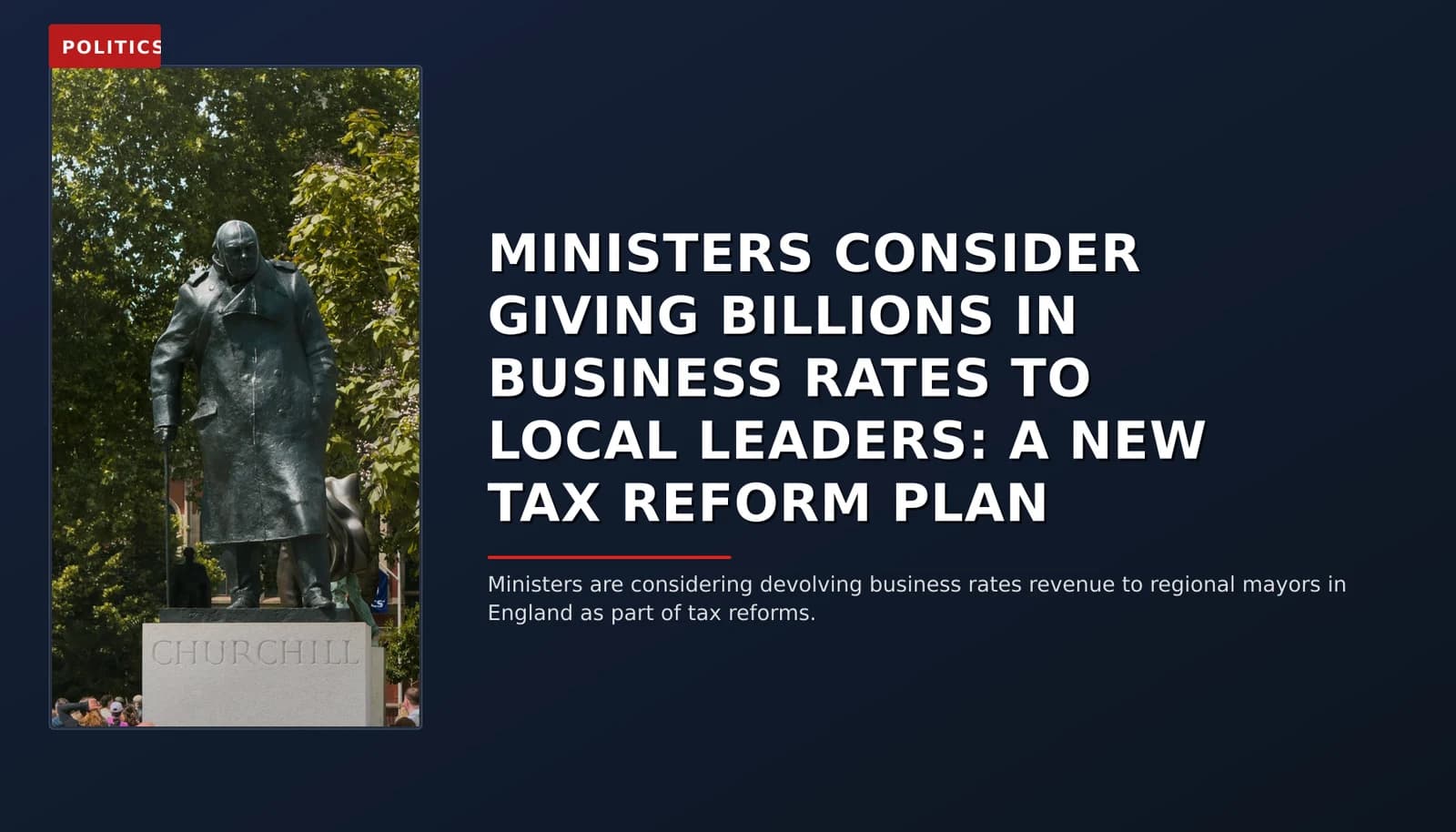
Ministers Consider Giving Billions In Business Rates To Local Leaders: A New Tax Reform Plan
The UK government is considering a major tax reform by devolving business rates revenue to regional mayors, aiming to empower local leaders and address economic disparities.

The government is exploring plans to transfer business rates revenue to regional mayors, aiming to empower local leaders and address economic disparities.
The UK government is reportedly considering a significant shift in tax policy, with ministers contemplating the devolution of business rates revenue to regional mayors across England. This move would mark a major reconfiguration of fiscal responsibilities, granting local leaders greater financial autonomy while aligning with broader efforts to decentralise power in areas such as justice, health, and education.
According to recent reports, Local Government Secretary Steve Reed has confirmed that the government is actively exploring this proposal. The plan, which has been floated by Chancellor Rachel Reeves, aims to provide regional leaders with a share of national taxes, potentially redistributing billions of pounds currently managed at the central level. This initiative is part of a broader strategy to enhance local governance and stimulate economic growth in varying regions.
The proposed reforms are not without their complexities. One key consideration under discussion is an equalization mechanism to ensure that wealthier areas do not gain an undue advantage, while poorer regions receive sufficient support to foster balanced development. This approach seeks to balance the devolved revenues with a fair distribution model, aiming to prevent exacerbating existing inequalities between different parts of England.
The idea of transferring business rates is not entirely new, but its current iteration appears to be more ambitious in scope. Business rates have long been a contentious issue in local government funding, with many arguing that the system does not adequately reflect the economic realities of individual regions. By devolving this revenue, the government hopes to empower mayors and local leaders to make decisions that better suit their areas' specific needs.
Read more: Makercield Byelection: Illegal Dump Site Sparks North-South Divide Debate
However, the proposal has sparked both optimism and concern among local authorities and fiscal experts. Supporters argue that it could lead to more tailored and effective policy-making, as regional leaders would have a direct stake in managing their local economies. Critics, on the other hand, warn of potential administrative challenges and the risk of uneven implementation across regions with varying capacities and priorities.
The Guardian has reported extensively on this developing story, highlighting the potential implications for both central and local government finances. As the discussions continue, it remains to be seen whether this ambitious plan will gain traction or face significant hurdles in the form of legislative processes and public opinion.
In the meantime, stakeholders are closely monitoring the progress of these negotiations. Local leaders,财政 experts, and policy analysts are preparing for what could be a seismic shift in how local government is funded in England. The outcome of this proposal will have far-reaching consequences for regional economies and the balance of power between central and local authorities.

More Stories

Makercield Byelection: Illegal Dump Site Sparks North-South Divide Debate
14 June 2026 at 21:183 min read
Read More
Bassetlaw Mp Jo White Reveals Three Decades Of Period Healthcare Advocacy: A Lifetime Of Fighting For Women's Rights
15 June 2026 at 01:262 min read
Read More
Roy Hattersley, Former Labour Deputy Leader, Dead At 93: A Legacy Of Uk Politics
14 June 2026 at 23:363 min read
Read MoreComments (0)
No comments yet. Be the first to share your thoughts!
Leave a Comment
Your email address will not be published. Comments are moderated before appearing.