
Pawns in a Bigger Game: Why the Starmer Arson Trial Isn’t the Story You Expected
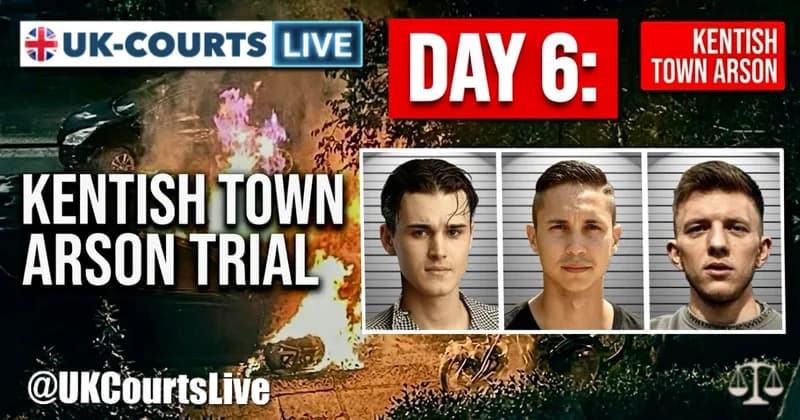
For days, the Old Bailey has been temporarily gripped by the trial of three men accused of targeting the Prime Minister’s properties and a vehicle in what the Crown describes as a precision arson campaign. But as the prosecution’s opening reaches its conclusion, a different, far more cold-blooded reality is emerging—one that suggests the "smoking gun" many were looking for may never exist.

For days, the Old Bailey has been gripped by the trial of three men accused of targeting the Prime Minister‘s properties, and one of his cars, in what the Crown describes as a precision arson campaign.
In the trade, we live by the old saw: "Dog bites man, No News; man bites dog, NEWS."
For those drawn to the all-you-can-eat buffet of highly processed, low-fact online commentary, this case was marketed as the ultimate "Man Bites Dog" exposé—a seismic event destined to shift the tectonic plates of national politics.

The digital whispers promised a "smoking gun": evidence of deep-rooted, historic connections between Sir Keir Starmer and the three defendants. The narrative suggested a case so volatile it wouldn't just turn reputations to ashes, but might torch the very legitimacy of the political establishment.
However, as the case moves out of the algorithmic engine room—where baseless speculation is the primary fuel for outrage and revenue—the revolutionary flames are beginning to gutter. Transitioning from the tangled ecosystem of social media into the courtroom’s domain of reasoned argument and hard evidence has acted as a fire extinguisher. What was marketed as a high-stakes political thriller is rapidly cooling into something far more familiar: a "Dog Bites Man" arson trial.
Granted, the case still retains some undeniably "Harry Palmer" elements—complete with a shadowy, anonymous online paymaster using the Bond-villain pseudonym ‘El Money’ and the instruction to use the secret emergency codeword ‘Geranium’ if the police came knocking. But a new face to this story is emerging.
In the online build-up, it had the hallmarks of the story of the year: a direct, targeted assault on the assets of the most powerful man in Britain, allegedly fueled by secret ties to the accused.
Yet, after five days of forensic scrutiny, a different picture is being painted. It is becoming increasingly clear that these three defendants had no historic connection to the Prime Minister, and, quite possibly, barely even knew each other before the first match was struck.
The "Smoking Gun" that the internet was hoping for—the direct link that would turn a criminal conspiracy into a political scandal—now has little to no hope of materialising.
Instead of a deep-state exposé, we are left with what is starting to look like a much simpler, though no less dangerous, tale: a case of "Fido bit a foreign national," where the defendants appear to be mere pawns in a pay-to-play arson scheme.
But as the prosecution’s opening reaches its conclusion, a different, far more cold-blooded reality is emerging—one that suggests the "smoking gun" many were looking for may never exist.
No Personal Connection
Despite the high-profile nature of the targets, including a car once owned by Keir Starmer and the home of his sister-in-law, Judith Alexander, the evidence presented so far points to a startling lack of personal or ideological motivation.
According to Prosecutor Duncan Atkinson KC, there is no evidence yet that Roman Lavrynovych, Petro Pochynok, and Stanislav Carpiuc even knew their targets were associated with the Prime Minister.
In court, they have been described not as political assassins, but as "mere pawns" in a larger, transactional game. Evidence points, not to an act of vengeance, but of a ‘pay to burn’ act carried out for the promise of money.
The 'El Money' Ghost
The trial has focused heavily on a shadowy Telegram handler known as "El Money." This Russian-speaking figure reportedly operated like a remote middleman, providing "targeting packs," reconnaissance instructions, and a cold-hearted price list: £500 for a windscreen, £2,000 for a fire.
While the "El Money" connection is undeniably eerie—complete with secret codewords like "Geranium"—it appears to be the end of the road for this trial. The prosecution has explicitly told jurors it is "no part of their considerations" to decide who El Money is or what his ultimate motives were.
A Forensic Reality Check
For the families involved, the terror was very real. The court heard moving testimony from Judith Alexander, who described the "billowing smoke" and the fear for her daughter’s life as they struggled to breathe through Covid masks while their exit was blocked by fire.
However, from a legal and journalistic standpoint, the case has shifted. It is no longer a political thriller; it is a forensic examination of digital snapshots, B&Q receipts for white spirit, and TFL bus tracking. The "spooky" elements—the anti-Islamic "Ayodhya" flyers and the Russian handler—provide a backdrop of international intrigue, but they do not change the core of the case: a series of allegedly paid criminal acts.
As the trial moves into the defense phase, the sensationalist "Starmer connection" is fading into the background. What remains is a sobering look at how easily individuals can be recruited via an app to commit dangerous acts for a crypto-payout that, in Lavrynovych's own words to police, never even arrived.
What to Expect in the Coming Weeks?
So as the court moves into the technical and forensic weeds of the evidence, the atmosphere in the public gallery has shifted. Gone is the electric anticipation of a grand political revelation. In its place is a meticulous accounting of bus journeys, DIY products purchases and phone metadata.
For those who arrived hoping this trial would provide a look behind the curtain of national security, the prosecution's instructions to the jury were a cold shower: they are not there to uncover the identity of "El Money" or delve into the murky geopolitics of the handler.
The case has now settled into a rhythm of digital breadcrumbs. We are no longer talking about the Prime Minister’s inner circle but about how long a notification lingers on a locked screen and the precise chemical makeup of white spirit.
The evidence suggests that instead of high-level operatives, the dock contains three men motivated by the promise of crypto-payments and a £2,000 bounty. It is a story of contract crime and opportunistic recruitment rather than a deep-seated political conspiracy.
Crucially, the jury has only heard the Crown’s opening and the initial presentation of evidence. The defence has yet to fully present its case, which may well lean into the claims of duress and the threats against family members mentioned by Lavrynovych in his police interviews.
However, for the observers who came for a "Man-Bites-Dog" sensation, the conclusion is already becoming clear. The smoke from the May fires has cleared and the flames, while devastating for the residents involved, have failed to illuminate the grand conspiracy many were hoping to see.
This trial is no longer a political thriller; it is a forensic account of how "El Money" bought a few nights of chaos, followed by the calculated engine of conspiratorial whispers across the digital landscape, for a relatively small price.
The trial is ongoing and is expected to continue for another two weeks...