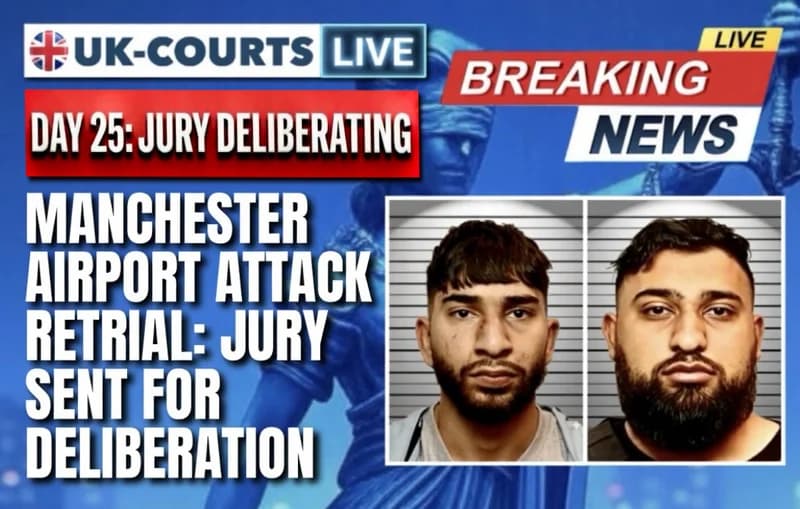

Manchester Airport Assault Trial: Week Three Summary
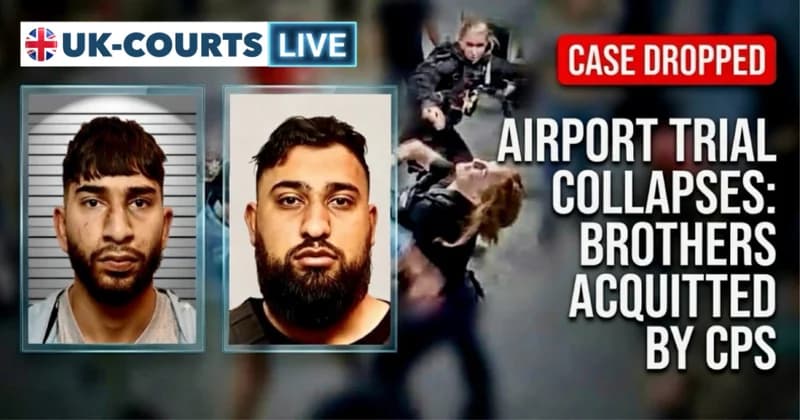
The Manchester Airport assault retrial has entered its third week, with the jury hearing for the first time from defendant Mohammed Fahir Amaaz. Mr Amaaz, accused alongside his brother of assaulting PC Marsden occasioning actual bodily harm, took to the witness stand following the conclusion of...


The Manchester Airport assault retrial has entered its third week, with the jury hearing for the first time from defendant Mohammed Fahir Amaaz.
Mr Amaaz, accused alongside his brother of assaulting PC Marsden occasioning actual bodily harm, took to the witness stand following the conclusion of the prosecution case on Tuesday. Mr. has previously been convicted of assaults on PCs Ellie Cook and Lydia Ward, in moments which are again being scrutinised during the retrial.
Evidence heard throughout the week revealed sharply contrasting accounts of events as witness examination and cross-examination presented the central issue of this trial into sharp focus: whether this was a case of sustained, unlawful violence, as claimed by the prosecution, or a fast-moving confrontation in which the defendant believed he was acting in self-defence.
Under cross-examination, Mr Amaaz accepted that a previous jury had convicted him of assault related to the events of 23 July 2024 in Manchester Airport's T2, but told the court he does not agree with those findings. Regarding his existing convictions, he said: “I understand the jury’s views and of course everyone has their own views. But I still maintain my innocence.”
The court heard first-hand accounts, supported by medical evidence, from police officers and Mr Amaaz himself, who each present themselves as victims of unlawful violence. In tense questioning, the accusaion of 'losing control' has been repeatedly directed to both Mr Amaaz and PC Marsden, whose alleged assault forms the basis of this retrial.
The week began with PC Lydia Ward returning to the witness box on Monday for a second day of evidence. She told jurors that officers approached Mr Amaaz in the airport pay station area intending to arrest him, not expecting anything out of the ordinary. She said she took hold of his right arm while PC Marsden took his left, with the aim of applying handcuffs.
PC Ward said the situation escalated quickly. She described Mr Amaaz’s arm tensing, which she took to bea sign of resistance, while she described his brother later obstructed officers. She told the court she then became aware of Mr Amaaz kicking PC Marsden with force, and intervened, attempting to pull Mr Amaaz away.
Moments later, she said, she was punched in the face by Mr Amaaz. She described falling backwards, briefly losing consciousness, and later noticing blood. The court heard she attended hospital that night and was found to have suffered a broken nose, which later required surgery.
PC Ward told jurors of her fear and concerns over further violence as the incident continued and said she activated her emergency button to call for assistance.
Under cross-examination, defence counsel suggested there had been failures in planning and risk assessment before the arrest. It was also put to her that she may have struck Mr Amaaz. She rejected those suggestions, stating she did not punch him and maintaining that officers were dealing with a fast-moving situation.
CCTV footage of the incident was shown to the jury. PC Ward stated she could not recall certain details, including whether PC Marsden had kicked or stamped on Mr Amaaz, saying she had just been punched and was disorientated.
Her evidence concluded later that day.
On Tuesday, the court heard from Detective Sergeant Danielle Bullivant, whose evidence focused on the investigation and the defendants’ arrest and interview. Jurors were told both defendants gave “no comment” interviews on legal advice.
The officer confirmed that CCTV footage was not shown to them during those interviews, in order to obtain what was described as an “untainted” account. The court also heard both defendants were later offered a further opportunity to be interviewed after the evidence had been gathered.
The jury was then presented with agreed facts, including medical evidence. PC Ward’s injuries were recorded as including bruising and a fracture to her nose. The court also heard details of injuries sustained by Mr Amaaz following the incident, including abrasions and the effects of Taser discharge. He later attended hospital reporting dizziness and vomiting, though no acute head injury was found.
With that, the prosecution case concluded.
Mr Amaaz then entered the witness box to give evidence in his own defence. He confirmed his background and family circumstances, including that several relatives work or have worked in policing. He told the court he had “nothing but respect” for the police.
In relation to Starbucks, he told the court he approached Mr Ismaeil to seek an explanation and an apology following what his mother had reported to him. He said he went over alone, intending to “get to the bottom of it” and avoid involving police if the matter could be resolved there and then.
He described the exchange as initially calm. Addressing him as “brother”, he said he explained what his mother had told him — that she had been subjected to racist abuse — and asked for an apology so they could “move on from it”. According to his account, the response was dismissive and increasingly agitated. He said Mr Ismaeil denied the allegation, told him to “go from here”, and that the situation shifted further when a comment was made suggesting the remark had been directed at a “little girl” instead.
Mr Amaaz told jurors this left him shocked and unsettled, but that he continued to press for an apology. He said the two men were standing only inches apart when, as he described it, Mr Ismaeil became more confrontational — stepping towards him and issuing a threat to kill him. Faced, he said, with a larger man closing him down at close range, he believed an attack was imminent. It was at that point, he said, that he reacted — delivering a headbutt and attempting to strike in order to create space between them and prevent what he thought was about to happen.
That account is disputed by the prosecution, who suggest there was no such threat and that the defendant’s actions were not defensive but deliberate. Mr Amaaz rejected that, maintaining that he believed he was about to be attacked and acted accordingly.
The second phase — the encounter with police — forms the basis of this retrial and was examined in detail.
Mr Amaaz said he did not initially realise those who grabbed him in the pay station were police officers. He described being taken hold of from behind without warning, pushed into a machine, and restrained in a way he found immediately alarming. He told the jury nothing was said to him at that point, and that his first thought was that the man Mr Ismaeil had been calling might have arrived.
He accepted that he tensed and resisted, but said this was a reflex reaction to being grabbed unexpectedly. Even after turning and seeing an officer, he said the level of force being used caused him to fear what was about to happen. He described thinking that if he was forced to the ground, he might be seriously harmed.
From there, his evidence was that events became confused and fast-moving. He accepted that he then used force. He said he kicked out towards an officer, now identified as PC Marsden, in order to get him away from his brother.
“I just wanted to get this person away from my brother and stop them from punching him,” he said.
He also accepted striking another officer, PC Cook. He told jurors he did not realise she was a woman.
“I just saw this person punching my brother in the face,” he said. “It was all happening so fast, I didn’t notice the little details.”
He described a strike in the throat shortly afterwards, which he said caused him to gasp and react instinctively. Turning, he struck again — this time making contact with PC Ward, who the jury has heard suffered a broken nose.
Asked why he struck her, he said: “I felt like I needed to protect myself from this person.”
He maintained throughout that he believed he was under attack.
The jury then heard that Mr Amaaz continued to use force, including punching an officer until she fell. He said he stopped when he no longer perceived a threat.
“As soon as I feel like this person isn’t a threat, I stopped,” he said.
A further moment relied upon by the defence concerns his account of seeing an officer in what he described as a “shooting stance”.
Mr Amaaz said he believed the officer was holding a firearm, later identified as a Taser, and that it was being pointed at his brother.
“I thought this man is going to shoot my brother,” he said. “I thought I need to stop this guy.”
He accepted striking the officer again, saying his aim was to prevent what he believed to be an imminent use of lethal force.
He told the court he did not register that two of the officers were women, describing the situation as unfolding too quickly for him to take in such detail, and said he was reacting to what he perceived simply as people attacking his brother and himself.
The prosecution case, put in cross-examination, is that this account does not withstand scrutiny. Mr Greaney KC suggested that the defendant had lost control, that the force used was excessive and unlawful, and that key aspects of his account — including not recognising police officers, not realising he was striking women, or mistaking a Taser for a firearm — were implausible.
Mr Amaaz disagreed, maintaining that his actions were proportionate to what he believed was happening at the time. He accepted that the blows he delivered were deliberate, but said each was in self-defence.
The trial is now entering its fourth week, with evidence continuing to be heard.
It leaves a series of sharply defined issues still developing before the jury. The physical acts themselves are not in dispute; what remains in contention is how they are to be understood in context, and what was reasonably perceived in those moments as events unfolded. As further evidence is heard, those competing accounts continue to form part of the overall picture the jury will eventually be asked to consider.