Autism: Exposing the Hidden Bias & Legal Realities of 2026
Autistic individuals face hidden barriers daily-it’s time to expose the bias and clarify the law protecting them. Understanding Autism requires not just empathy but a comprehensive analysis of the legal framework, societal attitudes, and real-life manifestations of discrimination.
Autistic individuals face hidden barriers daily-it’s time to expose the bias and clarify the law protecting them.
So we need to start being far more Ambitious About Autism acceptance, but to do this we need to better understand Autism and that requires not just empathy but a comprehensive analysis of the legal framework, societal attitudes, and real-life manifestations of discrimination.
As someone diagnosed with High Spectrum Asperger’s syndrome at 13 and now at 57, I've navigated the complexities of discrimination firsthand.
Today, I aim to dissect this issue, shedding light on its legal implications, societal impact, and the insidious and usually covert ways in which this discrimination actually manifests itself.
But in order to frame this conversation, we need first to understand why people on the spectrum are so often misunderstood and more often than not accused of causing offence during daily social interactions.
First of all you have except that Autistic people are almost exclusively literal-minded and, as such, won't respond to hints, innuendoes, tone of voice, or body language, or pick up on almost any other social cues, which are all to frequently not even noticed, let alone understood.
So as a general rule they don't notice anything objectionable, and cannot see why anyone else would even care about it, let alone be disturbed or offended by it. This is considered to be a theory-of-mind issue in which autistic people simply cannot understand that something is perceived by another person in a different manner than they themselves would.
In other situations, they may not be disturbed by, or even aware of, something that is done to them which many people might take great exception to; which all to often means, they might think nothing of doing the same to others, having no appreciation of how offensive it is.
Once again, the autistic person is unable to discern how someone else might be affected by or respond to something differently than they themselves do.
We must also fully take into account at this stage that these difficult and challenging interactions extend to all forms of modern Electronic Communication such as all Twitter/X Direct Messages, What’s App and even email, and therefore an autistic person's characteristic behaviours occurring in conversation on these platforms are now also fully legally protected.
Drawing parallels with Tourette’s syndrome highlights the societal double standards at play here. While allowances are almost always made for Tourette’s-related language, despite it often being expletive-driven and on frequent occasions what could be considered racially or sexually abusive, it is more than often overlooked as being a normal part of the presentation of their legally protected characteristic.
Similar understanding however totally eludes high-functioning autistic individuals. The so called “Rain Man Syndrome” that has recently been coined highlights this, where neuro-typiclal are fine dealing with someone on the spectrum who presents with more defined and less socially functional behaviours
However, they simply can’t cope with higher functioning autistic people (who are usually far more verbose individuals), as they struggle to comprehend in any meaningful way how someone outwardly appears so intelligent can also be so socially inept at the the same time, as it doesn’t in any way fit with their own totally normal neuro typical societal frame of reference in any understandable way.
Further, continuation and endorsement of this completely false perception and stereotype perpetuates greater misconceptions, fostering avoidance rather than engagement.
“Essentially autistic people are now fully and legally allowed to completely “be themselves” without having to “mask” their autistic traits for fear of causing any social offence, exactly the same as someone with Tourette’s!”
In the United Kingdom, autism is legally recognised as a learning disability, affording it protection under the Equality Act of 2010 and is now fully legally enshrined as a UK protected characteristic.
This classification and characteristic is not merely symbolic but carries significant legal weight, prohibiting discrimination on the basis of disability in various spheres of life, including employment, education, and access to goods and services. However, despite legislative safeguards, discrimination against individuals on the autistic spectrum persists, often taking more subtle and usually covert forms.
Real-life manifestations of discrimination against individuals on the autism spectrum are varied and multifaceted. In interpersonal interactions, neurotypical individuals all to often these day overtly virtue signal their desire to embrace neurodiversity, only to covertly engage in discriminatory behavior.
This can include avoiding eye contact, abruptly walking away from conversations, or feigning busyness to avoid interaction. Additionally, individuals may be excluded from social events or gatherings to circumvent uncomfortable interactions.
These behaviors cannot be considered to be merely social awkwardness but in reality constitute clear forms of discrimination and exclusion. They reflect a total reluctance to engage with neurodiverse individuals on equal terms and once again perpetuate harmful and dangerous stereotypes and misconceptions. Such actions undermine the principles of inclusivity and respect for neurodiversity that UK society society now claims to fully uphold.
CASE STUDY: The ‘Inclusion Paradox’ and the Rogue Internal Policy
In the current legal landscape, we are seeing a rising phenomenon I call the "Inclusion Paradox." This occurs when an organization—very often one that publicly advocates for neurodiversity—implements internal operational policies that structurally discriminate against their own autistic staff.
The Problem: The "Neuro-Normative" Operational Model
Imagine an organisation creates a new "Integrated Working" policy. On the surface, it looks professional. However, deep in the "Expected Behaviors" section, it mandates that all staff must be "flexible, reflexive, and socially collaborative" at all times. It demands "on-demand verbal updates" and "high-frequency social touchpoints."
Why this is a Legal Minefield:
By mandating a specific social style rather than a performance output, the company has created an actual Masking Mandate. For an autistic employee, "on-demand" social interaction is not a neutral task; it is a high-intensity cognitive burden. When the employee asks for written, asynchronous communication to manage this load, a "rogue" manager might label this as a "failure to collaborate" and trigger a Performance Improvement Plan (PIP), creating yet even more stress for an already overburdened autistic employee.
Under the Equality Act 2010, this is Section 15 Discrimination (Arising from Disability). The "poor performance" (the communication style) and any other performance issues thus caused or relating to it are direct manifestations of the disability. Therfore to discipline it is to discipline the autism itself, which is a huge red flag for any organisation.
The Solution: The Supremacy of the Workplace Adjustment Passport
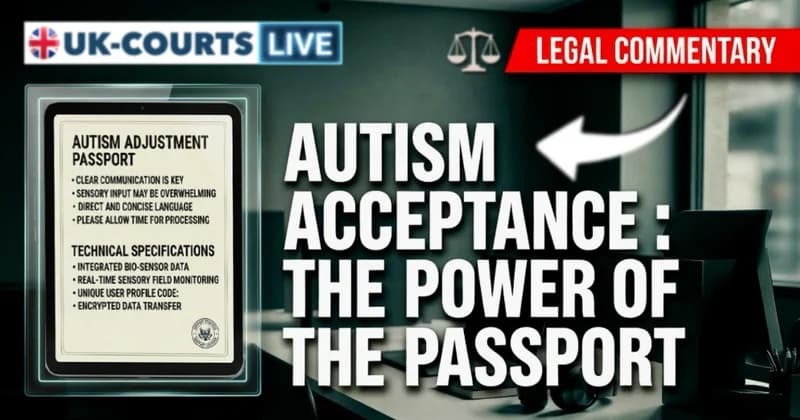
The "fix" is mechanically simple but culturally transformative: The Workplace Adjustment Passport. A legally compliant company ensures that this Passport—a living document detailing the employee's specific communication and sensory needs—acts as a Supremacy Document. It must override any "General Operational Policy."
If the General Policy says: "We prefer face-to-face meetings."
The Passport says: "the employee requires written agendas and email-first collaboration."
The Result: The Passport wins. Every time.
Why the Company is Legally Wrong
When a company allows a local manager to ignore a Passport in favor of a "Team Tone" policy, they commit Procedural Negligence.
**(1) Failure to Adjust (Section 20):** By insisting on "neuro-typical" collaboration, they have failed to remove the barrier that prevents the autistic staff member from doing their job.
**(2) Harassment & Victimization (Section 26 & 27):** If the manager "coaches" the staff member to "soften their tone" or "be more reflexive," they are engaging in forced masking—a practice that modern clinical standards recognize as psychologically damaging and a breach of the "Duty of Care."
The Verdict: An organization such as this one cannot truly claim to be "Ambitious about Autism acceptance" for and to its clients, while being "Hostile" to their autistic employees who serve them.
A policy that demands conformity over competency is not a management tool; it is a legal liability waiting for it's Tribunal, which will happen, with the outcome of the organisation (or dare I say it even Charity) losing not only in court but in the court of public opinion and suffering massive and huge very public reputational dammage to boot, especially in todays fast paced world of social media...
A Champion for Change: The Lawson Legacy
The structural shift toward this "Gold Standard" of reasonable adjustments has been catalyzed by the tireless advocacy of Donna Lawson and the team at the Ambitious about Autism charity and college. As the Deputy Director of National Services, Lawson has been instrumental in repositioning the Workplace Adjustment Passport not merely as a HR suggestion, but as a non-negotiable prerequisite for inclusive employment. Her work emphasizes that true inclusion is about "including us all differently" rather than forcing a neuro-normative mold. As Lawson herself has poignantly noted:
*"Acceptance is about actively accommodating who we are, as we are, and without trying to change us. There are a myriad of ways to support autistic people that don't involve the need to change us or deny who we are, but the adustment passport is the gold standard for this"*
By championing the Passport as a "Supremacy Document," Lawson is ensuring that the legal rights of autistic employees are no longer left to the whim of a "rogue" manager's personal preference, but are instead anchored in a formal, legally enforceable framework that protects the integrity of the individual.
CAUSATION:
The Latest Research into the causation of this discriminatory behaviour unveils a disconcerting truth: individuals in most cases feel massively socially disempowered when engaging with high-functioning autistics and feel huge resentment about this fact.
The fear of being unable to navigate potentially controversial conversations without their usual recourse to social norms or even simply and blatantly accusing the person of discrimination or abusive behaviours, deters meaningful interaction. This fear-driven avoidance perpetuates discrimination, hindering societal inclusivity.
It is also worth considering, for a slightly different perspective the admonitions of Temple Grandin, the renowned behaviourist and autism spokeswomen. Who has often addressed what she calls “Sins of the System.”
By this, she is referring to actions that, when examined objectively, usually do little or no harm to anybody else, or even to the perpetrator, but nevertheless are so frowned upon by society that they carry extremely severe sanctions and penalties
So It's now crucial that we finally and robustly call out these behaviours and hold individuals accountable for their discriminatory actions.
Merely virtue signalling about embracing neurodiversity while engaging in discriminatory behavior is not only hypocritical but also legally indefensible. Under the Equality Act, discrimination on the basis of disability, including autism, is unlawful and must be challenged at every level.
Furthermore, individuals must recognize that being offended by the literal and logical speech patterns of autistic individuals is not now acceptable and does not in any way excuse discriminatory or exclusionary behavior.
Autistic individuals have a complete legal right to freely express themselves in a manner that is comfortable and natural to them, and neurotypical individuals must now basically take this on the chin and simply respect and accommodate these behavioural differences.
It’s time to challenge this covert discrimination. Autistic individuals can and must assert their rights, demanding meaningful engagement without fear of repercussion. Virtue signaling about neural diversity loses any and all credibility if actions contradict inclusive principles.
The era of unchallenged discrimination must end. Let’s confront these biases, fostering genuine dialogue and understanding. Autistic voices now legally have to be heard, respected, and embraced within a truly inclusive society.
In conclusion, the journey towards true inclusivity for individuals on the autism spectrum requires a multifaceted approach encompassing legal protections, societal attitudes, and individual advocacy.
By dismantling entrenched biases, challenging discriminatory behaviour’sq, and fostering genuine dialogue and understanding, we can create a more equitable and inclusive society for all.