
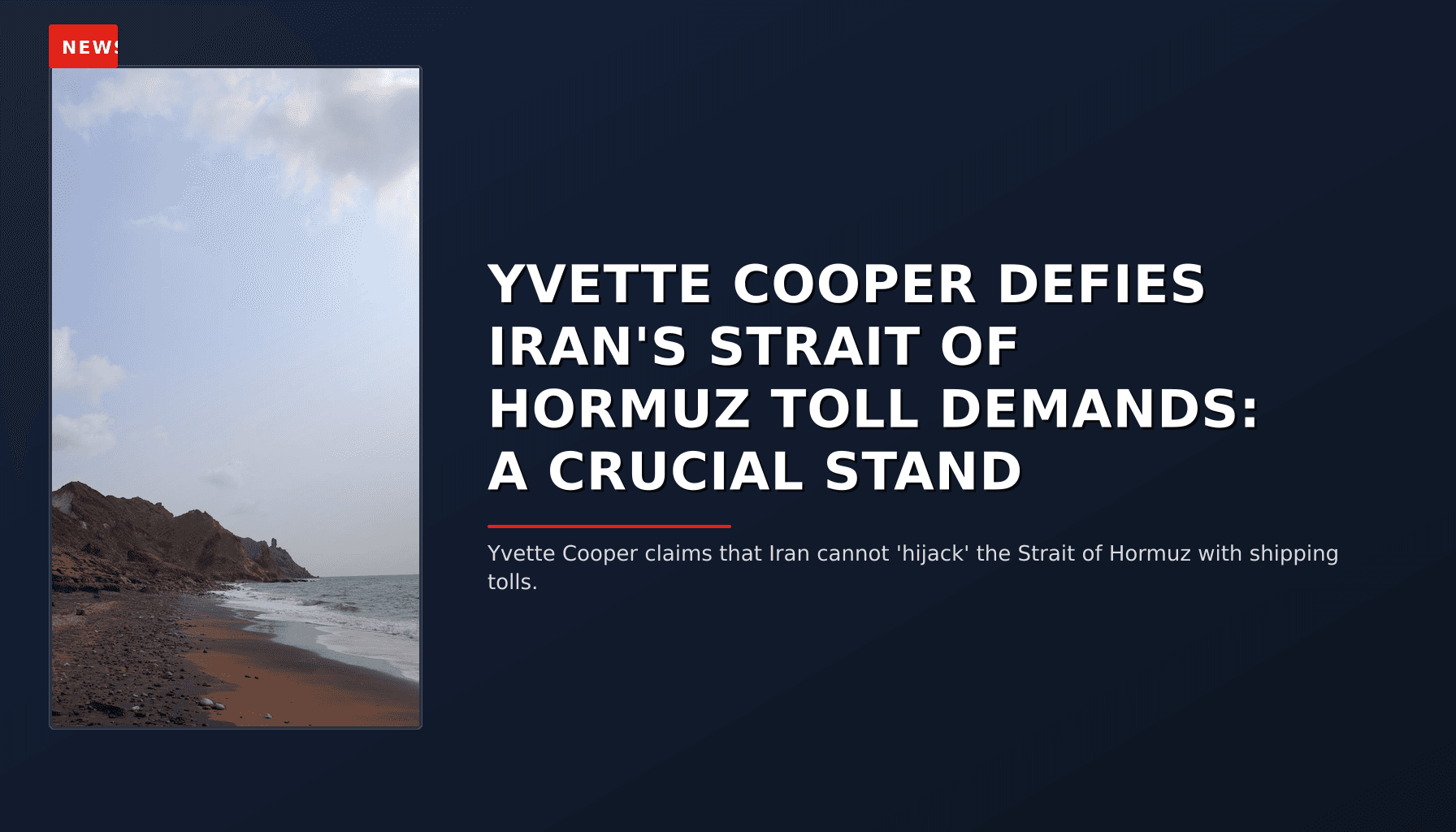
YVETTE COOPER DEFIES IRAN'S STRAIT OF HORMUZ TOLL DEMANDS: A CRUCIAL STAND
Yvette Cooper challenges Iran's claims over the Strait of Hormuz, arguing they lack capability to enforce shipping tolls. Sources from BBC and Independent back her stance.

In a bold move, Yvette Cooper challenges Iran's assertion over the Strait of Hormuz shipping lanes.
Yvette Cooper has made headlines by declaring that Iran lacks the capability to impose or control shipping tolls in the strategically vital Strait of Hormuz. This assertion comes amid growing international concerns about regional stability and maritime security. Cooper, a prominent UK politician, argued that such claims overlook the intricate web of international maritime law and global economic dependencies.
Her remarks were supported by key sources from reputable news outlets such as BBC News and The Independent, which highlight Iran's limited naval capabilities in enforcing such measures. These reports underscore the technical and logistical challenges Iran would face in attempting to 'hijack' a major shipping route that facilitates billions of dollars worth of trade annually.
The exact mechanism through which Iran could execute such control remains unclear, with experts and sources disagreeing on both the feasibility and implications of such actions. This uncertainty casts doubt over whether Iran's threats are mere posturing or indicative of a serious intent to disrupt global commerce.
Cooper's stance reflects a broader UK and Western policy approach towards Iran's regional influence. It signals a cautious optimism that international law and economic interdependence can prevent unilateral action by any single nation, even one as geographically significant as Iran.
The Strait of Hormuz is a咽喉 for global oil supplies, with over 30% of the world's seaborne oil passing through its waters each day. Any disruption here could send shockwaves through global energy markets and international relations. Cooper's comments aim to reassure an anxious international community that such scenarios are not inevitable.
Iran has repeatedly asserted its influence in the region, often clashing with Western powers over issues ranging from nuclear proliferation to regional security. However, Cooper's argument suggests that economic realities may temper Iran's ability to act unilaterally, given the reliance of even powerful nations on stable trade routes.
The international community is closely monitoring developments. The UK, along with its allies, has been actively engaged in ensuring the freedom of navigation through the Strait. Cooper's remarks align with this ongoing effort to maintain regional stability and uphold international law.
Looking ahead, the situation remains fragile. As tensions persist, both diplomatic efforts and military posturing are expected to intensify. The outcome will have far-reaching consequences for global energy security and Middle Eastern geopolitics.
Read more: PLAID CYMRU UNVEILS AMBITIOUS NHS AND ECONOMY PLANS: FOCUS ON CHILDREN'S SERVICES

More Stories
ED MILIBAND URGED TO MAINTAIN STANCE AGAINST NORTH SEA DRILLING: CRITICS CLAIM BENEFITS FLOW SOLELY TO NIGEL FARAGE
9 April 2026 at 09:342 min read
Read More
PLAID CYMRU UNVEILS AMBITIOUS NHS AND ECONOMY PLANS: FOCUS ON CHILDREN'S SERVICES
9 April 2026 at 08:053 min read
Read More
THE UK'S BREXIT DIVISIONS: A NATION STILL AT A STALEMATE
9 April 2026 at 06:162 min read
Read MoreComments (0)
No comments yet. Be the first to share your thoughts!
Leave a Comment
Your email address will not be published. Comments are moderated before appearing.