
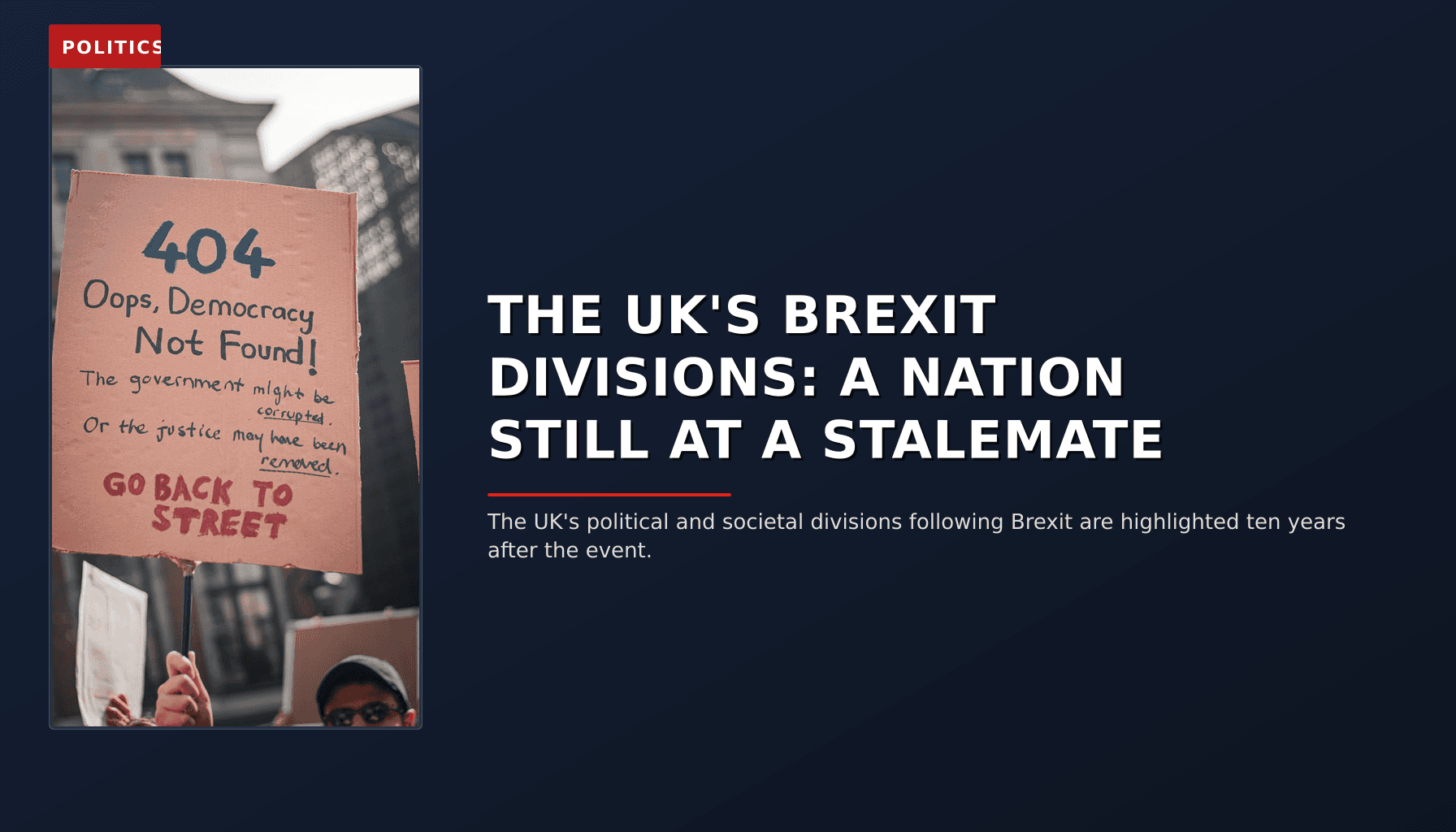
THE UK'S BREXIT DIVISIONS: A NATION STILL AT A STALEMATE
Ten years after Brexit, the UK remains divided politically and socially, with little progress made. Explore the ongoing challenges facing the nation.


Ten years after Brexit, the UK grapples with ongoing political and societal divisions that show little sign of resolution.
The United Kingdom continues to face significant challenges a decade after the EU referendum, as political and societal divisions persist due to Brexit. According to recent reports, the country remains deeply divided along lines drawn by the vote to leave the European Union. While some regions and communities have attempted to move forward, others feel stuck in a state of stagnation, unable to reconcile the deep fissures created by the decision to break away from the EU.
The referendum result in 2016 was not just a political decision but also a social earthquake that reshaped relationships across the nation. Areas like Northern Ireland and parts of Yorkshire saw stark divides, with urban centers often voting Remain and rural areas leaning towards Leave. This dichotomy has not only influenced policy-making but has also seeped into everyday life, affecting how people interact and perceive one another.
According to experts, this ongoing division has led to a 'frozen' state of progress for the UK. Unlike other nations that have faced significant changes post-EU membership, the UK's trajectory appears halted. Key areas such as trade negotiations, domestic policies, and international relations remain bogged down in discussions that seem to circle back to the same issues without making tangible advancements.
Some argue that the lack of progress stems from the inability of political leaders to find common ground. The Conservative Party has been particularly divided on how to approach Brexit's aftermath, with internal conflicts delaying decision-making and straining relationships both within government circles and across party lines.
Read more: 22,000 STUDENTS REQUIRED TO REPAY 'MIS-SOLD' MAINTENANCE LOANS: A Developing Controversy
Despite these challenges, there have been isolated instances of advancement in certain sectors. For example, the UK has managed to negotiate new trade deals with non-EU countries, albeit at a slower pace than initially hoped. However, these achievements are often overshadowed by the broader stagnation that defines much of the post-Brexit landscape.
The societal impact of this prolonged division cannot be overlooked. Communities once united by shared traditions and economic ties now find themselves at odds, with trust between different regions eroding over time. This has not only affected local governance but also influenced national policies aimed at reconciliation and unity.
Looking ahead, the question remains whether the UK can overcome these divisions and move past the Brexit stalemate. Political analysts suggest that without a concerted effort to bridge the gaps between differing views, the nation may continue to struggle with progress for years to come.
As the tenth anniversary of the EU referendum approaches, it is clear that Brexit's legacy in the UK is one of prolonged division and limited advancement. While some argue that time will heal these wounds, others fear that without meaningful reforms and dialogue, the divisions will only deepen.

More Stories
22,000 STUDENTS REQUIRED TO REPAY 'MIS-SOLD' MAINTENANCE LOANS: A Developing Controversy
9 April 2026 at 01:311 min read
Read More
THE UK GOVERNMENT UNVEILS RIGHT TO TRY INITIATIVE: A NEW APPROACH TO EMPLOYMENT FOR DISABLED INDIVIDUALS
9 April 2026 at 00:172 min read
Read More
Kemi badenach attacks PM: Scathing criticism over Iran war response
7 March 2026 at 14:153 min read
Read More
Comments (0)
No comments yet. Be the first to share your thoughts!
Leave a Comment
Your email address will not be published. Comments are moderated before appearing.