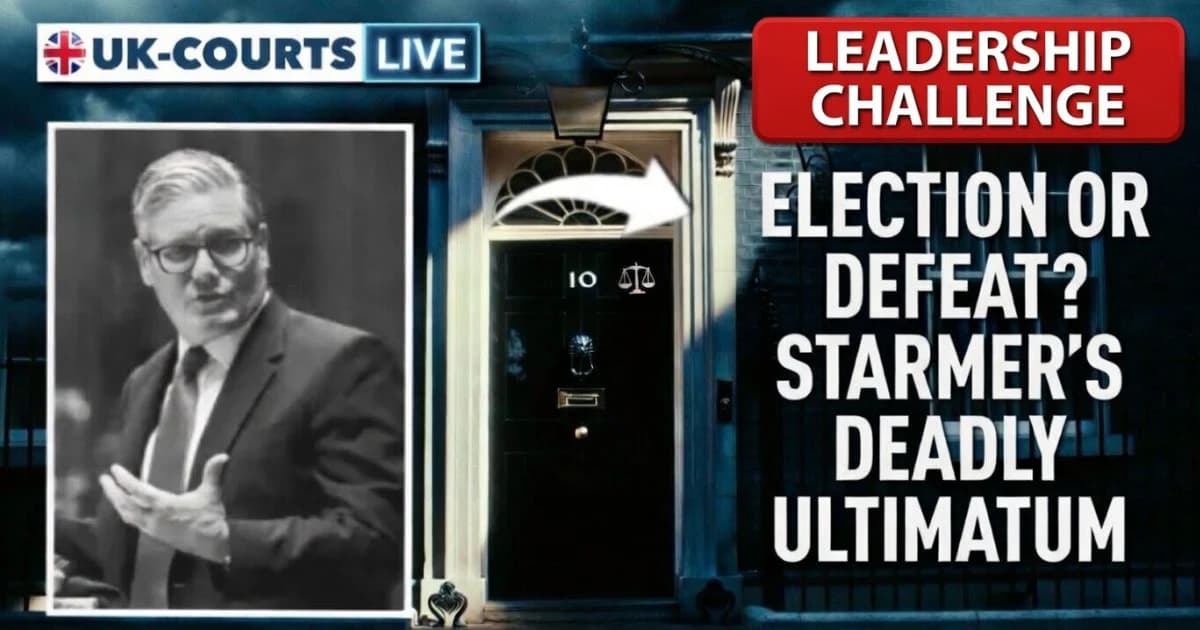
Could Starmer’s 'Nuclear Option' Stall Any Leadership Challenge?
As Westminster circles endlessly around the question of whether Sir Keir Starmer can politically survive the gathering unrest within his own party, attention has become fixated on one obvious storyline. Will Wes Streeting secure the 81 signatures required to force a leadership challenge? Will...
As Westminster circles endlessly around the question of whether Sir Keir Starmer can politically survive the gathering unrest within his own party, attention has become fixated on one obvious storyline.
Will Wes Streeting secure the 81 signatures required to force a leadership challenge?
Will disgruntled MPs finally decide they have had enough?
And if such a challenge materialises, will Starmer dig in for a bloody internal fight or quietly agree a timetable for a managed departure followed by a summer leadership contest conducted under the usual ritual humiliation of modern British politics?
Yet amid all the fevered speculation another possibility sits lurking in the corner of the room untouched, unspoken and treated with the same caution one might reserve for an unexploded wartime shell discovered beneath a suburban allotment.
It is the option that dare not speak its name because everybody in Westminster understands its implications perfectly well.
The nuclear option.
The possibility that Starmer simply refuses to yield, refuses to indulge a parliamentary coup and instead marches to Buckingham Palace to request a General Election, effectively saying to his own MPs: if you wish to remove me, then you may also explain to the country why you collapsed your own government in the process.
And suddenly the entire equation changes.
Because if that threat is real then this is no longer merely a leadership challenge.
It becomes a wager.
A colossal political gamble in which every Labour MP considering backing Streeting must decide whether they are prepared to stake not only Starmer’s future but their own careers, their party’s survival and possibly the keys to Downing Street itself.
Curiously, Starmer may have been signalling this for months in plain sight.
Repeatedly he has declared that he intends to lead Labour into the next General Election. Westminster journalists dutifully nod whenever he says it, scribble it into notebooks and move on to the next manufactured outrage about WhatsApp messages or leaked briefing wars.
But listen carefully to the wording.
He never says when.
Not in three years.
Not in three months.
Not next spring.
Not after a leadership review.
Simply the next General Election.
That omission matters rather more than many seem willing to admit.
Because in politics timing is everything and ambiguity is rarely accidental.
Viewed through that lens Starmer’s statement begins to sound less like reassurance and more like deterrence. Less a promise than a warning wrapped neatly inside one.
Challenge me if you wish.
But if you do, I will take the entire party with me into an election campaign and let the British public decide whether you were wise to light the match.
It is, in effect, political mutually assured destruction.
And once you begin looking at events this way the behaviour inside Labour suddenly makes a great deal more sense.
Imagine, for a moment, the scene facing those MPs now being quietly approached for signatures in support of a Streeting challenge.
The corridor conversations.
The tense glances.
The carefully lowered voices in Westminster bars where revolutionary fervour tends to evaporate rapidly somewhere around the second bottle of house red.
Each MP sits with pen hovering above paper contemplating the political equivalent of backing a horse at impossible odds while knowing the bookmaker might own the racetrack.
Because this is not simply about whether Starmer survives.
It is about what happens if he does not go quietly.
And here lies the brutal arithmetic haunting Labour MPs.
If Starmer calls an election in the current political climate many of those considering rebellion may very well lose their seats entirely. Reform’s polling surge has transformed what once looked like safe parliamentary territory into something considerably less comfortable. Constituencies previously regarded as immovable Labour fortresses now resemble hastily erected beach defences during an incoming tide.
For many MPs the personal financial calculation alone is sobering.
Lose a seat and three years of parliamentary salary disappears overnight. Roughly £290,000 vanishes into the political abyss alongside staffing budgets, influence, future ministerial ambitions and the comforting certainty of television producers suddenly returning phone calls.
That is already a substantial wager.
But the real cost sits elsewhere.
Because if Starmer were genuinely prepared to pull the trigger and call a snap election, those signing against him would also carry responsibility for whatever followed next.
And current polling suggests what follows next may not be remotely theoretical.
A failed rebellion could conceivably deliver power not merely away from Labour but directly into the hands of Nigel Farage and Reform UK.
That is the nightmare scenario stalking every private conversation currently taking place inside Labour.
The rebels are not simply considering whether to remove a leader.
They are considering whether, by forcing his hand, they could accidentally destroy the government itself.
Which is precisely why Starmer’s threat — if indeed it is a threat — carries such extraordinary force.
Because unlike most political bluffs this one possesses terrifying credibility.
Prime Ministers have very few truly devastating weapons available against their own party. Patronage fades. Authority weakens. Loyalty evaporates the moment blood enters the water.
But the power to collapse Parliament and send frightened MPs back to voters remains the Westminster equivalent of pulling open the cockpit door mid-flight and asking whether anybody else would like to try landing the aircraft.
Nobody wants to find out whether the man making the threat is serious.
And therein lies the genius, if one wishes to call it that, of Starmer’s current position.
He may not need to actually call an election at all.
He simply needs enough MPs to believe he might.
Because once that possibility enters the minds of wavering backbenchers every signature becomes an act not merely of rebellion but of potentially catastrophic risk-taking.
The calculation ceases to be: “Do I want Starmer gone?”
Instead it becomes: “Am I personally willing to gamble the Labour government, my seat and possibly a Farage premiership merely to discover whether Starmer was bluffing?”
That is a very different question altogether.
And perhaps that explains why, despite all the plotting, all the whispers and all the increasingly theatrical speculation surrounding Streeting’s numbers, the rebellion still appears stuck somewhere between fantasy and execution.
Many MPs may dislike Starmer.
Some may even desperately want rid of him.
But wagering your own political survival against a Prime Minister willing to detonate the entire board if cornered is another matter entirely.
Especially when everybody around the table understands the stakes perfectly well.