Qu’ran Burnings: Legal Precedent and the Thin Ice of Selective Prosecution!!
Qu’ran Burnings: Legal Precedent and the Thin Ice of Selective Prosecution!! Is The Qu’ran Protected By UK Law, But The National Flag Not Protected?Is The Qu’ran Protected By UK Law, But The National Flag Not Protected? By Jason King for VIDEO PRODUCTION NEWSBy Jason King for VIDEO PRODUCTION...

Qu’ran Burnings: Legal Precedent and the Thin Ice of Selective Prosecution!!
Is The Qu’ran Protected By UK Law, But The National Flag Not Protected?Is The Qu’ran Protected By UK Law, But The National Flag Not Protected?
By Jason King for VIDEO PRODUCTION NEWSBy Jason King for VIDEO PRODUCTION NEWSBy Jason King for VIDEO PRODUCTION NEWS
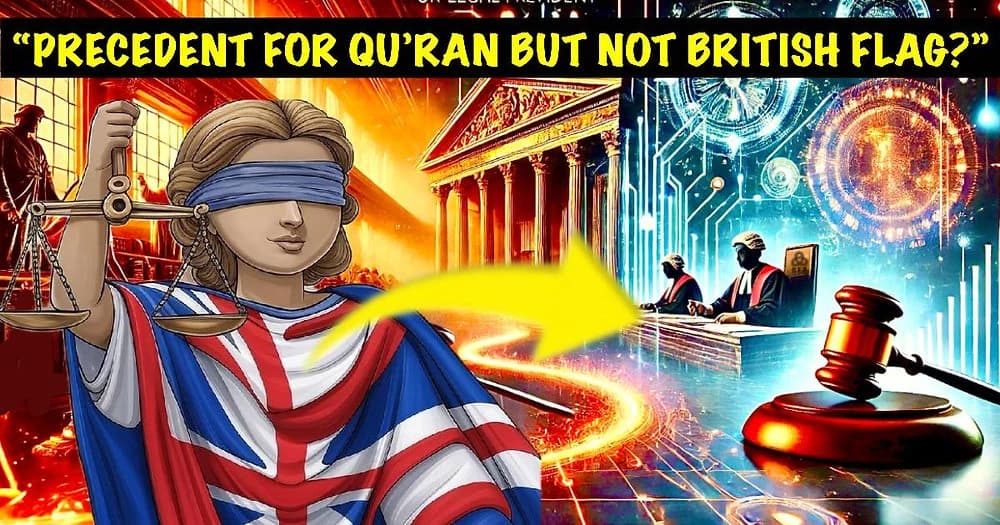
The law, we are told, applies equally to all.But does itBut does it? When policewatch passivelywatch passivelyas aUnion Jack is torn apartUnion Jack is torn apart, yetswiftly arrest those who burn a Qur’an,swiftly arrest those who burn a Qur’an,it raises a troubling question: is public order law about keeping the peace, or picking sides?
Recent protest actions have thrust us once more unto the breach, dear friends, as another public order case edges towards the courtroom, and with it, the uncomfortable question of whether our justice system is applying the law fairly—or whether we are witnessing the slow creep ofpolitically motivated prosecutionspolitically motivated prosecutions.
At the heart of the matter is an age-old legal principle:precedentprecedent. The foundation stone ofcommon lawcommon law, the guiding hand ofjudicial consistencyjudicial consistency, and—if wielded correctly—a rather potent headache for any prosecutor caught trying to enforceone rule for one group and another for the restone rule for one group and another for the rest.
The Legal Tightrope: Precedent, Consistency, and Public OrderThe Legal Tightrope: Precedent, Consistency, and Public Order
British law prides itself on treating like cases alike.British law prides itself on treating like cases alike.It’s the judicial equivalent of refusing to play favourites. The courts, bound by both centuries ofcommon lawcommon lawand modern legal protections likeArticle 7 of the European Convention on Human Rights (ECHR)Article 7 of the European Convention on Human Rights (ECHR), should never punish someone for an act that was not clearly illegal at the time it was committed. Equally,Article 10 guarantees freedom of expressionArticle 10 guarantees freedom of expression—even when that expression is controversial, offensive, or downright inflammatory.
Yet, recent events have raised eyebrows among those of us who spend our lives poring overcourt transcripts and police charging decisionscourt transcripts and police charging decisions. When one act of public protest—say, tearing up aUnion JackUnion Jack—passes without so much as a caution, but another—such asburning a Qur’anburning a Qur’an—lands the individual in the dock, it’s impossible not to ask:is the law being applied equally, or is selective prosecution now an unspoken policy?is the law being applied equally, or is selective prosecution now an unspoken policy?
This is not an abstract debate for legal theorists. This isreal, pressingreal, pressing, and likely to be argued incourtrooms up and down the countrycourtrooms up and down the countryas new cases come before the judiciary.
The Defence Barrister’s Playbook: Precedent as a ShieldThe Defence Barrister’s Playbook: Precedent as a Shield
If theCrown Prosecution Service (CPS)Crown Prosecution Service (CPS)wants to start distinguishing between “acceptable” and “unacceptable” forms of symbolic protest, they had better come armed with a watertight legal argument. Because any half-competent defence barrister will be ready with afour-pronged counterattackfour-pronged counterattack:
1.Inconsistent Enforcement of Public Order LawsInconsistent Enforcement of Public Order Laws– If the police turn a blind eye when one protester torches theUnion JackUnion Jackbut swiftly arrest another for burning areligious textreligious text, that disparity is not just unfair—it’slegally dubiouslegally dubious. A defence lawyer would argue that suchselective enforcementselective enforcementundermines public confidence in policing and potentially breaches theEquality Act 2010Equality Act 2010, which prohibits discrimination in the exercise of public functions.
2.Absence of Clear Harm or DisorderAbsence of Clear Harm or Disorder– ThePublic Order Act 1986Public Order Act 1986requires that an act be “threatening, abusive, or insulting” and likely to causeharassment, alarm, or distressharassment, alarm, or distress. But if no arrests were made when a group of protesters shredded aBritish flagBritish flagin front of patriotic demonstrators—who could reasonably have been expected to take offence—then why should another act ofsymbolic destructionsymbolic destructionsuddenly cross the legal threshold?
3.Violation of Free Speech RightsViolation of Free Speech Rights– Love it or loathe it,freedom of expression under Article 10freedom of expression under Article 10extends tooffensive speechoffensive speech. And if one group’s offensive protest is tolerated while another’s is criminalised, the judiciary will have to grapple with a fundamental question:does the state have the right to decide which political or ideological views are protected and which are punished?does the state have the right to decide which political or ideological views are protected and which are punished?
4.Selective Prosecution as a Violation of Equality Before the LawSelective Prosecution as a Violation of Equality Before the Law–Magna Carta 1215Magna Carta 1215,common lawcommon law, andcenturies of legal traditioncenturies of legal traditioninsist thatthe law must be applied evenlythe law must be applied evenly. If the CPS decides that one form of protest is legally acceptable while another is worthy of prosecution, the defence will argue that this represents anarbitrary—or even unlawful—application of justicearbitrary—or even unlawful—application of justice. And in a system that prides itself on the principle thatall are equal before the lawall are equal before the law, that’s a dangerous road to travel.
The Legal Domino Effect: What Happens Next?The Legal Domino Effect: What Happens Next?
If the courts start handing downconflicting rulingsconflicting rulings—convicting some protesters while letting others off the hook—the inevitablelegal challengelegal challengewill follow. Appeals will roll in,senior judgessenior judgeswill be forced to clarify the law, and sooner or later, the judiciary will have to make adefinitive rulingdefinitive rulingon whetherpublic order offencespublic order offencescan be prosecuted selectively.
In the most extreme cases, if evidence emerges thatpolice or prosecutors acted with a political agendapolice or prosecutors acted with a political agenda, we could even see ajudicial review of CPS charging decisionsjudicial review of CPS charging decisions. This would be alegal earthquakelegal earthquake, exposing the state to allegations ofpolitically biased prosecution strategiespolitically biased prosecution strategies.
Justice Must Not Become a Political FootballJustice Must Not Become a Political Football
At its core, this is not just a debate aboutflags, books, or religious sensitivitiesflags, books, or religious sensitivities. This is aboutthe rule of law itselfthe rule of law itself. Ifjustice becomes selectivejustice becomes selective—if it bends topolitical pressure rather than legal principlespolitical pressure rather than legal principles—we risk undermining the very foundation of ourlegal systemlegal system.
And once thatPandora’s boxPandora’s boxis open, it’s adevil of a job to shut it againdevil of a job to shut it again.
So, as these cases edge towards trial, one thing is certain:precedent mattersprecedent matters. And the moment the courts start enforcingone rule for one group and another for the restone rule for one group and another for the rest, theintegrity of the entire system is at stakeintegrity of the entire system is at stake.
Jason KingJason King
Birmingham City-DeskBirmingham City-Desk
VIDEO PRODUCTION NEWSVIDEO PRODUCTION NEWS