No, Brits Can’t Claim US Asylum Over Memes—It's a Fantasy
As viral claims spark false hope and shady fundraisers, we reveal the legal truth behind the absurd fantasy of fleeing UK law through American asylum. So…

As viral claims spark false hope and shady fundraisers, we reveal the legal truth behind the absurd fantasy of fleeing UK law through American asylum.
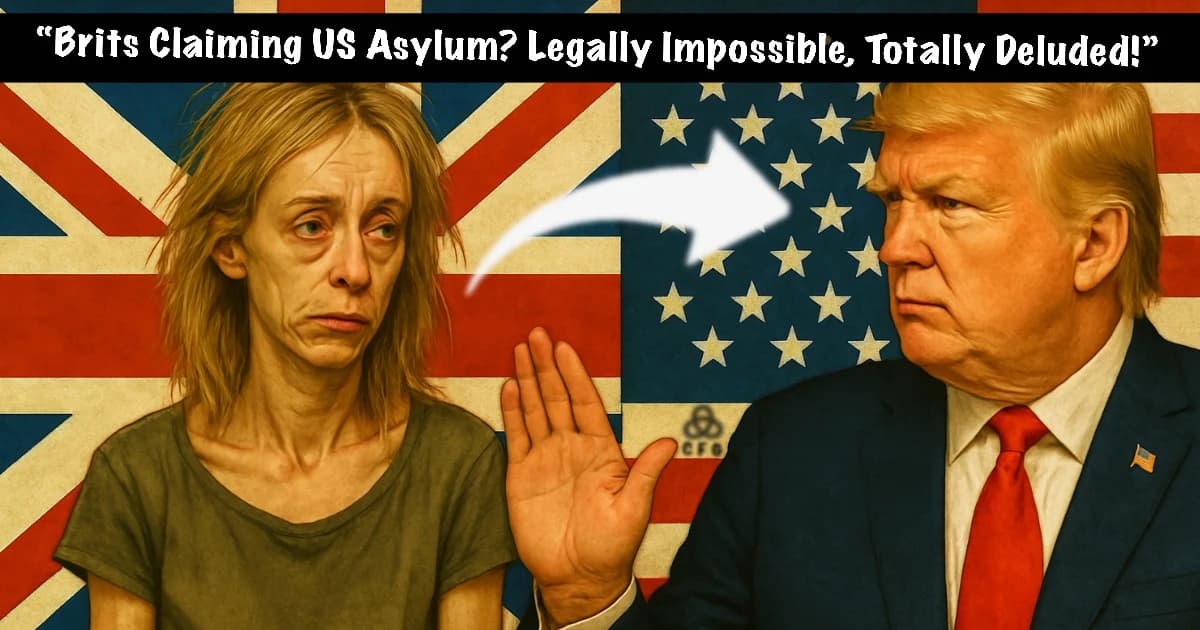
So let me be clear from the offset here it is legally impossible, both now and at any time in the future, for any British citizen to claim political asylum in the United States of America on the grounds of prosecution, investigation, or conviction under the laws of the United Kingdom.
This is not a matter of political opinion or interpretive argument—it is an immovable legal fact grounded in international asylum law, bilateral treaties, and decades of case law. And yet, following an utterly baseless and, frankly, absurd question asked at a recent White House press briefing by former Mumford & Sons banjo player turned amateur provocateur Winston Marshall, the internet is now awash with breathless claims that such asylum bids are not only possible, but imminent.
In the viral clip, Mr Marshall asks whether President Trump’s administration would “consider political asylum” for British citizens allegedly imprisoned or persecuted for “speech crimes” such as posting memes.
The Press Secretary’s response, presumably a polite and diplomatic deflection to a daft and ill-informed question, was immediately misrepresented across social media as a tacit endorsement of this completely fabricated legal pathway.
As a result, online fundraisers have now begun emerging from individuals and groups claiming to be launching legal bids to seek asylum in the US for such so-called “free speech prisoners”. Let us be clear: raising money for a legal application that has no foundation in law, with no chance of success, and without disclosing these legal facts to donors, is not an act of idealistic resistance—it is deception. It is, on any fair legal reading, possibly a form of fraud.
For those unfamiliar with asylum law, the 1951 Refugee Convention—codified and interpreted in both UK and US domestic law—requires an applicant to demonstrate a well-founded fear of persecution due to race, religion, nationality, membership of a particular social group, or political opinion.
Crucially, the persecution must emanate from, or be condoned by, the state. Prosecution under democratically enacted laws, with the availability of legal representation, judicial review, and a functioning appellate system, does not constitute persecution. The existence of laws penalising hate speech, harassment, or incitement—no matter how unpopular those laws may be in certain circles—is not persecution. It is, in the eyes of international law, governance.
The United Kingdom is a Tier 1 liberal democracy with a fully functioning independent judiciary, extensive human rights protections under the Human Rights Act 1998, and access to the European Court of Human Rights. There are no credible international legal bodies—UNHCR included—that regard British citizens as potential refugees from their own government. To argue otherwise, as some now seem determined to do, is as legally incoherent as it is laughable.
And yet, the grift machine grinds on. In what may become the most cynical exploitation of this fantasy to date, some individuals are now claiming that families under investigation by UK social services are preparing to seek political asylum in the United States.
Their justification? That intervention by safeguarding authorities constitutes “state persecution”. If this were even remotely plausible in law—and it is not—it would weaponise every child protection measure in Britain.
Every parent in breach of a care order or court direction could reframe their circumstances as political oppression, turning family courts into launchpads for transatlantic asylum bids. It would not only make a complete mockery of the UK's safeguarding framework, it would utterly dismantle the authority of child protection officers to act in the interests of vulnerable minors.
What’s more, any attempt by the United States to entertain such cases would rupture the foundations of bilateral diplomatic relations. The UK and US are longstanding allies, with extensive legal cooperation through extradition treaties, mutual legal assistance agreements, and shared security protocols. For one nation to declare the other a persecutory regime would trigger a formal breakdown in cooperation, not to mention open a geopolitical can of worms with implications far beyond the shores of Twitter/X Facebook and Rumble.
It must also be noted that individuals in the UK who have been issued with so-called “non-crime hate incidents” (Much as I personally strongly dislike them and would love to see them banned), are not criminalised, nor imprisoned. These are police-held records, most of which never progress beyond administrative noting. While the legal and ethical basis for their use is itself a matter for domestic judicial review—as it has been—the idea that they form the basis for US asylum claims is laughable. To describe them as “persecution” is akin to calling a parking ticket a war crime.
The harsh reality is this: those knowingly promoting this asylum narrative, and collecting funds based upon it, are not fighting tyranny. They are monetising legal illiteracy. They are packaging fantasy as strategy and selling false hope to an audience deliberately misled. A lie repeated at high volume does not become law—it becomes fraud. And in the end, it is not the fraudsters who suffer, but the donors duped into thinking they were contributing to a meaningful cause.
This is not a culture war issue. It is a matter of black-letter law, and that law is unequivocal.