
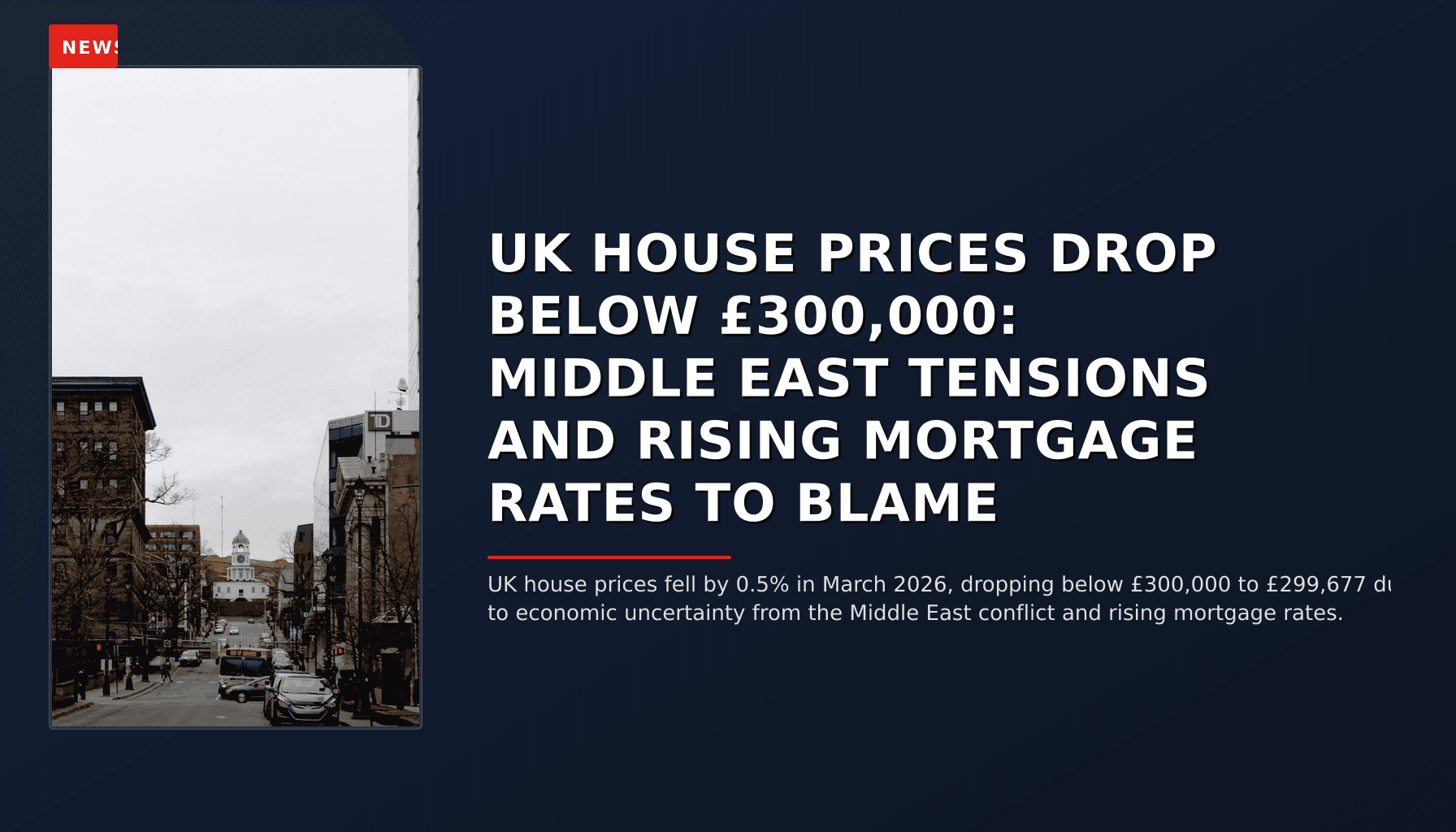
UK HOUSE PRICES DROP BELOW £300,000: MIDDLE EAST TENSIONS AND RISING MORTGAGE RATES TO BLAME
The UK housing market has seen a notable downturn in March 2026, with house prices dropping below £300,000 due to Middle East tensions and rising mortgage rates.

The UK housing market faces new challenges as prices fall below £300,000 due to geopolitical tensions and economic pressures.
In a significant shift for the UK housing market, house prices dropped by 0.5% in March 2026, marking the first time since early 2024 that they have fallen below £300,000, settling at £299,677. This decline has been attributed to a confluence of factors, primarily the ongoing uncertainty surrounding the Middle East conflict involving Iran and rising mortgage rates. According to recent reports from The Guardian, this downward trend reflects broader economic anxieties impacting buyer confidence.
The pace of annual property price growth has slowed considerably, now sitting at 0.8% year-on-year, down from 1.2% recorded in the previous month. This moderation is a stark contrast to the more robust increases seen over the past two years and underscores the delicate balance of the UK housing market. Experts suggest that the combination of geopolitical tensions and economic instability has created a challenging environment for potential buyers and sellers alike.
Halifax, one of the UK's leading mortgage providers, has expressed concerns over the rising costs associated with home ownership. Amanda Bryden, head of mortgages at Halifax, highlighted that higher energy prices and inflation expectations have driven up mortgage rates, which now stand at 5.84% for the average two-year fixed residential mortgage. This is the highest rate seen since July 2024 and reflects a broader trend of increasing borrowing costs.
The impact of these rising rates has been particularly pronounced among first-time buyers, who are increasingly price-sensitive due to their limited financial resources. Ms Bryden noted that mortgage rates are a key consideration for most buyers, with many opting to delay purchases or reduce their property aspirations in the face of higher borrowing costs. This sentiment is mirrored across the country, as prospective buyers carefully monitor market conditions before committing to a purchase.
Read more: KILDUNNE'S SOLO MONOLUGUE: THE LONELINESS OF WORLD CUP VICTORY
Regional disparities in house price growth have also come into sharp focus. Northern Ireland continues to outpace other regions, with an 8.7% annual increase taking average prices to £224,809. Scotland has seen a more moderate rise of 4.4%, reaching £222,716, while Wales recorded a 1.6% increase to £230,909. In contrast, the south of England, particularly the south-east and London, has experienced a softening in prices, with year-on-year drops of 1.9% and 1.2%, respectively.
The Bank of England has added further weight to concerns about economic stability by signaling potential interest rate hikes in response to inflation risks stemming from the ongoing Middle East conflict. This move reflects a broader shift in monetary policy, as central banks globally grapple with the dual challenges of inflation control and geopolitical instability. Recent forecasts suggest that buyers might yet see some respite, following a US-Iran ceasefire agreement that has somewhat tempered market anxieties.
Despite this potential reprieve, many prospective buyers remain cautious, opting to closely monitor mortgage rates before proceeding with purchases. This观望 approach is likely to persist as long as economic uncertainties continue to loom large over the housing market. The interplay between geopolitical tensions and domestic economic factors promises to shape the trajectory of the UK property market in the coming months.
Looking ahead, experts predict that the housing market will remain under significant pressure unless there is a substantial easing of global tensions and a corresponding reduction in inflationary pressures. With the Bank of England's stance on potential rate hikes and the ongoing Middle East conflict casting a shadow over economic prospects, the path forward for UK house prices remains uncertain. For buyers and sellers alike, navigating this complex landscape will require careful consideration and strategic planning.
Read more: NATIONAL CRIME AGENCY INVESTIGATES MAJOR INTERNATIONAL BANK FOR ANTI-MONEY LAUNDRING BREACHES

More Stories

KILDUNNE'S SOLO MONOLUGUE: THE LONELINESS OF WORLD CUP VICTORY
8 April 2026 at 07:322 min read
Read More
NATIONAL CRIME AGENCY INVESTIGATES MAJOR INTERNATIONAL BANK FOR ANTI-MONEY LAUNDRING BREACHES
8 April 2026 at 05:583 min read
Read More
DROPPING OIL PRICES: US AND IRAN REACH CEASEFIRE DEAL TO REOPEN STRAIT OF HORMUZ
8 April 2026 at 04:332 min read
Read MoreComments (0)
No comments yet. Be the first to share your thoughts!
Leave a Comment
Your email address will not be published. Comments are moderated before appearing.