
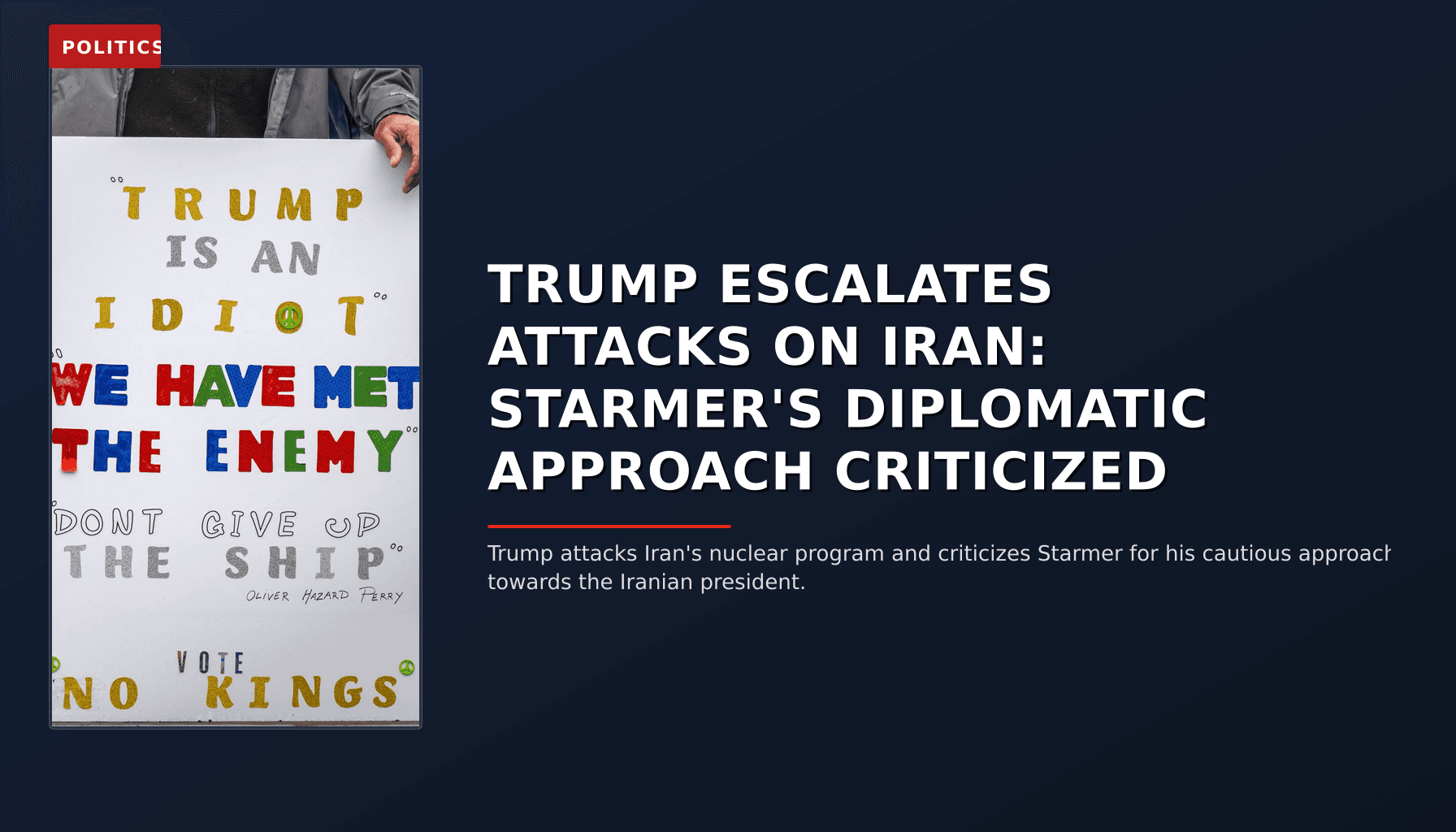
TRUMP ESCALATES ATTACKS ON IRAN: STARMER'S DIPLOMATIC APPROACH CRITICIZED
President Trump escalates attacks on Iran's nuclear program with new sanctions, while Prime Minister Starmer faces criticism for his cautious approach to Tehran.

U.S. President Trump has intensified his criticism of Iran's nuclear program, while Prime Minister Starmer faces scrutiny for his cautious engagement with Tehran.
In a significant escalation of tensions between the United States and Iran, President Donald Trump has announced new sanctions targeting Iran's nuclear program. These measures come amid growing international concern over Tehran's nuclear activities, which have been a focal point of global diplomacy for years. According to sources familiar with the situation, Trump's latest actions reflect his administration's hardline stance towards Iran, further complicating an already delicate geopolitical landscape.
The new sanctions are part of a broader strategy by the U.S. government to curb Iran's nuclear capabilities and deter what it perceives as aggressive behavior. This move follows months of escalating rhetoric from Trump, who has consistently criticized Iran's leadership and its policies in the Middle East. While the exact details of these sanctions have yet to be fully outlined, they are expected to impact key sectors of Iran's economy, further straining relations between the two nations.
Meanwhile, in London, Prime Minister Rishi Starmer's government is adopting a notably different approach towards Tehran. Sources indicate that Starmer is taking a cautious or 'tiptoeing' strategy when engaging with Iranian president Ebrahim Raisi. This approach has drawn criticism from some quarters, who argue that it fails to match the tougher stance being taken by the U.S. and other Western allies.
Critics of Starmer's approach suggest that his caution may undermine efforts to present a united front against Iran's nuclear program. They argue that a more assertive strategy would better align with international consensus and pressure Tehran to adhere to non-proliferation agreements. However, supporters of Starmer's tactics maintain that diplomacy remains the most effective tool in addressing complex geopolitical issues, even when dealing with contentious regimes like Iran's.
The divergence in approaches between Trump and Starmer highlights the broader challenges of coordinating international responses to Iranian nuclear policy. While the U.S. pushes for stringent sanctions and a tougher line, the UK appears more inclined towards dialogue and incremental measures. This differing strategy could potentially strain transatlantic relations, particularly if other European nations follow suit or remain neutral on the issue.
As tensions continue to rise, both sides are likely to face increasing pressure to justify their positions. For Trump, maintaining a strong stance against Iran is seen as crucial for his administration's foreign policy credentials. For Starmer, balancing domestic priorities with international obligations will be key to navigating this complex diplomatic landscape. The outcome of these efforts could have far-reaching implications for regional stability and global nuclear non-proliferation efforts.
More Stories
THE UK GOVERNMENT'S IMMIGRATION REFORMS UNDER SCRUTINY: HOME SECRETARY'S PROPOSALS SPARK CONTROVERSY
19 March 2026 at 01:243 min read
Read More
EXCLUSIVE: BEN JENNINGS' CARTOON SPARKS CONTROVERSY OVER NIGEL FARAGE'S CONTENT CREATION
19 March 2026 at 00:333 min read
Read More
KEMI BADENACH ATTACKS PM: SCATHING CRITICISM OVER IRAN WAR RESPONSE
7 March 2026 at 14:153 min read
Read More
Comments (0)
No comments yet. Be the first to share your thoughts!
Leave a Comment
Your email address will not be published. Comments are moderated before appearing.