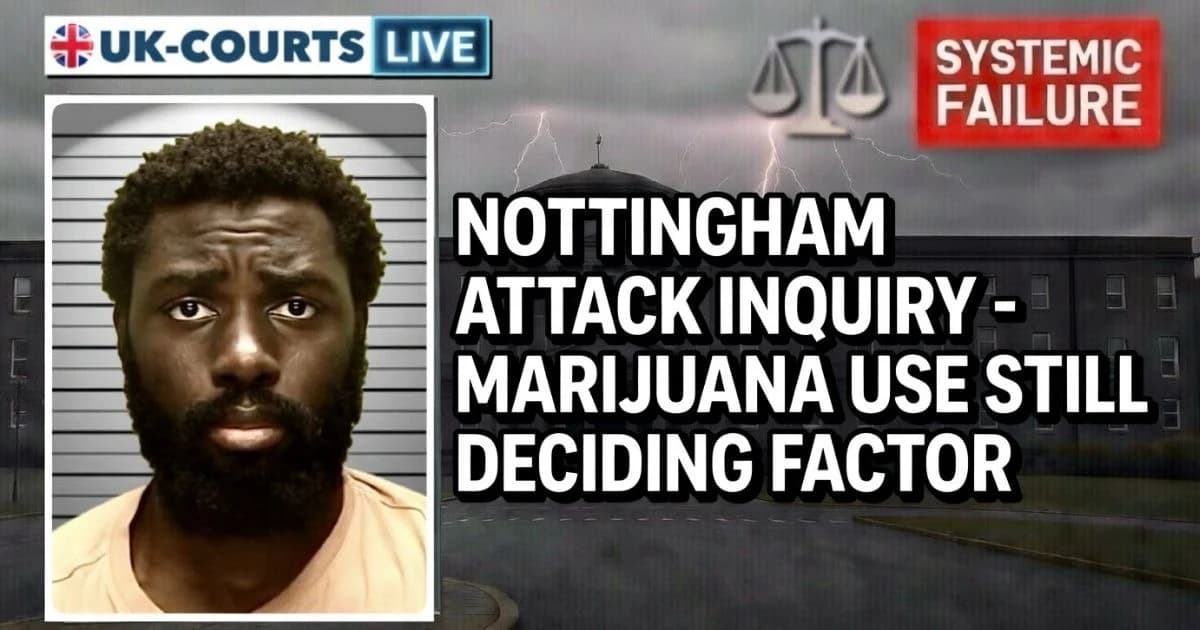
Nottingham Inquiry: Police Apologise for Missing Drug Test & Impact on Calocane Defence
Inquiry bombshell as police admit missed drugs test that may have impacted Calocane’s dimi responsibility defence, raising fresh questions over failures before the attacks The senior investigating officer in the Nottingham attacks has apologised for failing to obtain a hair sample from Valdo...

Inquiry bombshell as police admit missed drugs test that may have impacted Calocane’s dimi responsibility defence, raising fresh questions over failures before the attacks
The senior investigating officer in the Nottingham attacks has apologised for failing to obtain a hair sample from Valdo Calocane following his arrest, telling a public inquiry that the omission may have limited evidence relevant to the issue of diminished responsibility.
Detective Superintendent Leigh Sanders, who has since retired from Nottinghamshire Police, gave evidence on Wednesday to the ongoing inquiry into the June 2023 killings and associated attempted murders. He accepted that, in hindsight, a hair sample should have been taken while Calocane was in custody.
“I have apologised in my statement for that,” Mr Sanders said. “In hindsight perhaps I should have obtained a copy of head hair whilst he was in custody because to do so would at least have alleviated some of the fears of the families… in relation to the negation of the possible defence of diminished responsibility.”
Calocane fatally stabbed University of Nottingham students Barnaby Webber and Grace O’Malley-Kumar, both aged 19, in Ilkeston Road in the early hours of 13 June 2023. He later killed Ian Coates, 65, in the Mapperley Park area before stealing his van and driving it into pedestrians at two locations in Nottingham city centre, resulting in three further victims sustaining serious injuries.
He was initially charged with three counts of murder and three counts of attempted murder. In January 2024, prosecutors accepted his pleas of not guilty to murder but guilty to manslaughter on the grounds of diminished responsibility, alongside admissions to attempted murder. He is currently subject to an indefinite hospital order.
The inquiry heard that no blood or urine samples were obtained after Calocane declined to provide consent, and that a decision was taken not to pursue a hair sample on the basis that there was no known history of drug misuse.
Mr Sanders acknowledged that decision during his evidence, stating: “I apologise that we didn’t do it.”
He was asked by counsel to the inquiry, Rachel Langdale KC, about the potential evidential value of such a sample. Mr Sanders said he understood that the presence of drugs in a hair sample might have assisted in rebutting the defence of diminished responsibility, although he added that it would not have demonstrated intoxication at a specific time.
“A sample of hair would not be able to provide analysis that showed drugs or alcohol in the system at a specific time or date,” he said.
Mr Sanders also told the inquiry that, at the time of the investigation, he believed Calocane had committed murder, describing his actions as deliberate and unforced.
The inquiry has also heard clinical evidence relating to Calocane’s mental state following his arrest, including assessments carried out in custody and prior to his transfer to a high-security hospital. Emily Doherty, a senior social worker, told the inquiry he appeared to “disregard” the seriousness of his offences and was “quite passive” when discussing the meaning of murder, adding that he “didn’t present as somebody who was wholly aware of what implications a murder charge could have”.
However, expert psychiatric evidence presented in the case has consistently concluded that Calocane was suffering from paranoid schizophrenia at the time of the offences, with symptoms including persistent auditory hallucinations and delusional beliefs. The Court of Appeal was told that his actions were carried out during an acute psychotic episode which “substantially impaired his ability to form a rational judgement and to exercise self-control”, and that the offending would not have occurred in the absence of that condition .
The inquiry heard that Calocane reported hearing voices “all the time”, including during assessments, with clinicians describing the symptoms as consistent with psychosis and including a “running commentary” on his actions. Evidence was also given that there had been a period prior to the attacks during which his mental state was not fully documented following discharge from mental health services.
The inquiry has also heard that Calocane had prior contact with police due to violence and stalking in the period before the attacks, including an allegation of assault on an emergency worker which led to him being subject to a court process he later failed to attend. A warrant was subsequently issued for his arrest but was not executed.
Police recordes document earlier incidents of violent and intrusive behaviour, including forcing entry into neighbouring properties during episodes linked to his mental state.
In the light of the evidence now heard, and the growing body of material examined by the inquiry concerning both policing and clinical decision-making, the central question turns to what lessons may be drawn to reduce the risk of comparable incidents in future. A key issue emerging from the proceedings is the decision not to categorise Calocane as a patient requiring sustained detention or a structured, enforceable monitoring framework, capable of managing risk and triggering intervention during periods of relapse.
UK Courts Live’s investigation has identified a specific factor underpinning that approach: clinicians were aware that any such regime would have required strict abstinence from cannabis as a condition of safe management in the community, and formed the view that compliance with that requirement was unlikely. That issue, while central to questions of risk, oversight and enforceability, has not formed a prominent line of examination within the inquiry to date. As proceedings continue, it remains a critical question whether the most consequential decisions surrounding long-term management and compliance will be directly confronted.