
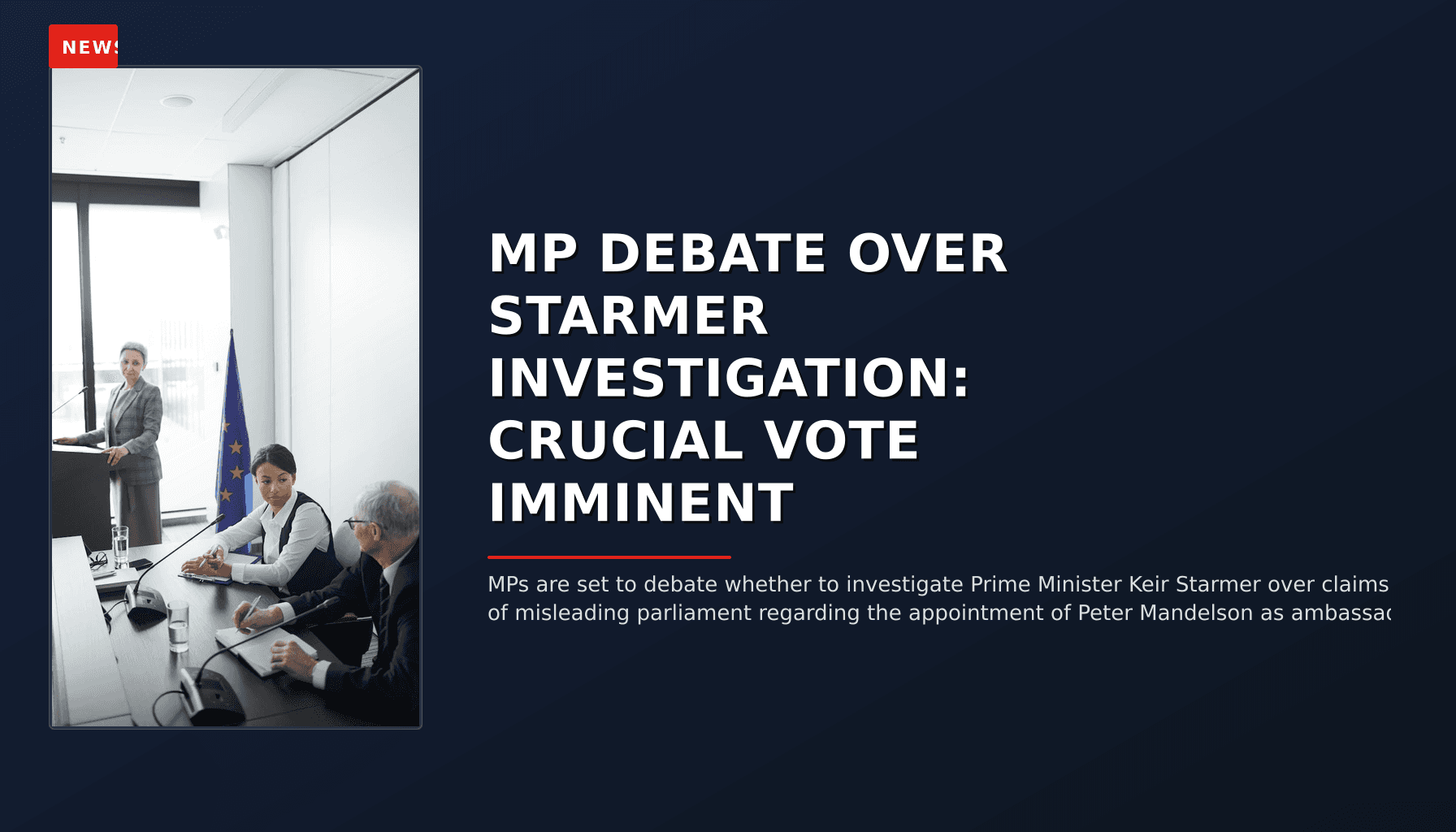
MP DEBATE OVER STARMER INVESTIGATION: CRUCIAL VOTE IMMINENT
MPs are set to vote on whether to investigate Prime Minister Keir Starmer over claims of misleading parliament regarding Peter Mandelson's appointment as ambassador. The debate highlights issues of ministerial accountability and security vetting procedures.

MPs will soon decide whether to investigate Prime Minister Keir Starmer over claims of misleading parliament regarding Peter Mandelson's ambassador appointment.
The House of Commons is on the brink of a significant decision as MPs prepare to debate whether Prime Minister Keir Starmer should face an inquiry for allegedly misleading parliament. The controversy centers around the appointment of Peter Mandelson as UK ambassador to France, a move that has sparked intense political debate. According to sources close to the matter, the House of Commons speaker, Lindsay Hoyle, has indicated that a vote on referring Starmer to the privileges committee will take place this Tuesday. This decision could set a precedent for how ministers are held accountable for their public statements.
The opposition Conservative Party has been at the forefront of these allegations, arguing that Starmer knowingly misled parliament by announcing Mandelson's appointment before his security vetting was complete. They claim this constitutes a ministerial resignation offence, which could have serious implications for Starmer's position as Prime Minister. Speaking on the matter, a senior Tory MP stated, 'If it is proven that the Prime Minister deliberately misled parliament, it would be an unprecedented step in modern politics.'
In defense of Starmer, government sources maintain that his comments were based on the information available at the time. They argue that while the security vetting process was ongoing, there was no explicit policy preventing the announcement of a diplomatic appointment before its completion. This position has been supported by David Lammy, the deputy prime minister, who acknowledged 'time pressures' faced by the Foreign Office last January when Mandelson's appointment was confirmed. However, critics argue that these pressures should not excuse what they perceive as a breach of parliamentary protocol.
A key element in this debate is a memo written by Simon Case, former cabinet secretary, which reportedly advised completing security vetting before announcing high-profile diplomatic appointments. If made public, this document could undermine the government's stance and add weight to the Conservative's allegations. The memo highlights what some MPs see as a failure in internal procedures, raising questions about the integrity of the appointment process. As one MP put it, 'The Prime Minister cannot claim ignorance of proper procedure when such clear guidance was available.'
Read more: Keir Starmer Accuses Dominic Robbins Of Obstructing Truth Over David Mandelson'S Vetting
The upcoming vote is part of a broader trend of increasing scrutiny on government actions and ministerial accountability. Similar debates have occurred in recent years over other high-profile appointments, but this case has drawn particular attention due to the involvement of Peter Mandelson, a veteran politician with a controversial past. His appointment has been criticized by some who view him as an establishment figure, while others argue that his experience makes him uniquely suited for the role.
As the debate unfolds, both sides are preparing their arguments carefully. For Starmer and the government, this is an opportunity to defend their actions and reaffirm the Prime Minister's commitment to transparency. For the Conservatives, it represents a chance to challenge what they see as a misuse of power and set a new standard for ministerial accountability. The outcome of this vote could have far-reaching implications for how future governments handle similar situations.
Public opinion remains divided on the issue, with some expressing concern over the politicization of parliamentary procedures and others demanding greater transparency in government decision-making. Regardless of the vote's result, the case has already highlighted critical issues regarding security vetting protocols and the ethics of diplomatic appointments. As one political analyst noted, 'This isn't just about Starmer or Mandelson—it's about how we hold our leaders accountable in a democratic society.'
With the debate scheduled for Tuesday, all eyes are on the House of Commons as MPs prepare to cast their votes. The outcome will not only determine whether Starmer faces an inquiry but could also influence how future Prime Ministers navigate similar challenges. As the political landscape continues to evolve, this case serves as a reminder of the delicate balance between executive power and parliamentary oversight in the UK.
Read more: KEIR STARMER'S ALLIANCES UNDER SCRUTINY: THE FUTURE OF LABOUR UNITY

More Stories
Keir Starmer Accuses Dominic Robbins Of Obstructing Truth Over David Mandelson'S Vetting
21 April 2026 at 09:521 min read
Read More
KEIR STARMER'S ALLIANCES UNDER SCRUTINY: THE FUTURE OF LABOUR UNITY
26 April 2026 at 15:112 min read
Read More
Labour Leadership Unrest: Keir Starmer'S Future In Doubt
22 April 2026 at 20:232 min read
Read MoreComments (0)
No comments yet. Be the first to share your thoughts!
Leave a Comment
Your email address will not be published. Comments are moderated before appearing.