
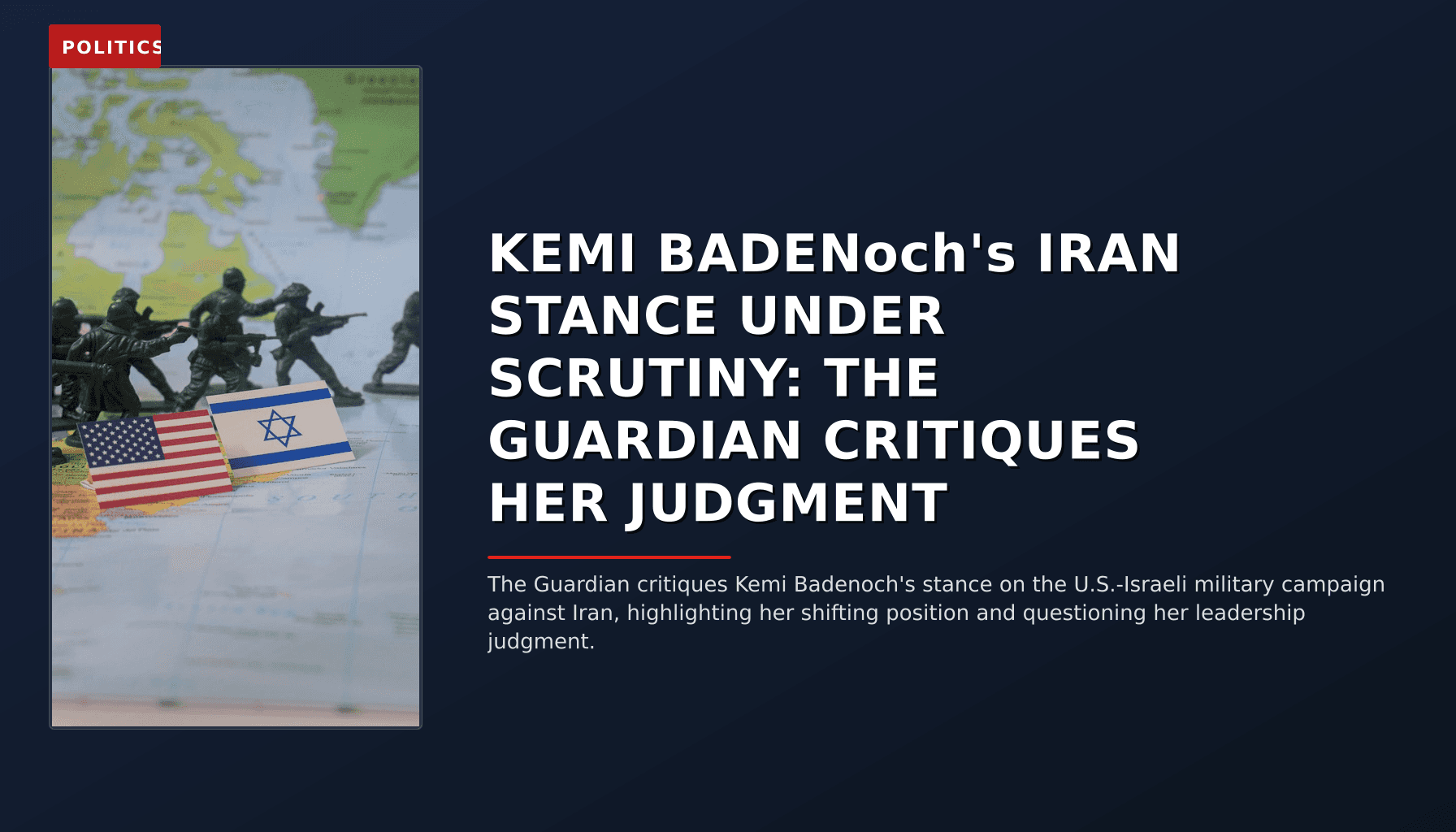
KEMI BADENoch's IRAN STANCE UNDER SCRUTINY: THE GUARDIAN CRITIQUES HER JUDGMENT
The Guardian critiques Kemi Badenoch's shifting stance on Iran, questioning her judgment and alignment with U.S. conservatism.

The Guardian questions Kemi Badenoch's leadership judgment over her shifting stance on the U.S.-Israeli military campaign against Iran.
In a recent editorial, The Guardian has raised concerns about Kemi Badenoch's evolving position on the U.S.-Israeli military campaign targeting Iran. Initially, Badenoch aligned herself with the White House's hardline approach, reflecting what appeared to be a strong transatlantic unity in confronting Tehran. However, she later distanced herself from this stance, advocating instead for British forces to take independent action by striking targets within Iran, a shift that has sparked debates over her political judgment and strategic clarity.
The Guardian's critique is part of a broader analysis that questions the alignment of Badenoch and her Conservative Party with radical elements of U.S. conservatism. The article suggests that while the UK should engage in defense policies that align with American interests, there must be a careful balance to avoid blind obeisance to White House directives. This nuanced approach is seen as crucial for maintaining British autonomy and national interests amidst an increasingly volatile international landscape.
Badenoch's flip-flop on the Iran issue has not gone unnoticed, particularly within circles that closely monitor British foreign policy decisions. Her initial support for the U.S.-Israeli campaign was interpreted as a sign of solidarity with Washington, but her subsequent call for British strikes in Iran revealed a more complex calculus. Critics argue that this inconsistency undermines her credibility as a leader and raises questions about her ability to navigate delicate diplomatic situations effectively.
The editorial also draws parallels between Badenoch's approach and that of former UKIP leader Nigel Farage, highlighting what it perceives as a broader deficit of serious political thinking on the right in British politics. While Farage's tactics have historically been more overtly confrontational, The Guardian suggests that both politicians exhibit a tendency to prioritize ideological posturing over pragmatic statecraft.
Furthermore, The Guardian is critical of Badenoch's apparent focus on appeasing U.S. audiences at the expense of considering what is in the best interests of British voters. This critique underscores concerns about the influence of transatlantic political dynamics on UK domestic policies and international relations. The article emphasizes the importance for leaders to maintain a clear sense of duty towards their home constituencies while engaging with global affairs.
In examining Badenoch's stance, The Guardian also touches upon the broader implications of social media's role in shaping political thought and decision-making. It suggests that leaders like her must be vigilant against radicalization through such platforms, which can skew their perspectives away from centrist, balanced policies towards more extreme positions. This cautionary note is particularly relevant as digital influence continues to play a pivotal role in modern politics.
The article concludes by underscoring the necessity for leaders to strike a delicate balance between international alliances and domestic priorities. It calls for a reevaluation of how British politicians approach foreign policy decisions, urging them to adopt positions that reflect both national interests and a deep understanding of global geopolitical dynamics. The critique serves as a reminder of the challenges inherent in crafting effective, nuanced policies amidst the pressures of 24-hour news cycles and social media-driven public opinion.
Looking ahead, this analysis could influence ongoing debates within the Conservative Party about its stance on foreign policy and transatlantic relations. Badenoch's handling of the Iran issue may set a precedent for how her colleagues approach similar complex diplomatic scenarios in the future. The Guardian's commentary has already sparked discussions among political analysts and policymakers, highlighting the need for more thoughtful and strategic engagement with international affairs.
More Stories
KEMI BADENACH ATTACKS PM: SCATHING CRITICISM OVER IRAN WAR RESPONSE
7 March 2026 at 14:153 min read
Read More
YVETTE COOPER CRITICIZES US-INFLUENCED FOREIGN POLICY
15 March 2026 at 23:091 min read
Read More
UK GOVERNMENT CONSIDERS ENERGY BILL INTERVENTION: ED MILIBAND'S INDICATION OF POTENTIAL ACTION
16 March 2026 at 00:442 min read
Read More
Comments (0)
No comments yet. Be the first to share your thoughts!
Leave a Comment
Your email address will not be published. Comments are moderated before appearing.