Rhiannon Whyte murder: Deng majek to be sentenced amid age row
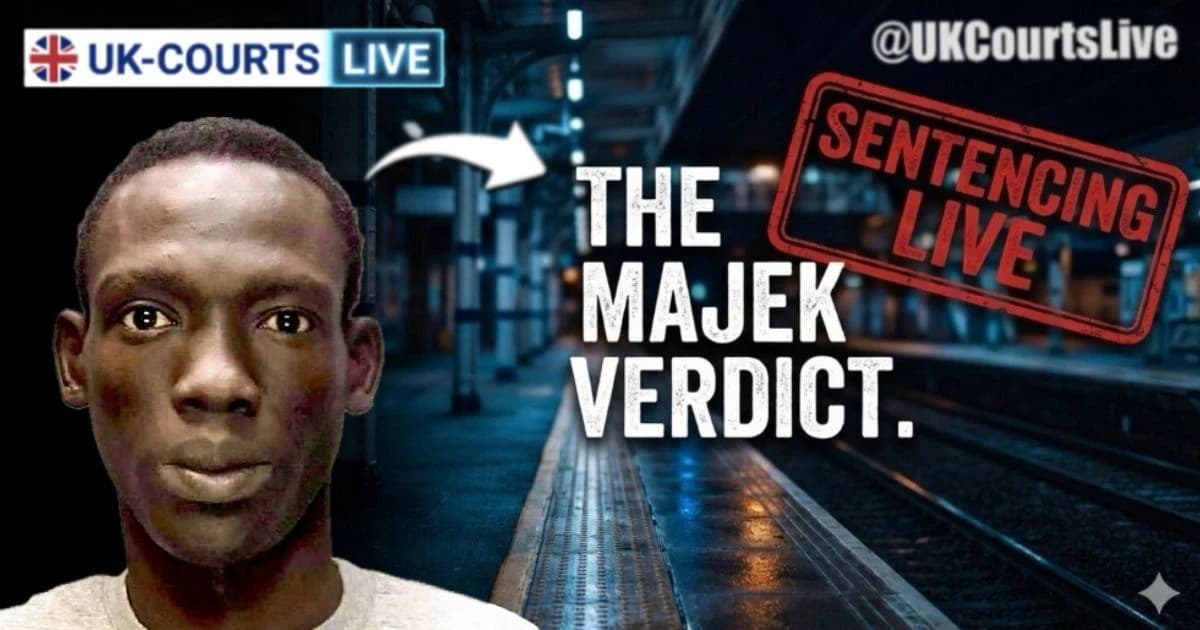
Tomorrow, the court will decide Deng Majek’s fate after the brutal murder of Rhiannon Whyte, with sentencing expected to bring a formal end to one of the most disturbing cases of the year. The sentencing of Deng Majek will take place tomorrow, with UK Courts Live reporting live from Wolverhampton...

Tomorrow, the court will decide Deng Majek’s fate after the brutal murder of Rhiannon Whyte, with sentencing expected to bring a formal end to one of the most disturbing cases of the year.
The sentencing of Deng Majek will take place tomorrow, with UK Courts Live reporting live from Wolverhampton Crown Court throughout the day in the culmination of our blow-by-blow court reporting on the case so far. Firstly, before we get into the details of this case and the problems it highlights around discovering the true age of undocumented asylum seekers, it is necessary to address a serious factual error which constitutes a potential contempt of court in how this matter has been reported recently.
Reports claiming that two unnamed Home Office officials have privately confirmed the defendant is 27 years old represent a significant breach of the strict liability rule under the Contempt of Court Act 1981.
By publishing purported private intelligence regarding a central factual dispute while the case remains sub judice, there is a substantial risk of serious prejudice to the sentencing process.
The disclosure of such sensitive personal data by government officials to third parties would also likely constitute a criminal offence under the Data Protection Act 2018 and a breach of the Civil Service Code.
Any determination regarding the age of a defendant is a matter of evidence to be settled exclusively by the presiding judge in open court and cannot be superseded by unverified, extra-judicial briefings.
The publication of these claims to a wide audience further compounds the legal risk by attempting to influence the factual basis of a life sentence before the court has reached its own conclusion.
The fact that there is no jury at this stage of proceedings does not negate the duty to comply with contempt of court rules when publishing anything about the case.
Last October, Sudanese migrant Deng Chol Majek, whose age remains formally unconfirmed, was found guilty of the murder of Rhiannon Skye Whyte following a trial at Wolverhampton Crown Court. Majek, formerly resident at an asylum hotel in Walsall, was convicted unanimously after two hours of deliberations, with the jury rejecting his claim that he was not the person seen in the CCTV footage.
The court delayed sentencing while attempting to resolve a central factual issue: whether Majek should be sentenced as a mature adult or as an offender under the age of 21, a distinction which materially affects the sentencing framework available to the judge. That dispute has not yet been conclusively determined by available evidence.
Suella Braverman, a former senior UK Conservative politician and former Home Secretary newly defected to Reform,has been one of the most prominent political figures to raise concerns about age assessment within the asylum system, particularly in relation to unaccompanied asylum-seeking children and young people arriving without documentation.
She brought in a number of reforms, including provisions that allowed refusal to cooperate with age assessment processes to be considered when determining whether to believe an asylum seeker’s self-declared age, subject to safeguards.
Her focus has consistently been on what she describes as adults presenting as children in order to exploit immigration and safeguarding frameworks. She has argued that this creates systemic risks, undermines confidence in asylum decision-making, and places inappropriate pressure on child protection services.
Braverman has repeatedly warned that adults claiming to be minors can access accommodation, education and welfare provisions designed exclusively for children, while also benefiting from greater protection against detention or removal. She has described this as an abuse of the system that diverts limited resources away from genuinely vulnerable minors.
A central element of her criticism has been safeguarding. She has argued that placing adults of unknown age into child-specific environments presents inherent risks to children, particularly in shared accommodation or educational settings, and that misclassification can expose minors to harm. Her emphasis has been that the system must prioritise child safety, not default assumptions.
During her tenure at the Home Office, Braverman was openly critical of existing age assessment methods, which relied heavily on social-worker-led interviews and behavioural observations. She argued these processes were subjective, inconsistent between local authorities, and vulnerable to manipulation where no reliable documentary evidence existed.
She framed reform as necessary to protect genuine children, prevent exploitation, restore public confidence, and reduce strain on local authorities and the asylum system as a whole. In her view, fairness required that safeguards for minors remain robust, but credible challenges to claimed age must be resolved with greater evidential certainty.
As Home Secretary, she supported legislative reforms through the Nationality and Borders Act 2022 and the Illegal Migration Act 2023. These measures enabled the creation of a National Age Assessment Board, sought greater consistency in decision-making, and opened the door to the use of scientific techniques alongside social assessments.
Braverman frequently defended these policies in media interviews and parliamentary debate, arguing that without more rigorous age verification the system incentivised deception and placed children at risk. Her position attracted sustained criticism from medical bodies, social workers and rights organisations, who raised ethical and scientific concerns, but she maintained that the balance had tipped too far against effective enforcement.
Since leaving office, Braverman has continued to speak publicly about immigration and asylum policy, maintaining that unresolved age disputes remain emblematic of broader structural weaknesses in the system. While no longer responsible for policy implementation, her arguments on age verification have remained consistent with those advanced during her time as Home Secretary.
Sentencing in the Majek case will proceed once the court determines the factual basis upon which sentence must be passed, a decision that rests solely with the judge and must be grounded in admissible evidence presented in open court.
Debate is likely to continue over age assessments and how to prevent abuse of the system