
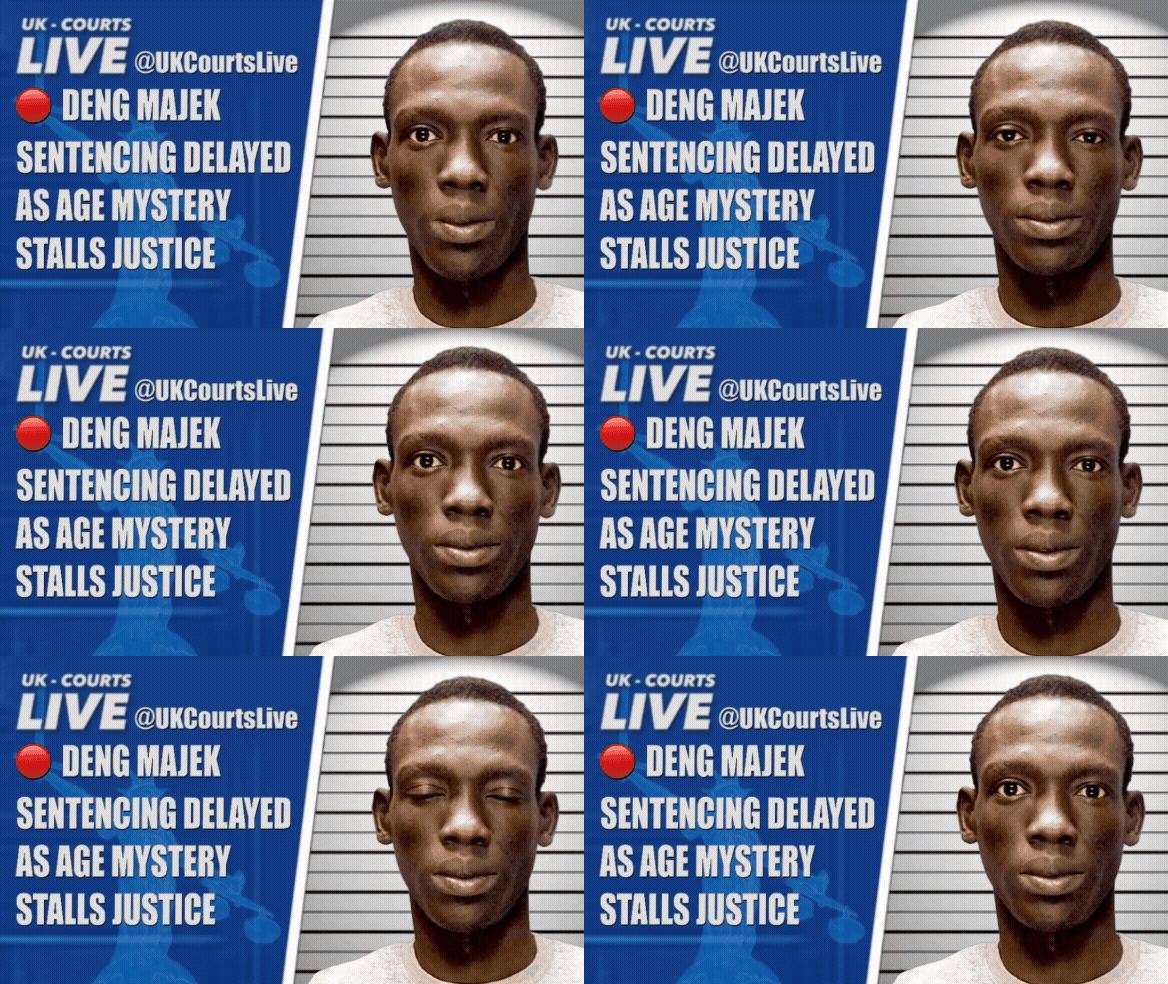
Migrant age mystery delays murder sentence
A legal battle over whether murderer Deng Chol Majek is under 21 has forced a judge to delay sentencing. Inside the "benefit of the doubt" loophole. Sentencing in the murder case of Deng Chol Majek has been delayed. The original sentencing date of 15 December 2025 was postponed because the court...

A legal battle over whether murderer Deng Chol Majek is under 21 has forced a judge to delay sentencing. Inside the "benefit of the doubt" loophole. Sentencing in the murder case of Deng Chol Majek has been delayed. The original sentencing date of 15 December 2025 was postponed because the court has not yet been able to determine his age with sufficient confidence for sentencing purposes.
A new provisional sentencing hearing has now been set for 30 January 2026 at Wolverhampton Crown Court. This decision was made at a hearing on 5 December 2025, when the judge noted that time had run out to resolve the age assessment before the end of the year.
Deng Chol Majek, a Sudanese asylum seeker, was convicted in October 2025 of murdering 27-year-old Rhiannon Skye Whyte, a hotel worker at the Park Inn in Walsall where he was residing. He followed her from the hotel after her shift and stabbed her multiple times with a screwdriver at Bescot Stadium railway station on 20 October 2024. She died from her injuries several days later. No reason for the attack was ever found, with Majek claiming at trial that he wasn’t there, despite extensive CCTV evidence.
The key distinction the court seeks to establish is not whether he was a child but whether he was under 21 or 21 and over at the time of the offence. This single factual question carries substantial procedural consequences.
Under English sentencing law, offenders aged 18 to 20 are subject to a different statutory framework from those aged 21 and over. Judges must account for youth and maturity, which involves a different starting point, potential maximum terms, and distinct guidance on culpability, development, and rehabilitation. Notably, in the most serious categories of murder—those that would attract a whole life order for offenders aged 21 or over—the starting point is capped at 30 years for those aged 18 to 20. In cases of extreme violence, the difference can translate to many additional years in custody.
Majek’s case falls in the narrow but legally significant zone between late adolescence and full adulthood. The court cannot proceed to sentence until this question is resolved.
Previously available evidence did not settle the matter cleanly. There is no birth certificate or reliable documentary record. Conflicting accounts emerge from previous encounters with authorities overseas, with an earlier record suggesting he is several years older and a Majek’s explanation attributing discrepancies to language barriers.
Independent assessments have placed him in his mid-20s, while he asserts an age that would now make him 19.
The court ordered assessments conducted to date, relying on interviews and similar methods, have not delivered the precision required for this matter.
More concrete, medical evidence has been sought but not yet obtained. No CT scan has been undertaken due to waiting lists, with priority given to patients requiring scans for medical reasons.
This particular instance, where determining an undocumented immigrant’s age is critical—because sentencing without resolving age would risk legal error—lays bare the truth that uncertainty around ages of young male migrants is not the exception but the norm. The original assessment gave the impression he could have been in his mid-20s, but he stated an age that would now make him 19, and he was treated as such because it was deemed plausible.
With no commonly available method of ascertaining ages with certainty, it is routine to give immigrants the benefit of the doubt.
This reflects standard practice in such cases. When greater precision is required, authorities typically rely on interviews and psychological assessments rather than medical examinations. These methods cannot provide absolute certainty or pinpoint accuracy. Instead, where uncertainty persists and the claimed age is plausible as being under 18, the individual is given the benefit of the doubt.
The same uncertainty underpins a broader issue in the treatment of people of unknown age within systems designed primarily for children. In immigration and asylum processes, age is determinative for housing, education, safeguarding, and criminal justice.
Current policy adopts a cautious approach: if it is plausible that someone is under 18, they are treated as such. This principle aims to protect genuine children. However, when applied to those who are not children, it carries significant consequences. Local authorities must place them in care settings, schools, colleges, or supported accommodation, often alongside children two or three years younger—or more.
This introduces serious safeguarding risks for actual children.
There is an acknowledged margin of error that can result, for example, in adults sharing classrooms or living arrangements with considerably younger minors. An adult placed among children may struggle to integrate, compounded by gaps in age, physical maturity, and life experience. Tension due to disempowerment can become predictable, sometimes manifesting as behavioural conflict. The core concern is that it creates potentially dangerous and unsafe situations for the younger children involved.
The system also generates incentives. Adults receive more limited support than children in areas such as accommodation, education, protection from removal, and treatment by police and courts. This creates a structural incentive to claim youth when documentation is absent.
Age assessments are inherently imperfect, conducted by social workers and heavily dependent on narrative consistency, educational history, life chronology, cultural interpretation, and subjective judgement. They are time-consuming, often taking months. During this period, placements proceed based on initial assumptions, which institutions and children must accommodate—even if later proven incorrect.
The outcome is a framework where considerable effort and resources may still fail to yield a definitive answer, as illustrated by this case.
This tension is structural, not confined to one case. Until practical, widely available methods can reliably differentiate late adolescence from early adulthood, courts and local authorities will grapple with these challenges. The consequences will continue to affect sentencing decisions, safeguarding arrangements, and public confidence.
For now, sentencing must wait. In law, age is not a mere detail—it is foundational. Where that foundation remains uncertain, the system must pause.