
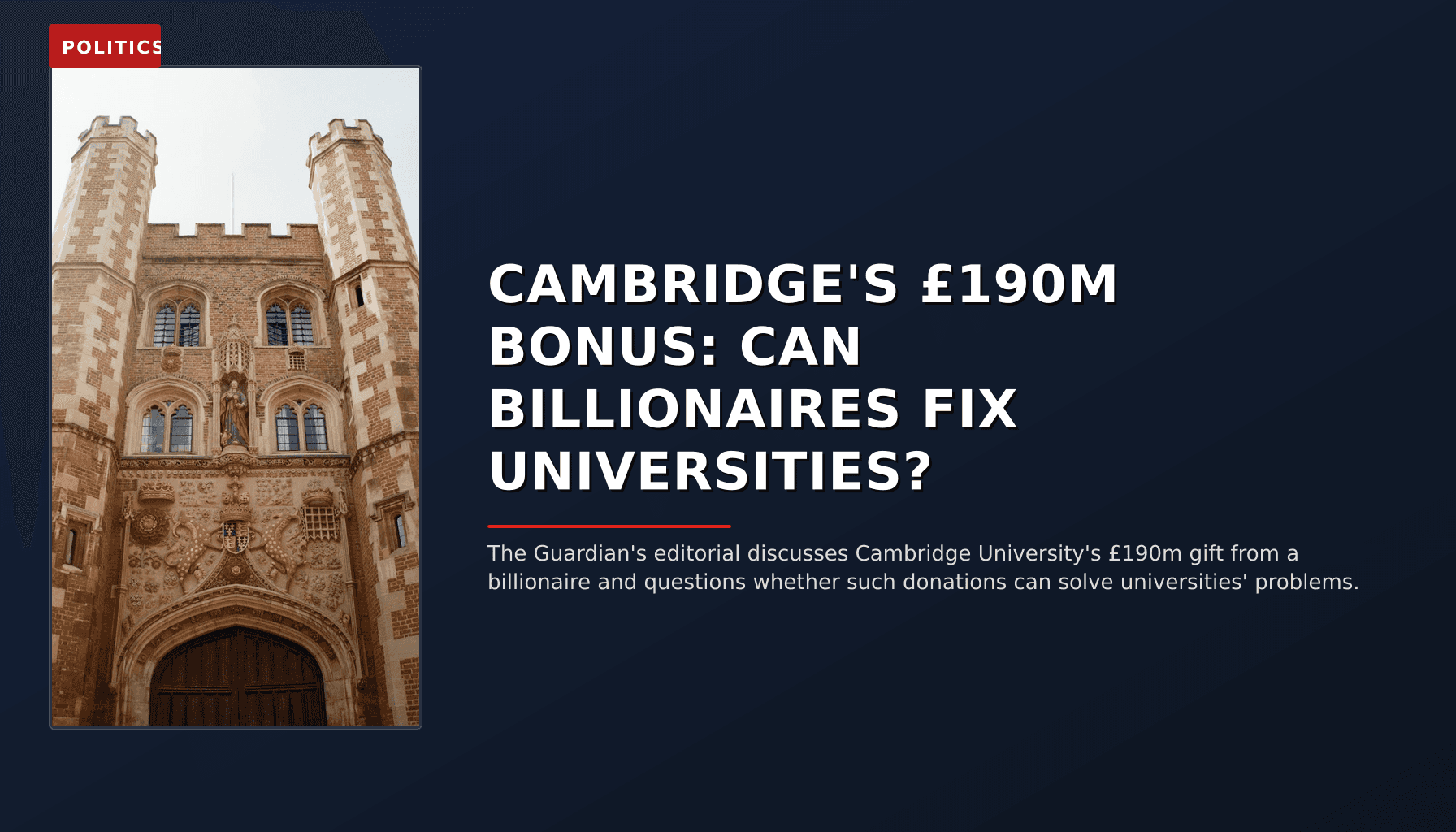
CAMBRIDGE'S £190M BONUS: CAN BILLIONAIRES FIX UNIVERSITIES?
The Guardian questions whether Cambridge's £190m gift from a billionaire addresses deeper issues in higher education. The donation raises concerns about reliance on private wealth to solve systemic academic challenges.


The Guardian questions whether Cambridge's £190m gift from a billionaire addresses deeper issues in higher education.
Cambridge University has received a substantial donation of £190 million, according to recent reports. This generous gift raises important questions about the role of billionaires in funding educational institutions and whether such donations can effectively address the core challenges faced by universities today.
The donation, as highlighted by The Guardian, comes at a time when higher education institutions are grappling with financial pressures, operational costs, and the need to maintain academic excellence. While the gift is undoubtedly significant, it prompts a broader discussion about reliance on private wealth to solve systemic issues within academia.
Critics argue that while donations from wealthy individuals can provide much-needed resources, they may not tackle the deeper structural problems faced by universities, such as funding shortages, staff recruitment challenges, and the need for sustainable long-term financial strategies. The editorial suggests that relying too heavily on such contributions might divert attention away from these critical areas.
The Guardian's editorial also points out that the influx of money from a single source could potentially skew priorities within the institution. This raises concerns about whether the interests of the donor align with the broader academic mission, and whether this could inadvertently influence decision-making processes at Cambridge.
Read more: Kemi badenach attacks PM: Scathing criticism over Iran war response
Furthermore, there is a growing debate over the ethical implications of accepting large donations from individuals who may have their own agendas. While philanthropy is often seen as a positive force, there are concerns about transparency, accountability, and the long-term impact of such largesse on academic independence.
Supporters of such donations counter that they provide essential funding that governments have failed to allocate adequately. They argue that without these contributions, many universities would struggle to maintain their programs, facilities, and research endeavors, potentially hindering progress in various fields.
However, the Guardian's analysis underscores the need for a more nuanced approach to university financing. It emphasizes the importance of diversifying revenue streams, ensuring equitable access to education, and maintaining the integrity of academic institutions free from undue influence.
Looking ahead, the editorial calls for a closer examination of how these donations are utilized and their impact on the broader educational landscape. It suggests that universities should adopt transparent policies regarding donor contributions and engage in open dialogue with stakeholders about the implications of such largesse.
Read more: Unprecedented £40bn planned for parliament refurbishment: Public scrutiny intensifies
In conclusion, while Cambridge's £190 million gift is undeniably beneficial, it serves as a reminder of the complexities inherent in relying on billionaire donations to address systemic issues in higher education. The debate over the role of philanthropy in academia is far from settled and requires careful consideration of both the benefits and potential drawbacks.

More Stories

Kemi badenach attacks PM: Scathing criticism over Iran war response
7 March 2026 at 14:153 min read
Read More
Unprecedented £40bn planned for parliament refurbishment: Public scrutiny intensifies
6 March 2026 at 22:143 min read
Read More
Conservative peer resigns over PPE deal investigation: Scrutiny intensifies
6 March 2026 at 20:363 min read
Read More
Comments (0)
No comments yet. Be the first to share your thoughts!
Leave a Comment
Your email address will not be published. Comments are moderated before appearing.