Virtual prisons: The cure for UK knife crime sentencing?
🔴 EDITOR’S NOTE (FEBRUARY 2026): We are republishing this 2025 Op-Ed as a parliamentary petition gains traction. With prison capacity at a breaking point and public patience at zero, the "Virtual Prison" is no longer a sci-fi concept—it is a logistical necessity. In the bustling streets of London,...
🔴 EDITOR’S NOTE (FEBRUARY 2026):
We are republishing this 2025 Op-Ed as a parliamentary petition gains traction. With prison capacity at a breaking point and public patience at zero, the "Virtual Prison" is no longer a sci-fi concept—it is a logistical necessity.
In the bustling streets of London, the shadow of knife crime looms large, casting a dark cloud over communities and instilling fear in the hearts of residents.
Despite concerted efforts to tackle this scourge, recent data paints a grim picture: knife crime incidents are on the rise, and the number of offenders receiving prison sentences is declining to the point where the proportion of knife offenders given immediate jail sentences has fallen to 26.2 per cent.
This is down from a peak of 42.9 per cent in 2020 and the lowest on record, according to Ministry of Justice figures for the quarter to September 2023. Behind this troubling trend lies a harsh reality - the shortage of prison facilities to accommodate the growing influx of offenders.
In the eyes of the law, repeat offenders of carrying illegal bladed articles (Knives) in public should face mandatory prison sentences under the 'two strikes and you're out' law. However, in practice, judges find themselves grappling with a dilemma: how to enforce these mandates when there simply aren't enough prison spaces available.
The result? Judicial discretion is influenced not only by legal considerations but also by pragmatic concerns regarding the capacity of the criminal justice system.
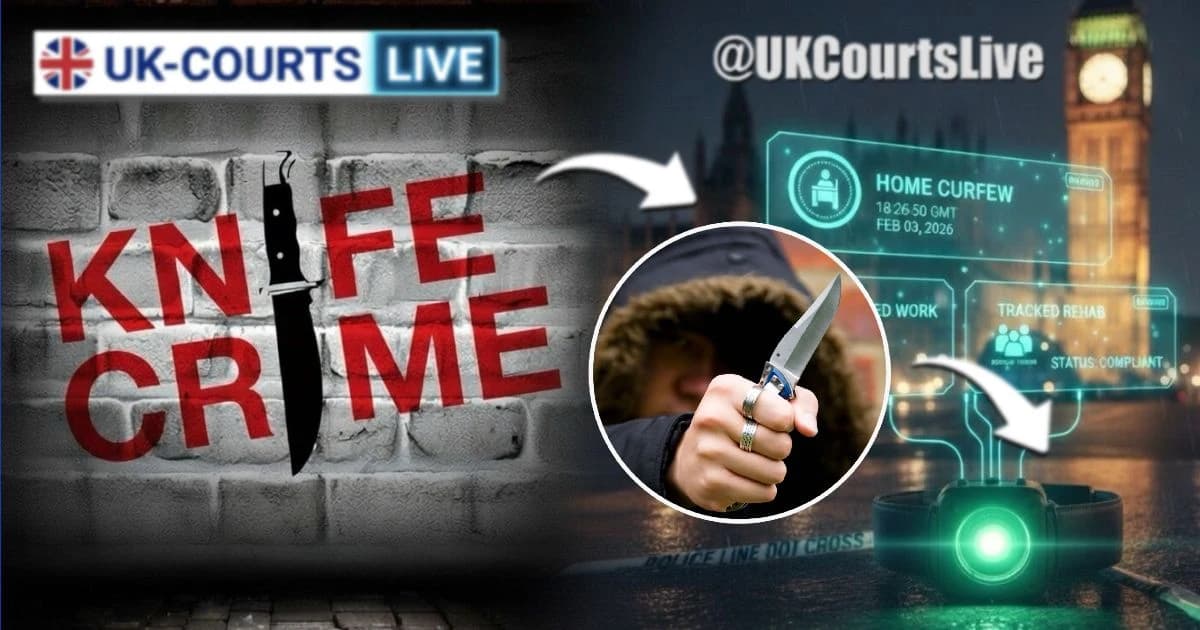
Enter virtual prison sentences via GPS ankle bracelets - an innovative alternative to traditional imprisonment that offers a glimmer of hope in the face of mounting challenges.
But What is a True Virtual Prison Sentence:
While GPS ankle bracelets are already a fixture of the British justice system, their current application is largely limited to enforcing overnight curfews or restricting offenders from specific exclusion zones.
A true Virtual Prison Sentence, however, represents a fundamental shift in philosophy. Instead of merely managing an offender’s free time, it effectively transforms their residence into a functional cell.
Under this model, the standard logic of a curfew is reversed. The offender is required to remain within their home for the vast majority of the day, mirroring the confinement of a physical wing.
Liberty is restricted to a strictly monitored "exercise hour" where the prisoner may walk or run within a designated local perimeter before being mandated to return.
Practical necessities, such as food shopping, are handled with equal rigour. If an offender lives alone and lacks a support network to assist them, they may be granted a precise window—perhaps ninety minutes twice a week—to travel directly to and from a pre-approved local shop.
For those living with partners or parents, even this concession is removed, as the household is expected to facilitate the prisoner’s basic needs. By leveraging real-time tracking to enforce these rigid parameters, the system ensures that the "virtual" element refers only to the walls, not the severity of the punishment.
By utilising this existing technology to monitor offenders' movements and enforce restrictions, virtual prison sentences present a cost-effective and logistically feasible solution to the overcrowding crisis plaguing our prisons.
However, despite the potential benefits of virtual prison sentences, their adoption remains conspicuously absent from public discourse.
Why? The answer lies in the complex intersection of politics, practicality, and ethics. The political sensitivity surrounding the implementation of virtual prison sentences, particularly in diverse urban communities like London, raises concerns about fairness, equity, and representation.
Moreover, the practical challenges of navigating legal frameworks, addressing privacy concerns, and ensuring equitable implementation further complicate the conversation. But perhaps the most pressing question is this: why are we allowing a shortage of prison facilities to dictate our approach to justice?
The stark reality is that failing to address this issue not only compromises the effectiveness of our justice system but also perpetuates the cycle of violence and victimization plaguing our communities.
If we are serious about reducing knife crime and fostering safer streets for all Londoners, we cannot afford to turn a blind eye to innovative solutions like virtual prison sentences.
The path forward requires bold and decisive action. It demands increased awareness and dialogue surrounding alternative sentencing options, collaborative efforts between policymakers, criminal justice authorities, and communities, and a steadfast commitment to addressing the root causes of knife crime.
Only by confronting the challenges head-on and embracing innovative solutions can we hope to chart a course towards a safer and more just future for London., normal, In conclusion, the knife crime conundrum is a stark reminder of the urgent need for innovative solutions in our criminal justice system.
As the specter of knife crime continues to haunt our streets, the time to act is now. Let us seize this moment to reimagine justice, to build a future where all Londoners can live free from the fear of violence and the scourge of knife crime.