
Violent disorder and protests: Why crossing the line means prison
With fewer violent disorder cases now set to reach a jury due to new judicial reforms and increased incentives for early guilty pleas, understanding where the legal line lies at a heated protest is more important than ever. Discover the exact legal threshold where lawful protest becomes violent...

With fewer violent disorder cases now set to reach a jury due to new judicial reforms and increased incentives for early guilty pleas, understanding where the legal line lies at a heated protest is more important than ever. Discover the exact legal threshold where lawful protest becomes violent disorder — and why hundreds have faced prison for crossing it under UK public order law.
With proposed restrictions on jury trials, expanded incentives for early guilty pleas, and new judicial reforms set to bring most violent disorder cases within magistrates’ sentencing powers, this is the right moment to republish our legal explainer in an enhanced form. The aim remains the same: to provide a precise, reliable account of what violent disorder is — and why the law functions exactly as it does.
Violent Disorder: The Clear Legal Boundary Between Legitimate Political Protest and Criminal Threats
After the 2024 riots, online commentary became saturated with misplaced claims that hundreds of people were being prosecuted for “doing nothing” or for “just protesting.” These narratives spread quickly, but they rest on a basic misunderstanding of the offence. The law surrounding violent disorder is not obscure, not new, and not open to creative interpretation. It is clear. And it has been consistent for decades.
Under Section 2 of the Public Order Act 1986, violent disorder occurs when three or more people:
1. use or threaten unlawful violence, and
2. their conduct together would cause a person of reasonable firmness to fear for their safety.
There is no requirement for anyone to throw a punch, brandish a weapon, or inflict injury. Threats can be conveyed through actions alone. Smashing windows, kicking doors, forcing entry into residential areas, arming oneself with makeshift weapons, or hurling objects—all of these are treated in law as threats of violence when carried out by a group.
This is not an eccentric modern interpretation. Earlier common-law offences such as Unlawful Assembly and Rout made clear that a group’s collective behaviour could intimidate and endanger the public even if no single blow was struck. Section 2 simply reflects that long-standing principle in statute.
Violent disorder is about group threat, not individual combat.
Another recurring misconception is the belief that a person can remain within a disorderly crowd and avoid liability so long as they personally did not intend harm. Legally, this is wrong. When a crowd begins to threaten unlawful violence, the expectation is that reasonable people withdraw. Those who remain become part of the group dynamic. The law recognises that a mob’s power lies in its numbers. Presence sustains momentum; momentum sustains threat.
For that reason, defences such as “I didn’t attack anyone,” “I only shouted,” or “I wanted to protest peacefully” do not negate liability if the individual chose to stay and actively participate in the group once violence or threats began. The dividing line is not about politics, personal motive, or the content of one’s views. It is simply about whether a person continued to lend their presence and conduct to a threatening group.
The disorder outside the Potters International Hotel in Aldershot illustrates this legal threshold with complete clarity.
Across the wider movement, dozens of protests outside asylum accommodation passed without serious incident. People attended, expressed their views—sometimes loudly—and went home. No one at these peaceful events, before or after Aldershot, was arrested for disagreeing with government policy. Political opinion was never the issue.
The problem arose only at the single protest where a large breakaway group escalated into serious disorder. Individuals climbed onto roofs. Some forced entry into areas where asylum seekers were residing. Others struck windows and doors, shouted abuse at families inside, and hurled bicycles at the building. The threat was not theoretical: people were inside the hotel during the incident, including men, women, and children. The law is unequivocal that such conduct constitutes a threat of violence.
This context is essential because many online claims ignore it entirely. The most circulated example was the case of Jamie Lee Turvey, presented on social media as a harmless protester jailed for leaning on a wall and opening a gate. Those depictions omitted key facts established at trial. Turvey opened access points during the disorder, removed bricks from a wall, dropped them in front of officers, and warned police that things would “kick off” if arrests were made. He was described by prosecutors as one of the individuals contributing to the group’s aggressive forward movement.
These are not trivial acts. In the context of a threatening crowd, they are integral to the group dynamic. A jury, having heard all the evidence, convicted him.
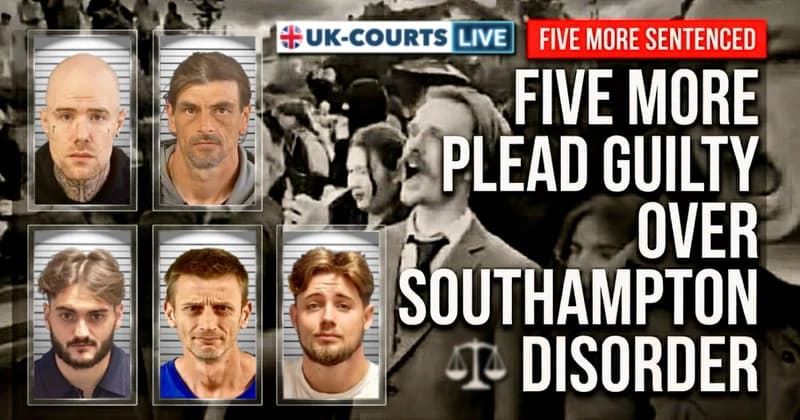
Following Aldershot, eight individuals were sentenced. Seven adults pleaded guilty at various stages; one 13-year-old girl was dealt with separately due to age. Despite discounts for guilty pleas, almost all of the adults received sentences exceeding two years’ immediate imprisonment.
This is a crucial point. Even with early pleas—normally one of the strongest mitigations in the sentencing process—the seriousness of their actions meant substantial custodial terms were inevitable. Violent disorder has long carried such weight. Current guidelines anticipate custodial sentences for anyone who willingly involves themselves in group threats or violence, especially where there are vulnerable victims or serious disruption.
This is not a new approach, nor is it a politically driven crackdown. It is exactly how the courts have always treated the offence.
Protest is lawful. Violence and threats are not.
The boundary between protest and violent disorder is not remotely ambiguous. People are free to protest loudly, passionately, and regularly. They may hold banners, chant, march, and criticise the government as forcefully as they please. None of that amounts to violent disorder.
But when a group begins to force entry into buildings, damage property while residents are inside, surround homes or hotels in a menacing manner, bang on doors and windows, or throw objects capable of causing harm, the law recognises that as threatening violence. These acts are inherently intimidating. They create fear. They endanger people. And when done by three or more individuals acting together, they meet the statutory definition.
The test is always the same: Would a person of reasonable firmness fear for their safety?
If the answer is yes, the offence is complete.
Public order offences protect the freedom of the public to go about their lives without facing intimidation by groups acting in a threatening manner. Without them, families could be surrounded by hostile crowds with no recourse until someone was physically assaulted.
The right to protest sits alongside the right of others to live free from fear. Violent disorder is the legal mechanism that draws that line. It does not criminalise viewpoints. It criminalises threatening group behaviour.
In reassessing this offence now, with new sentencing and procedural changes on the horizon, it is more important than ever that public discussion reflects the law as it actually is—not as some online commentators would prefer it to be. Clear facts, consistently applied, leave no room for misunderstanding.