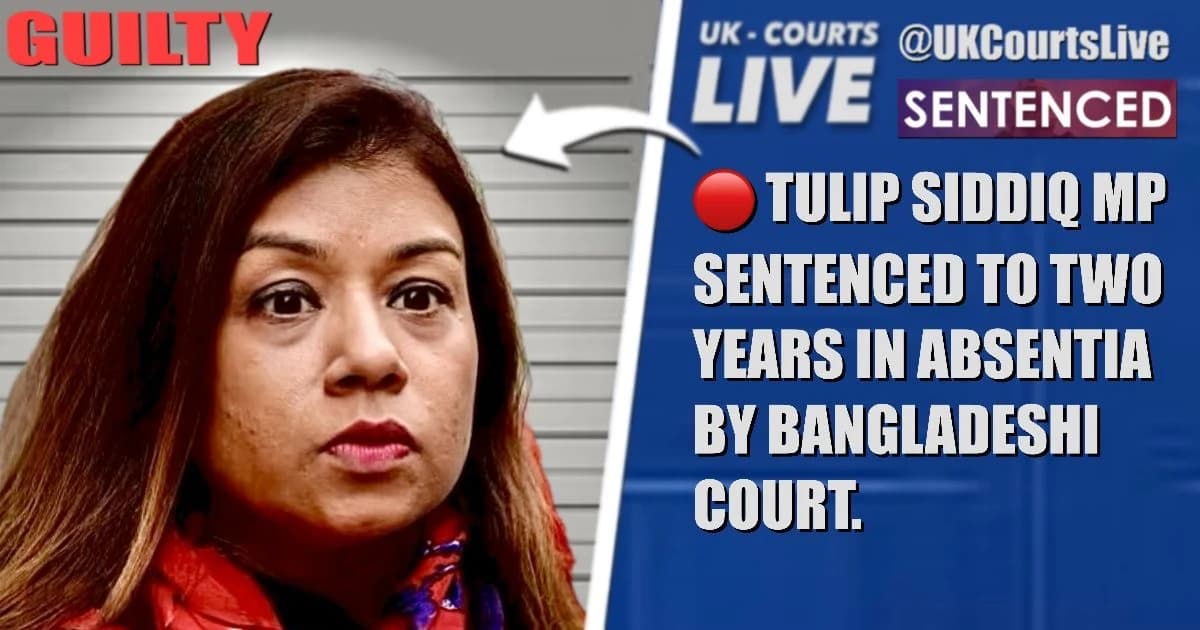
Tulip Siddiq sentenced in Bangladesh after trial in absentia
Labour MP Tulip Siddiq has been sentenced to two years in prison in Bangladesh after being convicted in her absence over allegations she used political influence to help her relatives secure land – a verdict she has condemned as a “kangaroo court” and “flawed from beginning to end.” Tulip Siddiq...

Labour MP Tulip Siddiq has been sentenced to two years in prison in Bangladesh after being convicted in her absence over allegations she used political influence to help her relatives secure land – a verdict she has condemned as a “kangaroo court” and “flawed from beginning to end.”
Tulip Siddiq handed jail sentence in Bangladesh after trial held in her absence
British Labour MP Tulip Siddiq has been handed a two-year prison sentence in Bangladesh after being convicted in her absence over allegations she helped secure a plot of land for family members. The mother-of-two, who resigned as a minister in January over scrutiny of her ties to her aunt and former Bangladesh Prime Minister Sheikh Hasina, denounced the proceedings as a “kangaroo court” and a “Kafkaesque nightmare”.
Siddiq was sentenced alongside 16 others over claims the land – in the outskirts of Dhaka – was unlawfully allocated through political influence. The court also imposed a fine of 100,000 Bangladeshi taka (£620). Failure to pay could add six months to her sentence. Siddiq remains in London and is not expected to serve time, with the UK having no extradition treaty with Bangladesh.
She was tried in absentia. Siddiq said she has never been served documents, charges or even notified about the proceedings. “There’s been absolutely no summons, no charge sheet. I have had no contact whatsoever from the Bangladeshi authorities,” she said. “The only reason I know I’ve been convicted is because I read it in the newspapers.”
Court documents alleged Siddiq used “special power” over her aunt to secure the land for family members. She strongly rejects all accusations and says she has instructed lawyers in both countries. Her party voiced serious concerns over due process. A Labour spokesperson said: “Tulip Siddiq has not had access to a fair legal process in this case and has never been informed of the details of the charges against her.”
Powerful political forces are also shaping the case. Hasina – who fled Bangladesh after her government was toppled during mass protests in 2024 – was sentenced in related cases to prison and, separately, to death over a violent crackdown on demonstrators. Her Awami League party labelled the latest verdicts “politically driven” and said the process would not pass “any reasonable test of judicial fairness”
Bangladesh’s interim government has launched a series of sweeping corruption prosecutions against Hasina, family members and former associates. Siddiq faces other outstanding investigations, though she maintains she has done nothing wrong and says the charges are “false and vexatious”.
For now, Siddiq retains the Labour whip and remains a sitting MP. She says she will continue to challenge the case and insists she has been denied any proper opportunity to respond.
Access to the Law: What does a foreign criminal conviction mean for a serving British MP?
The case raises an obvious question: what happens when a sitting UK MP is convicted and sentenced by a foreign court? The short answer is that there is no automatic legal consequence in the UK, and Siddiq remains a Member of Parliament with the Labour whip intact.
Despite receiving a two-year sentence in Dhaka, there is no legal obligation on the Labour Party, Parliament, or the UK government to act because the conviction was delivered overseas. Under the Representation of the People Act 1981, MPs are only disqualified if they are convicted and sentenced by a UK court to more than 12 months in custody. Foreign judgments do not trigger that rule, even when an MP holds dual nationality.
There is also no extradition process underway. The UK and Bangladesh do not have a bilateral extradition treaty, and Bangladesh is treated under UK law as a “Category 2” country. Any extradition request would have to clear multiple hurdles, including dual-criminality tests and human rights safeguards, and would be scrutinised by the Home Secretary and UK courts before any arrest could be considered. No request has been filed at this stage, and Siddiq remains in London.
Labour is also not compelled to take disciplinary action because party rules do not require suspensions or expulsions on the basis of foreign convictions. A party spokesperson has already said Siddiq did not receive a fair legal process and had never been notified of the specific charges against her. She therefore keeps the whip and continues as the elected MP for Hampstead and Highgate.
Any change to her status—such as a recall petition, a by-election or removal from office—would only happen if either the House of Commons Standards regime intervenes or Siddiq resigns voluntarily. Neither route has begun. Parliament cannot remove an MP for a foreign conviction alone.
The position is legally straightforward but politically unusual. Siddiq has been convicted overseas, denies wrongdoing, has called the process flawed, and continues to face further charges in Dhaka. But in practical UK terms nothing changes: she does not lose her seat, she does not face arrest, and she has no legal duty to return to Bangladesh to serve the sentence.
It means the consequences of the verdict fall almost entirely outside Britain’s legal system – and remain a political, diplomatic and reputational matter rather than a constitutional one.