Britain Doesn’t Need Another Asylum White Paper. It Needs a Backbone.
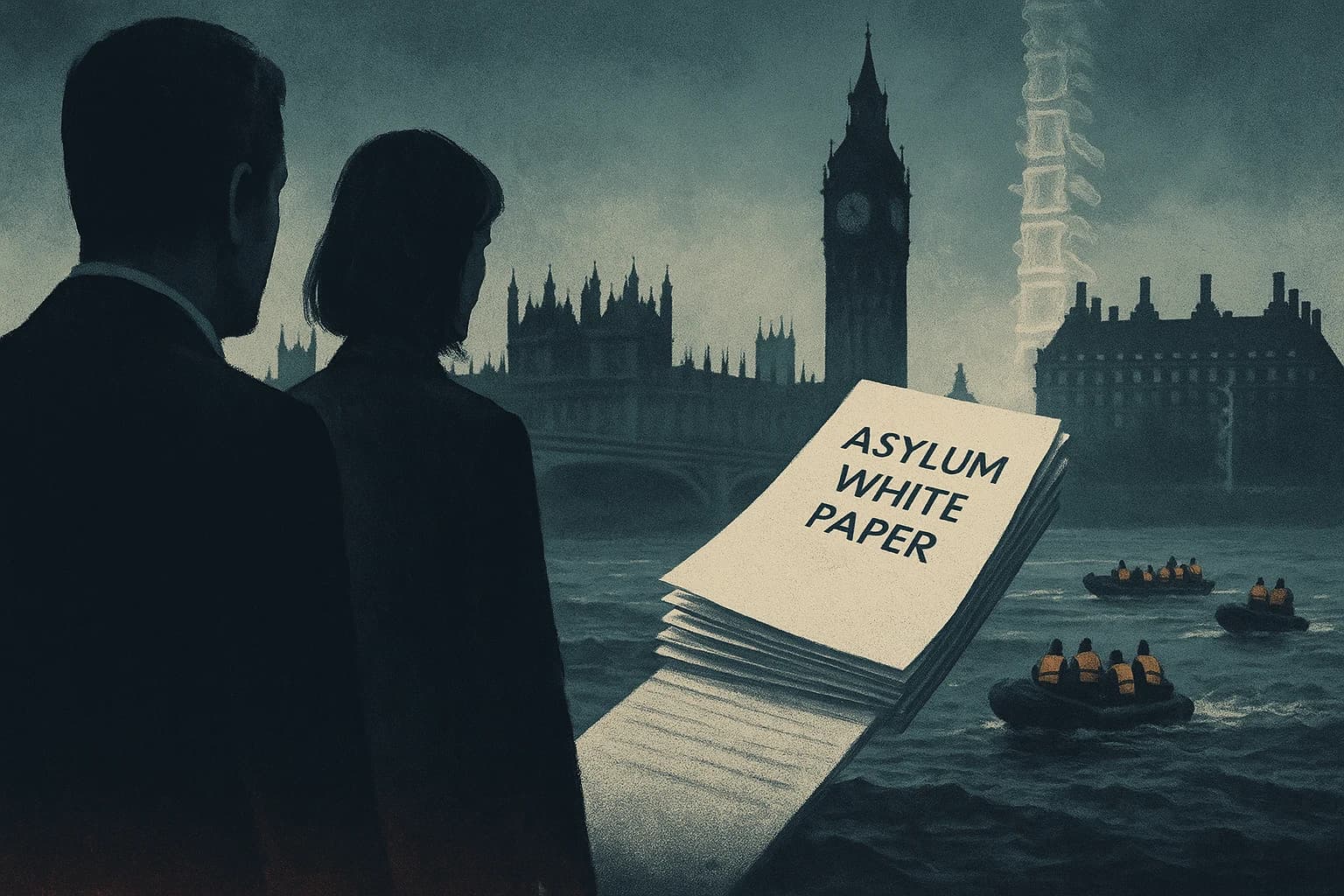
The Government has produced, with great fanfare, what it calls the “most sweeping asylum reforms in modern times”. At 90 pages, it certainly sweeps. It sweeps numbers into footnotes, failures into euphemisms, and responsibility into “consultations” and “international...

The Government has produced, with great fanfare, what it calls the “most sweeping asylum reforms in modern times”. At 90 pages, it certainly sweeps. It sweeps numbers into footnotes, failures into euphemisms, and responsibility into “consultations” and “international partners”. https://www.gov.uk/government/publications/asylum-and-returns-policy-statement/restoring-order-and-control-a-statement-on-the-governments-asylum-and-returns-policy
What it does not do is the one thing the British public have been patiently, then impatiently, asking for: to stop illegal arrivals and to remove those who have no right to remain.
Read past the solemn forewords from the Prime Minister and the Home Secretary and you find something quite extraordinary: a document that is, in truth, a long and rather abject confession. It admits our asylum system has become a magnet. It admits people “asylum shop” across the continent and choose Britain because we are more generous, slower to act and reluctant to remove. It admits that hotels have been used on an industrial scale, that enforcement has been timid, that appeals drag on for years.
And then – having pleaded guilty on every count – it proposes that the answer is… more of the same, only with extra bureaucracy and a new logo.
The Long Apology of a Political Class That Lost Control.
Look at the Government’s own figures. Since 2021, over 400,000 people have claimed asylum in the UK. At the same time, the EU has seen claims fall while ours rise. One doesn’t need a PhD in public policy to understand what this means: people smugglers and economic migrants can see which country has “soft touch” written in 20-point type across its statute book.
The paper explicitly acknowledges that Britain has become “the destination of choice” because our offer is comparatively generous and our removals comparatively feeble. This is not Nigel Farage speaking, nor a Reform Party leaflet. This is Sir Keir Starmer’s own Government.
Yet when you examine the proposed “solution”, the central problem is left fundamentally untouched. The key pull factor has always been simple: once you are in the UK, the odds of ever being removed are slim. That is the winning line in every smuggler’s sales pitch.
What does the Government do about this? It does not commit to removing more people than arrive. It does not set a clear numerical target the public can actually see. Instead, we get new committees, a shiny new appeals body, and paragraphs of legalese about how Article 8 will be “rebalanced” and Article 3 “reinterpreted with partners”.
It is the political equivalent of an overlong school report: earnest, verbose, terrified of the plain word “no”.
“Tough” Reforms That Will Melt on Contact With Reality
On the surface, some proposals sound stern. Refugee status will be “temporary”. Settlement will, in theory, only be possible after twenty years, not five. Asylum support will move from a duty to a discretionary power. Hotels are to be phased out, digital ID rolled in, and families of failed claimants finally considered for removal.
For a public already exhausted by years of drift, this may sound like a turning point.
But one must ask a simple question: what in the recent behaviour of the British state leads anyone to believe these measures will be applied with the necessary firmness?
For decades, we have watched Governments of both red and blue stripes promise tough reforms and then retreat under pressure from lawyers, NGOs, quangos and sympathetic headlines. They talk like Denmark and act like Brussels. Why should we imagine that a system which has singularly failed to enforce five-year limits will suddenly become ruthless at twenty?
In practice, “temporary” status will simply mean more casework, more appeals, more scope for late claims and new grounds. It will create a class of people in long-term limbo – neither fully integrated nor removable – all at the taxpayer’s expense. It is administrative purgatory dressed up as prudence.
Even the much-vaunted clampdown on support is hedged with caveats. We are promised that support may be withdrawn where people are uncooperative, or working illegally, or “non-compliant”. We have heard such language before. It invariably ends with lawyers explaining that virtually any enforcement action would breach some derived right that did not exist when most voters were born.
Digital ID: Brussels By the Back Door
The introduction of mandatory digital ID for right-to-work checks deserves particular scrutiny. The Government insists this is aimed at illegal working, and no doubt some ministers believe it. But Britons have not forgotten the last time Westminster tried to impose ID cards – and the principled opposition that defeated them.
To roll out a de facto ID regime under the guise of immigration control is to treat the British people as suspects in their own land. It is striking that a Government incapable of tracking people in hotels now claims it will efficiently administer a national digital identity system without error, abuse or mission creep.
We voted to take back control, not to import the bureaucratic reflexes of the European Union by stealth.
Sovereignty Once Removed
Perhaps the most telling passages in the entire statement are those dealing with the European Convention on Human Rights and the wider “thicket” of international law.
The Government recognises, correctly, that expansive interpretations of Articles 3 and 8 have significantly curtailed our ability to deport foreign criminals and failed asylum seekers. It complains that public confidence is being undermined, that the balance between individual rights and the public interest has been lost.
And what is its answer? To “work with partners”, to “seek reform”, to “clarify” guidance.
In other words, it accepts from the outset that ultimate authority does not lie with the elected House of Commons, but with courts and conventions over which the British voter has no direct say.
A genuinely reforming Government would do something else entirely. It would legislate, in clear and unapologetic terms, that in matters of border control Parliament is supreme and that, where there is conflict between domestic statute and supranational interpretation, the former prevails. If necessary, it would be prepared to leave arrangements that deny us that right.
This paper will not even say the words. It wishes to sound robust while remaining safely inside the warm bath of international approval. Entry, you claim asylum there. The UK is not a prize to be “shopped” for across the continent.
Compassion Requires Control
The most pernicious lie in this debate is that toughness and decency are opposites. They are not. They are inseparable.
A system that allows tens of thousands of people, many of them young men, to pay criminal gangs and cross a dangerous sea is not compassionate. A system that strands genuine refugees in years of uncertainty while lawyers spin out hopeless cases is not compassionate. A system that tells the British public one thing at election time and does another in office is not compassionate.
True compassion is ordered, lawful and finite. It means helping those most in need through controlled, safe routes – not rewarding those who jump the queue. It means protecting taxpayers, public services and social cohesion so that generosity remains politically and morally sustainable.
The Government’s asylum white paper pays lip service to these truths, but shrinks from the logical conclusion: that Britain must once again decide who comes here, on what terms, and in what numbers – and that no external body, however august, should be able to veto that decision.
Until we recover that simple constitutional self-respect, we will continue to produce ever-longer documents apologising for problems we refuse to solve.
What the British people are asking for is not a fresh forest of paperwork. They are asking for their country back. It is time someone in Westminster had the courage to say so – and to act on it.