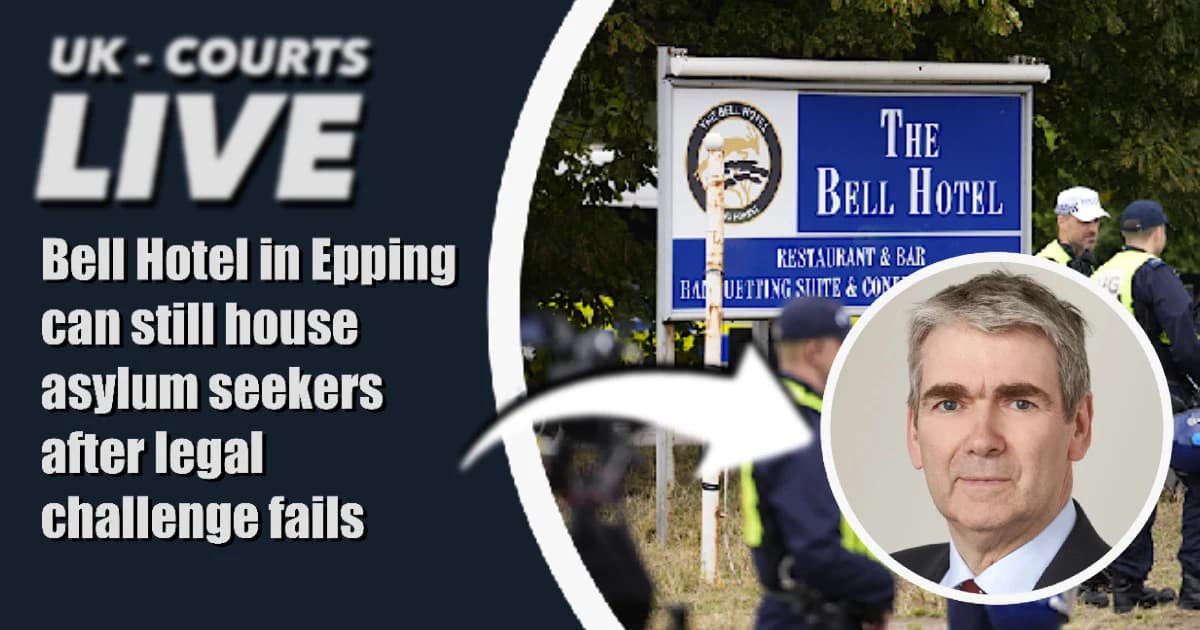
Bell Hotel in Epping can still house asylum seekers after legal challenge fails
Asylum seekers will continue to be housed at the Bell Hotel in Epping after a High Court judge dismissed a local council’s bid for an injunction on planning grounds. Mr Justice Mould ruled that Epping Forest District Council (EFDC) had failed to demonstrate a breach of planning control serious...
Asylum seekers will continue to be housed at the Bell Hotel in Epping after a High Court judge dismissed a local council’s bid for an injunction on planning grounds.
Mr Justice Mould ruled that Epping Forest District Council (EFDC) had failed to demonstrate a breach of planning control serious enough to warrant the drastic remedy of an injunction against the hotel’s owner, Somani Hotels.
The Home Office, intervening in the case, branded the council’s application “misconceived” and successfully argued that the statutory duty to provide contingency accommodation for asylum seekers outweighed any localised planning concerns.
Delivering judgment, the judge declared: “I have not been persuaded that an injunction is a commensurate response to that postulated breach of planning control.”
He emphasised a “continuing need” for hotels to serve as emergency housing, describing this obligation as a “significant counterbalancing factor” in the planning balance.
EFDC had contended that converting the hotel to accommodate asylum seekers amounted to a material change of use, triggering increasingly frequent protests and community tensions.
Yet the court found no evidence to support claims of heightened criminality or anti-social behaviour among the residents.
Mr Justice Mould demanded an “evidence-based” and “statistically sound analysis” to substantiate any such propensity, noting: “There is no such evidence before the court.”
He rejected anecdotal assertions, stating: “The fact that persons accommodated in asylum accommodation… from time to time commit criminal offences or behave antisocially provides no reliable basis for asserting any particular propensity of asylum seekers to engage in criminal or anti-social behaviour.
“Persons who are members of the settled population also commit crimes and behave antisocially from time to time.”
The ruling comes against the backdrop of a high-profile incident involving Hadush Gerberslasie Kebatu, an Ethiopian national housed at the Bell Hotel shortly after arriving in the United Kingdom.
Kebatu was sentenced to 12 months’ imprisonment in September for sexually assaulting a girl in Epping, only to be mistakenly released, re-arrested, and ultimately deported with a £500 payment.
Protests outside the hotel erupted on 11 July 2025, prompting EFDC to seek urgent relief.
The judge acknowledged the council’s “reasonable” desire for a swift resolution to public order disruptions but ruled that an injunction was not the appropriate mechanism.
“Public opposition to the development of land, even if that opposition manifests itself in street protests, is not in itself evidence of planning or environmental harm generated by the development to which there is such strong objection,” he said.
Politically, the decision has ignited fierce criticism.
Shadow home secretary Chris Philp described it as “a dark day for local democracy and a slap in the face to the people of Epping.”
He accused the Labour government of prioritising “the rights of illegal immigrants above the rights of British citizens” and highlighted the Home Office’s robust defence of the hotel’s continued use, even after Kebatu’s conviction.
A Labour source retorted that Mr Philp had “some brass neck,” pointing out that the Conservatives had vastly expanded hotel usage during their tenure.
The source added: “If he wants to understand why there are so many asylum seekers in hotels, he should cast his mind back to his time in the Home Office. He was the one opening all these hotels.”
A Home Office spokesperson vowed to close every migrant hotel, stating: “This government will close every asylum hotel. Work is well underway to move asylum seekers into more suitable accommodation such as military bases, to ease pressure on communities across the country.
“We are working to do so as swiftly as possible as part of an orderly, planned and sustained programme. This judgment allows us to do that.”
The Bell Hotel first accommodated asylum seekers from May 2020 until March 2021, reopened briefly as a commercial hotel in August 2022 for three months, then reverted to Home Office use amid reduced tourist demand, according to the owner’s legal team.
Earlier this year, EFDC secured a temporary injunction barring further placements after 12 September, but the Court of Appeal overturned that order, deeming it “seriously flawed in principle.”
With the latest High Court dismissal, the hotel—currently housing up to 138 asylum seekers—remains operational under the Home Office contract, free from immediate planning enforcement.