
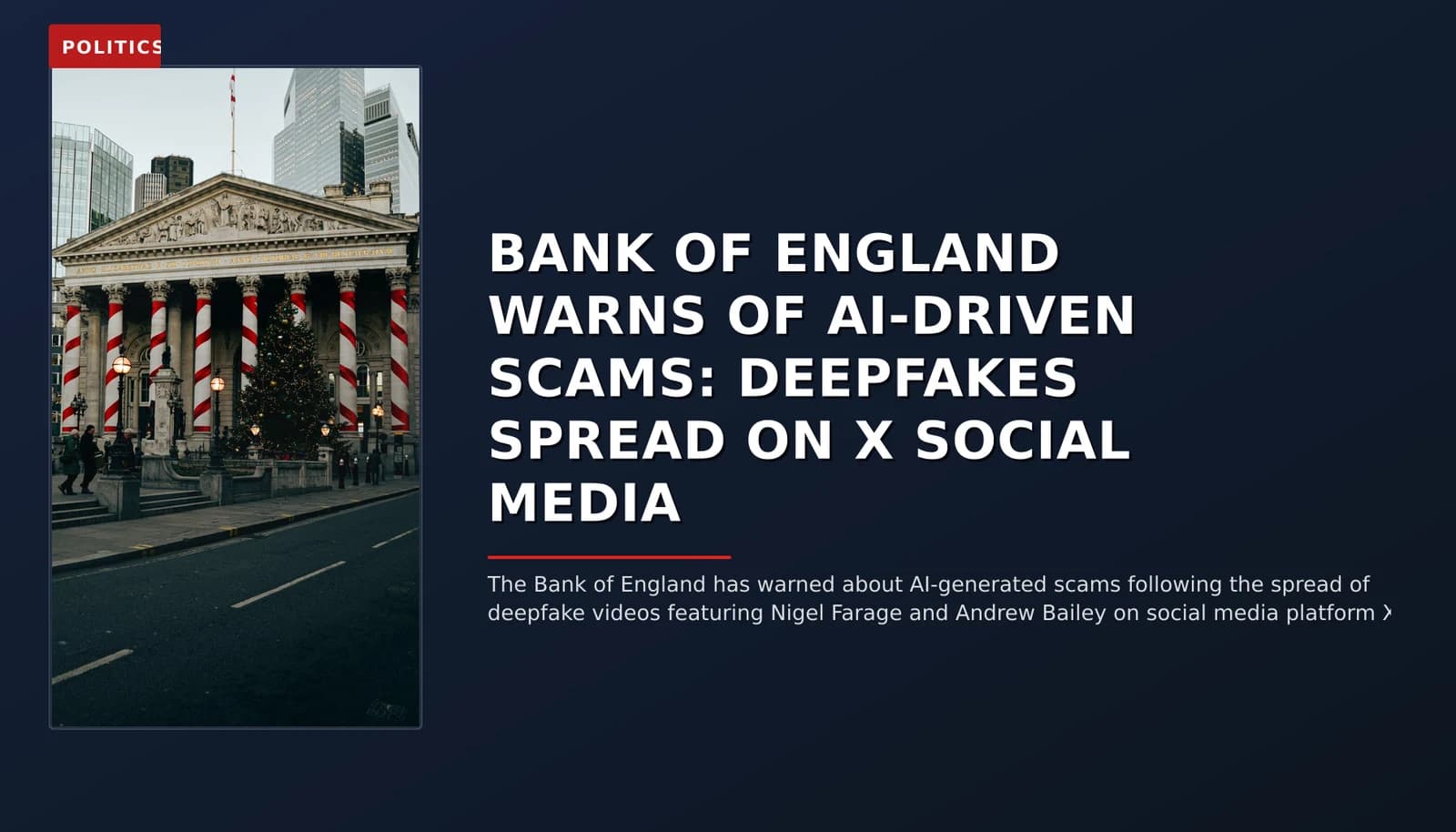
Bank Of England Warns Of Ai-Driven Scams: Deepfakes Spread On X Social Media
The Bank of England has warned about AI-generated scams following the spread of deepfake videos on X social media, urging public vigilance and reporting suspicious content.

The Bank of England has issued a warning following the emergence of deepfake videos on X social media, urging public vigilance against AI-generated fraud.
In a concerning development, the Bank of England has raised alarms about AI-driven scams, particularly after deepfake videos featuring prominent figures were shared widely on social media platform X. These videos purportedly depict Nigel Farage confronting Andrew Bailey, the BoE governor, with one clip showing Farage brandishing a weapon. The emergence of such content underscores growing concerns over the misuse of advanced technology for fraudulent purposes.
The Bank's caution comes in response to the rapid spread of these deepfakes, which have sparked both public alarm and regulatory scrutiny. Deepfake technology, known for its ability to create highly realistic synthetic media, has increasingly become a tool for deception and fraud. This incident highlights how quickly such technologies can be weaponized to mislead and manipulate individuals.
Andrew Bailey, the Governor of the Bank of England, has urged members of the public to remain vigilant and report any suspicious content they encounter. He emphasized that these AI-generated scams are part of a broader trend of fake adverts impersonating financial institutions, leading to potential financial harm for unsuspecting victims. The BoE's warning serves as a call to action for both individuals and social media platforms to take proactive measures against such threats.
Nigel Farage, a former politician and prominent figure in UK politics, has denied any involvement in the violent acts depicted in the deepfake videos. In a statement, he described the content as 'bizarre' and reiterated that he had no role in their creation or dissemination. Such disclaimers are crucial to protect individuals from being wrongfully associated with harmful or illegal activities.
Read more: New Eu Border System Delays: Disruption Persists For Years
The Bank of England has also taken steps to address the issue by engaging with Reform UK and social media platforms. These discussions aim to find ways to mitigate the spread of deepfake content and enhance measures to combat AI-driven fraud. The BoE's involvement highlights the importance of collaboration between regulatory bodies, tech companies, and law enforcement in tackling this emerging threat.
This incident is not isolated; it reflects a broader trend where artificial intelligence is being exploited for fraudulent purposes. As highlighted by UK personal finance expert Martin Lewis, the landscape of online scams has become akin to the 'wild west,' with criminals continuously finding new ways to exploit technological advancements. This Wild West analogy underscores both the unpredictability and the scale of the threat posed by AI-driven fraud.
In response to these challenges, the UK government is pushing forward with its Online Safety Act, which aims to establish a safer digital environment. However, the act's implementation has been delayed, with sources indicating it will not come into effect until next year. This delay leaves a critical window during which existing regulations must suffice in addressing the evolving threat of deepfake content.
X, the social media platform owned by Elon Musk, has faced criticism over its handling of such issues. The company prohibits the use of its platforms for impersonation with intent to deceive, but enforcement remains a challenge. Ofcom is currently investigating X over similar controversies involving its Grok tool, which further questions the platform's ability to manage deepfake content effectively.
Read more: Defence Investment Plans Spark Cabinet Strife: Tensions Rise Amid Disagreements
The Bank of England's warning serves as a stark reminder of the risks associated with AI technology when misused. As these tools become more accessible and sophisticated, the potential for fraud and deception grows exponentially. Regulatory bodies must work closely with tech companies to develop robust frameworks that can keep pace with technological advancements.
Looking ahead, public awareness and education will play a critical role in countering AI-driven scams. The BoE has urged individuals to report any suspicious content they encounter, contributing to the collective effort to combat these threats. Additionally, ongoing dialogue between regulators, tech firms, and law enforcement will be essential in establishing effective measures to mitigate such risks.

More Stories

New Eu Border System Delays: Disruption Persists For Years
9 June 2026 at 14:442 min read
Read More
Defence Investment Plans Spark Cabinet Strife: Tensions Rise Amid Disagreements
9 June 2026 at 11:432 min read
Read More
Young People Need Money: A Fairer System To Fight Economic Inequality
9 June 2026 at 06:283 min read
Read MoreComments (0)
No comments yet. Be the first to share your thoughts!
Leave a Comment
Your email address will not be published. Comments are moderated before appearing.